Ribes cereum var. cereum
Wax currant
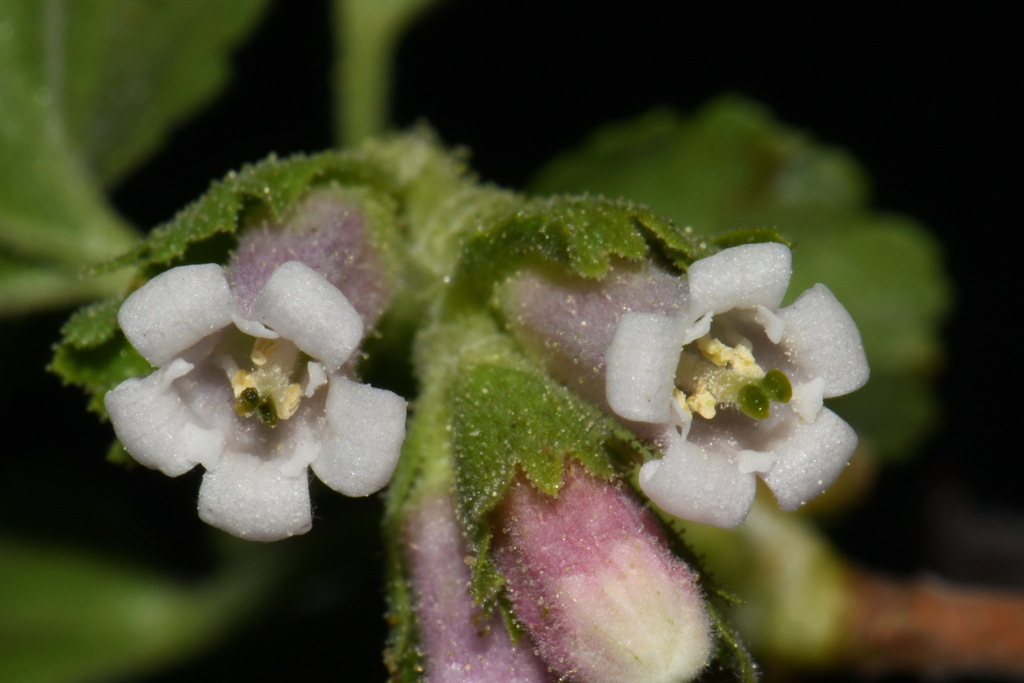
(c) Brian Finzel, some rights reserved (CC BY-SA), uploaded by Brian Finzel · licence
Family: Grossulariaceae · Type: Shrub · Native
Ribes cereum var. cereum (Wax currant) is a native California shrub in the Grossulariaceae family, recognized by spicy scent, glossy round leaves, and tubular flowers.
Wax currant is a California native shrub found in the Klamath Ranges, high Cascade Range, Sierra Nevada, Tehachapi Mountains, Transverse Ranges, San Jacinto Mountains, Great Basin, and Desert Mountains on dry montane to alpine slopes, among rocks, and forest edges at elevations of 875 to 2,365 meters. Flowering from June to July, this plant produces delicate pale flowers in small clusters with wide-tipped bracts featuring several prominent teeth. Growing with an open, spreading form reaching 0.5 to 2 meters tall, it develops a multibranched structure with slender stems. Its leaves vary from nearly smooth to densely hairy, with a variable texture that can range from glabrous to prominently glandular. The shrub forms small, edible fruits that attract local wildlife in its high-elevation mountain habitats.
Identification and appearance
Key characters: 31 sympatric species; key features are spicy scent, glossy round leaves, and tubular flowers
Habitat and range
Habitat: dry montane to alpine slopes, among rocks, forest edges
Elevation: 875-2365 m
California counties: Mono, San Bernardino, Los Angeles, Siskiyou, Tulare, Plumas, Inyo, Riverside, Kern, Madera, Nevada, Alpine, El Dorado, Amador, Mariposa, Ventura, Placer, Shasta, Lassen, Sierra, Fresno, Tuolumne, Modoc
Outside California: to British Columbia
Bloom period
Ribes cereum var. cereum blooms Jun-Jul.
How to tell it apart
vs Rubus: Ribes has palmately lobed leaves; blackberry has compound leaves with 3-7 separate leaflets.; vs Rhus: Ribes has palmately lobed simple leaves; sumac has pinnately compound leaves with separate leaflets.; vs Quercus: Ribes has toothed maple-like lobes; oak has smooth-edged rounded lobes and acorns.; vs Acer: Ribes has drooping flower clusters; maple has upright flower clusters and winged paired fruits.; vs Holodiscus: Ribes has broad palmately lobed leaves; ocean spray has pinnately arranged leaflets on compound leaves.
Frequently asked questions
Is Ribes cereum var. cereum native to California?
Yes. Ribes cereum var. cereum is native to California (recorded as native).
When does Ribes cereum var. cereum bloom?
Ribes cereum var. cereum blooms Jun-Jul.
Where in California does Ribes cereum var. cereum grow?
Ribes cereum var. cereum occurs in Mono, San Bernardino, Los Angeles, Siskiyou, Tulare, Plumas, Inyo, Riverside and other counties, at elevations of 875-2365 m.
What plant family does Ribes cereum var. cereum belong to?
Ribes cereum var. cereum is in the Grossulariaceae family, genus Ribes.
What habitat does Ribes cereum var. cereum grow in?
Ribes cereum var. cereum grows in dry montane to alpine slopes, among rocks, forest edges.
Related species
Other California species in the same genus, family, or bioregion.
Sources: Jepson eFlora · Index of California Plant Names · CalPhotos
Last updated 2026-10-07
Data from The California Species Project — 14,000+ California species with verified data from CNPS, CDFW, USFWS, Cal-IPC, and more.