Ricinus communis
Castor bean
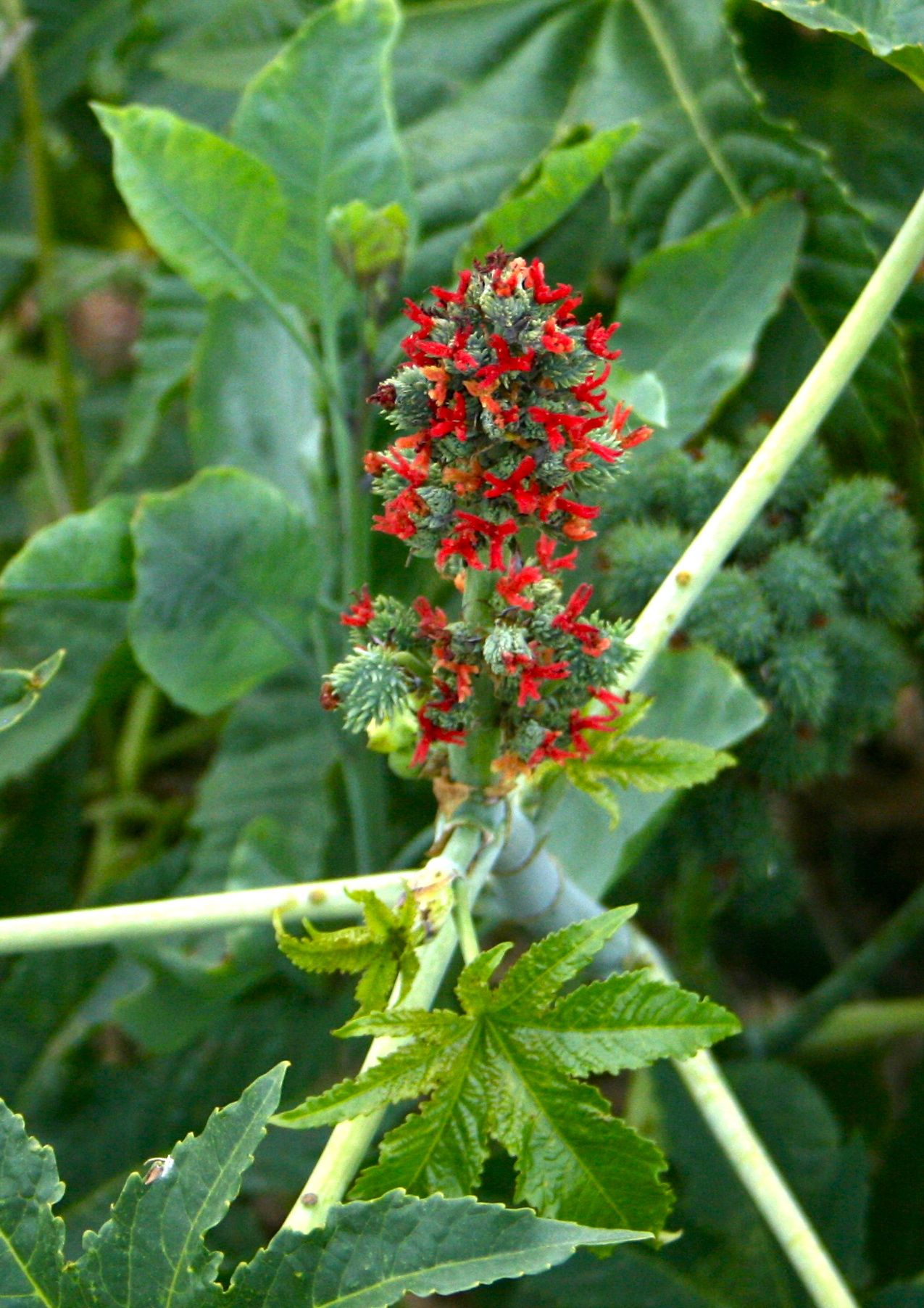
Photo by Chez Brungraber
Family: Euphorbiaceae · Type: Shrub / Tree · Not Native
Conservation status: Cal-IPC Yes
Ricinus communis (Castor bean) is a non-native California shrub / tree in the Euphorbiaceae family, recognized by Only Ricinus species worldwide and in California, naturalized from cultivation as an ornamental.
Castor bean is a naturalized shrub found in the Great Valley, Central Coast, and Southern California in disturbed areas at elevations below 300 meters. Flowering throughout the year, this plant produces distinctive male and female flowers on the same plant, with reddish plumose styles on the female flowers. Growing as a shrub occasionally reaching tree-like proportions of 1 to 3 meters tall, it develops an ascending to erect branched trunk. Its large alternate leaves are palmately lobed with 7 to 11 sharply toothed segments, measuring 1 to 5 decimeters across and attached by long glandular petioles. The fruit is a spiny capsule approximately 1.2 to 2 centimeters in diameter, containing smooth, shiny seeds with mottled coloration.
Identification and appearance
Key characters: Only Ricinus species worldwide and in California, naturalized from cultivation as an ornamental
Habitat and range
Habitat: Disturbed areas
Elevation: < 300 m
California counties: Los Angeles, Orange, Ventura, Santa Clara, San Bernardino, San Diego, Riverside, San Mateo, Santa Barbara, San Luis Obispo, Kern, Marin, Monterey, Colusa, Contra Costa, Butte, Alameda, Yolo
Outside California: eastern United States, native to Europe
Bloom period
Ricinus communis blooms All year.
Conservation status
Cal-IPC Yes
How to tell it apart
vs Acer: Ricinus has umbrella-like leaves with stem attached to center; maple leaves attach at the edge.; vs Tetrapanax: Ricinus leaves are glossy and smooth; Tetrapanax leaves are fuzzy-white underneath.; vs Kalopanax: Ricinus has smooth bark and herbaceous stems; Kalopanax has spiny woody trunk.; vs Platanus: Ricinus leaf stem attaches at blade center; sycamore leaf stem attaches at blade edge.; vs Malva: Ricinus leaves are glossy and waxy; mallow leaves are soft and dull-surfaced.
Frequently asked questions
Is Ricinus communis native to California?
No. Ricinus communis is not native to California (recorded as not native).
When does Ricinus communis bloom?
Ricinus communis blooms All year.
Where in California does Ricinus communis grow?
Ricinus communis occurs in Los Angeles, Orange, Ventura, Santa Clara, San Bernardino, San Diego, Riverside, San Mateo and other counties, at elevations of < 300 m.
What plant family does Ricinus communis belong to?
Ricinus communis is in the Euphorbiaceae family, genus Ricinus.
Is Ricinus communis invasive in California?
Ricinus communis is listed by Cal-IPC with an invasiveness rating of Yes.
Related species
Other California species in the same genus, family, or bioregion.
Sources: Jepson eFlora · Index of California Plant Names · CalPhotos
Last updated 2026-10-07
Data from The California Species Project — 14,000+ California species with verified data from CNPS, CDFW, USFWS, Cal-IPC, and more.