Rigiopappus leptocladus
Rigiopappus
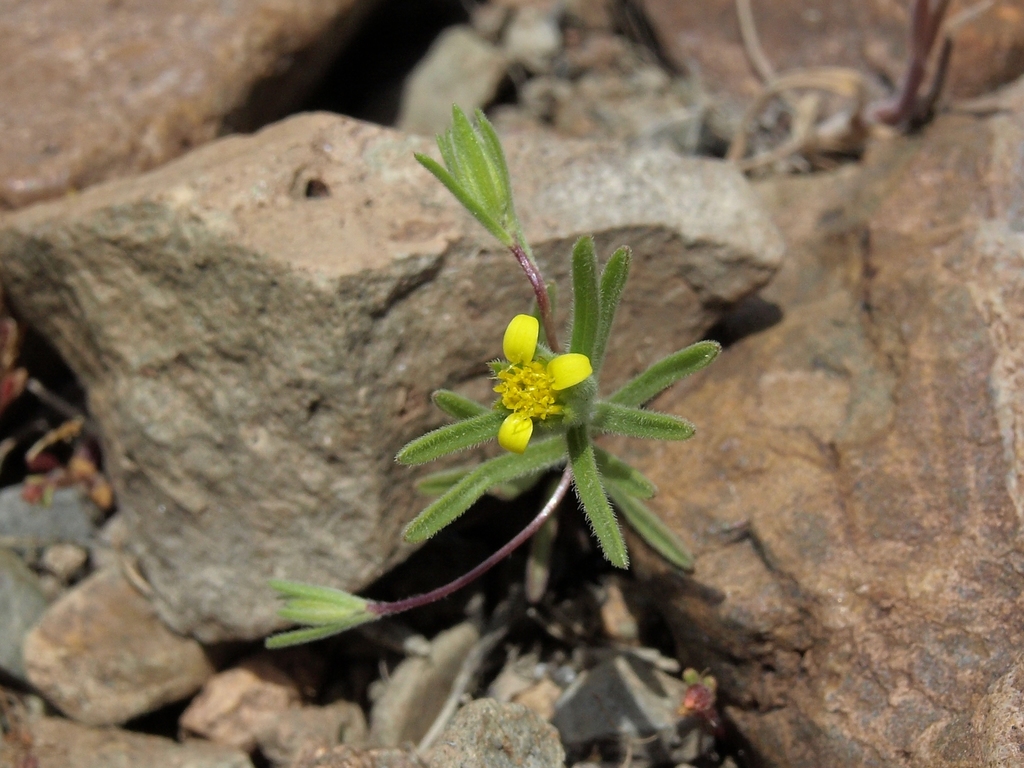
(c) Jim Morefield, some rights reserved (CC BY), uploaded by Jim Morefield · licence
Family: Asteraceae · Type: Herb · Native
Rigiopappus leptocladus (Rigiopappus) is a native California herb in the Asteraceae family, recognized by Monotypic genus endemic to western North America, representing a unique evolutionary lineage within the sunflower family.
Rigiopappus is a California native annual found in northwestern California, the Cascade Range, Sierra Nevada, Central Valley, central western California, western Transverse Ranges, southern California Ranges, and Modoc Plateau in grassy sites and openings among shrubs or trees at elevations of 100 to 2,200 meters. Flowering from April to July, this plant produces yellow flowers often tinged with red or purple, with ray flowers measuring 0.3 to 1 millimeters long and disk flowers in clusters. Growing 5 to 30 centimeters tall with generally erect stems that are minutely hairy and may have branches exceeding the main stem, it develops from a taproot. Its leaves are mostly alternate, narrowly oblanceolate to lance-linear, 9 to 30 millimeters long and 1 to 2 millimeters wide, with entire margins and sparse hair. The fruit is 4 to 5 millimeters long, cylindric to spindle-shaped, and covered in minute coarse hairs with 3 to 5 awl-shaped pappus scales.
Identification and appearance
Key characters: Monotypic genus endemic to western North America, representing a unique evolutionary lineage within the sunflower family
Habitat and range
Habitat: Grassy sites, openings among shrubs or trees
Elevation: 100-2200 m
Outside California: to Washington, Idaho, Nevada
Bloom period
Rigiopappus leptocladus blooms Apr-Jul.
How to tell it apart
vs Madia: Madia leaves are sticky-glandular and aromatic; Rigiopappus leaves are dry and sandpapery-rough.; vs Achillea: Achillea has finely divided fern-like leaves; Rigiopappus has simple narrow linear leaves.; vs Eclipta: Eclipta grows in wet muddy areas; Rigiopappus grows in dry grassy openings and shrublands.; vs Galinsoga: Galinsoga has opposite oval leaves; Rigiopappus has alternate narrow linear leaves.; vs Cosmos: Cosmos has large showy flowers with dissected leaves; Rigiopappus has tiny flowers with narrow simple leaves.
Frequently asked questions
Is Rigiopappus leptocladus native to California?
Yes. Rigiopappus leptocladus is native to California (recorded as native).
When does Rigiopappus leptocladus bloom?
Rigiopappus leptocladus blooms Apr-Jul.
What plant family does Rigiopappus leptocladus belong to?
Rigiopappus leptocladus is in the Asteraceae family, genus Rigiopappus.
What habitat does Rigiopappus leptocladus grow in?
Rigiopappus leptocladus grows in Grassy sites, openings among shrubs or trees.
Related species
Other California species in the same genus, family, or bioregion.
Sources: Jepson eFlora · Index of California Plant Names · CalPhotos
Last updated 2026-10-07
Data from The California Species Project — 14,000+ California species with verified data from CNPS, CDFW, USFWS, Cal-IPC, and more.