Robinia pseudoacacia
Black locust
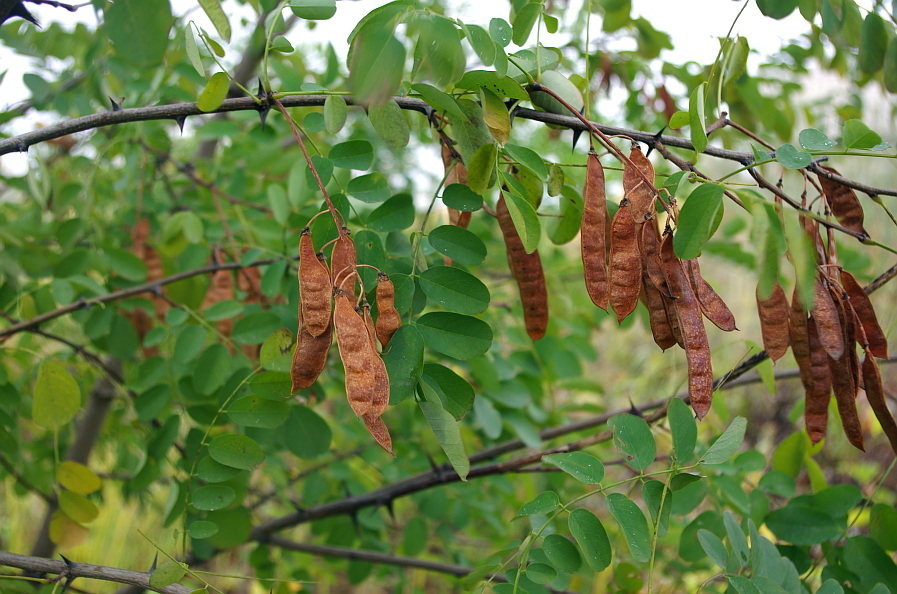
(c) Георгий Виноградов (Georgy Vinogradov), some rights reserved (CC BY), uploaded by Георгий Виноградов (Georgy Vinogradov) · licence
Family: Fabaceae · Type: Tree · Not Native
Conservation status: Cal-IPC Yes
Robinia pseudoacacia (Black locust) is a non-native California tree in the Fabaceae family, recognized by non-native status and tree habit also distinctive.
Black locust is a naturalized tree found in California Floristic Province and Great Basin regions, locally common near abandoned houses, roadsides, canyon slopes, and streambanks at elevations of 50 to 1,900 meters. Flowering from May to June, this tree produces white flowers with corolla 1.5 to 2 centimeters long. Growing with an upright, branching form to moderate heights, it develops a sturdy trunk with rough, deeply furrowed bark. Its compound leaves are composed of multiple oval leaflets arranged pinnately, typically dark green and arranged in dense clusters. This introduced species is known for its ability to thrive in disturbed landscapes and readily colonize open areas.
Identification and appearance
Key characters: Geographically isolated with no sympatric species; non-native status and tree habit also distinctive
Habitat and range
Habitat: Locally common near abandoned houses, roadsides, canyon slopes, streambanks
Elevation: 50-1900 m
California counties: Amador, Butte, Inyo, Los Angeles, Kern, Riverside, San Bernardino, San Diego, Santa Barbara, Shasta, Lake, Alameda, Mendocino, Napa, Santa Cruz, Tulare, Monterey, Orange, Solano, El Dorado, Placer, Calaveras, Fresno, Marin, Nevada, San Luis Obispo, Santa Clara, Trinity, Tuolumne, Ventura, Yolo, San Mateo, Siskiyou, Sacramento, Yuba, Contra Costa, Mono, Humboldt, Tehama, Sierra, Stanislaus, San Joaquin, Mariposa
Outside California: native to eastern United States, widely cultivated
Bloom period
Robinia pseudoacacia blooms May-Jun.
Conservation status
Cal-IPC Yes
How to tell it apart
vs Lagerstroemia: Robinia has compound leaves with many leaflets; crepe myrtle has simple undivided leaves with crinkled flowers.; vs Amorpha: Robinia has large showy flowers (over half inch); Amorpha has tiny dark purple flowers in dense spikes.; vs Gleditsia: Robinia leaflets are larger (1-2 inches) with smooth pods; honeylocust has tiny leaflets and long twisted pods.; vs Tipuana: Robinia flowers in drooping clusters; tipu tree has flowers in upright branched clusters.; vs Koelreuteria: Robinia has pea flowers and flat pods; goldenrain tree has small yellow flowers and papery lantern pods.
Frequently asked questions
Is Robinia pseudoacacia native to California?
No. Robinia pseudoacacia is not native to California (recorded as not native).
When does Robinia pseudoacacia bloom?
Robinia pseudoacacia blooms May-Jun.
Where in California does Robinia pseudoacacia grow?
Robinia pseudoacacia occurs in Amador, Butte, Inyo, Los Angeles, Kern, Riverside, San Bernardino, San Diego and other counties, at elevations of 50-1900 m.
What plant family does Robinia pseudoacacia belong to?
Robinia pseudoacacia is in the Fabaceae family, genus Robinia.
Is Robinia pseudoacacia invasive in California?
Robinia pseudoacacia is listed by Cal-IPC with an invasiveness rating of Yes.
Related species
Other California species in the same genus, family, or bioregion.
Sources: Jepson eFlora · Index of California Plant Names · CalPhotos
Last updated 2026-10-07
Data from The California Species Project — 14,000+ California species with verified data from CNPS, CDFW, USFWS, Cal-IPC, and more.