Romulea rosea var. australis
Rosy sand crocus
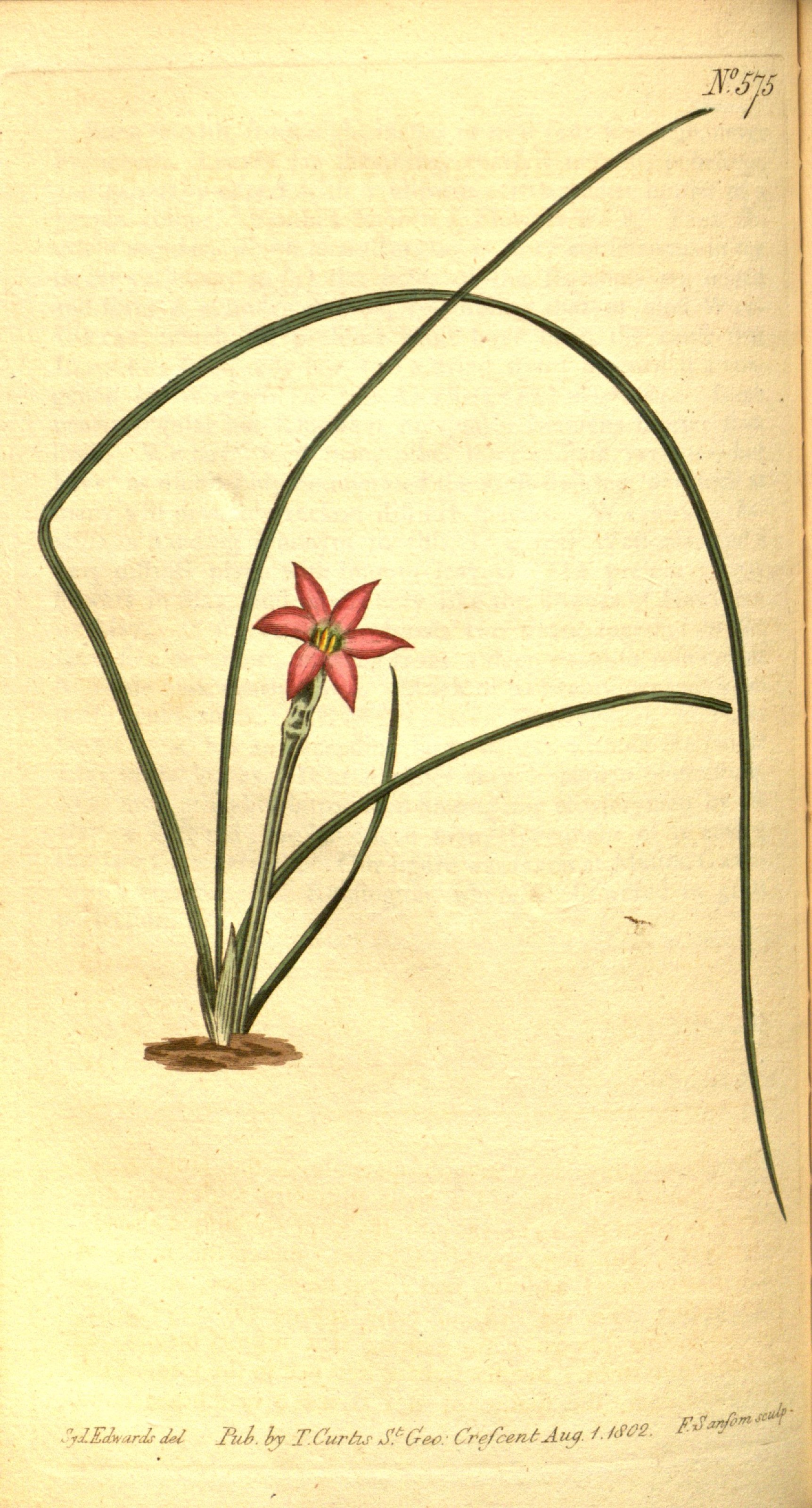
Bentham-Moxon Trust.; Curtis, William; Curtis's botanical magazine dedications, 1827-1927 : portraits and biographical notes.; Royal Botanic Gardens, Kew.; Stanley Smith Horticultural Trust. (via Wikimedia Commons) · CC0
Family: Iridaceae · Type: Herb · Not Native
Conservation status: Cal-IPC Yes
Romulea rosea var. australis (Rosy sand crocus) is a non-native California herb in the Iridaceae family, recognized by Only Romulea species in California, part of a genus native to Africa and Mediterranean regions.
Rosy sand crocus is a naturalized perennial found in northern coastal California, central California coast, Sacramento Valley, and San Francisco Bay Area in disturbed areas and sandy or hard-packed soils at elevations below 50 meters. Flowering from March to April, this plant produces pink or lilac flowers with yellow perianth tubes approximately 1.5 to 2 centimeters long. Growing with slender stems generally less than 10 centimeters tall, it has grass-like leaves 5 to 35 centimeters long and 1 to 2.5 millimeters in diameter. Its leaves are thin and linear, emerging from a compact base with delicate, pale green coloration. The fruit is 10 to 15 millimeters long with persistent bracts, suggesting a resilient reproductive strategy in its adopted landscape.
Identification and appearance
Key characters: Only Romulea species in California, part of a genus native to Africa and Mediterranean regions
Habitat and range
Habitat: Uncommon. Disturbed areas, dry, sandy or often hard-packed soil
Elevation: < 50 m
California counties: Butte, Monterey, Marin, Sacramento, Humboldt, San Mateo, Santa Cruz, Contra Costa, Mendocino, San Luis Obispo, San Diego, Yuba
Outside California: alien in Australia, elsewhere, native to southern Africa
Bloom period
Romulea rosea var. australis blooms Mar-Apr.
Conservation status
Cal-IPC Yes
How to tell it apart
vs Sisyrinchium: Romulea has round grooved leaves; Sisyrinchium has flat, grass-like leaves and flowers in clusters.; vs Crocus: Romulea has leaves round in cross-section; Crocus has flat leaves with white stripes down the center.; vs Hemerocallis: Romulea is under 4 inches tall; Hemerocallis is much larger with strap-like leaves and lily flowers.; vs Iris: Romulea has tiny solitary flowers under 4 inches; Iris is much larger with showy flowers and petal-like styles.; vs Sparaxis: Romulea has solitary flowers and round grooved leaves; Sparaxis has flower spikes and flat sword-like leaves.
Frequently asked questions
Is Romulea rosea var. australis native to California?
No. Romulea rosea var. australis is not native to California (recorded as not native).
When does Romulea rosea var. australis bloom?
Romulea rosea var. australis blooms Mar-Apr.
Where in California does Romulea rosea var. australis grow?
Romulea rosea var. australis occurs in Butte, Monterey, Marin, Sacramento, Humboldt, San Mateo, Santa Cruz, Contra Costa and other counties, at elevations of < 50 m.
What plant family does Romulea rosea var. australis belong to?
Romulea rosea var. australis is in the Iridaceae family, genus Romulea.
Is Romulea rosea var. australis invasive in California?
Romulea rosea var. australis is listed by Cal-IPC with an invasiveness rating of Yes.
Related species
Other California species in the same genus, family, or bioregion.
Sources: Jepson eFlora · Index of California Plant Names · CalPhotos
Last updated 2026-10-07
Data from The California Species Project — 14,000+ California species with verified data from CNPS, CDFW, USFWS, Cal-IPC, and more.