Rorippa curvisiliqua
Curvepod yellow cress
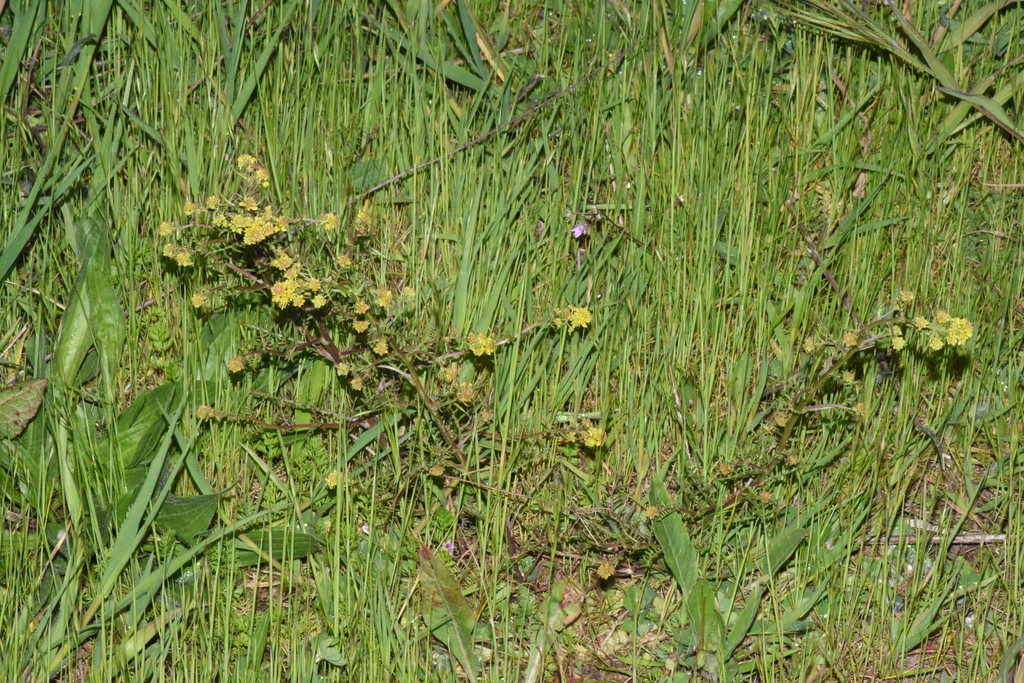
(c) Gabriel Campbell-Martinez, some rights reserved (CC BY) · licence
Family: Brassicaceae · Type: Herb · Native
Rorippa curvisiliqua (Curvepod yellow cress) is a native California herb in the Brassicaceae family, recognized by distinctive curved linear fruits provide clear identification.
Curvepod yellow cress is a California native annual found in the California Floristic Province and Modoc Plateau in streambanks, marshy ground, and meadows at elevations below 3,500 meters. Flowering from May to October, this plant produces small yellow flowers with spreading petals 0.6 to 1.8 millimeters long. Growing with ascending or prostrate stems 10 to 40 centimeters tall, it typically emerges with several stems from the base. Its leaves are distinctively pinnately lobed, with oblong to oblanceolate basal leaves featuring linear or oblong lateral lobes that can be entire or slightly toothed. The plant produces curved silique fruits 4 to 13 millimeters long, which arch upward from thin spreading pedicels.
Identification and appearance
Key characters: 10 sympatric species; distinctive curved linear fruits provide clear identification
Habitat and range
Habitat: Uncommon. Streambanks, marshy ground, seepage areas, lake shores, mud flats, meadows
Elevation: < 3500 m
California counties: Modoc, Alpine, Butte, Fresno, Kern, Lake, Lassen, Los Angeles, Madera, Mariposa, Mendocino, Mono, Monterey, Placer, Plumas, San Bernardino, San Diego, Santa Barbara, Santa Clara, Santa Cruz, Shasta, Siskiyou, Tehama, Trinity, Tulare, Tuolumne, Riverside, Humboldt, Orange, San Joaquin, Sierra, Sonoma, Ventura, Marin, Nevada, Amador, Inyo, San Benito, San Luis Obispo, Sutter, El Dorado, Calaveras, Napa, Del Norte, Contra Costa, Yolo, Glenn, San Francisco, Sacramento, San Mateo, Yuba, Solano, Stanislaus, Imperial, Merced, Colusa
Outside California: to Alaska, Rocky Mountains
Bloom period
Rorippa curvisiliqua blooms May-Oct.
How to tell it apart
vs Barbarea: Rorippa stems stay round and smooth; Barbarea stems develop distinct ridges or angles you can feel.; vs Sisymbrium: Rorippa has a simple rounded stigma tip; Sisymbrium's stigma is clearly two-lobed.; vs Nasturtium: Rorippa pods are short and plump; Nasturtium pods are elongated and curved like tiny bananas.; vs Hirschfeldia: Rorippa grows in wet areas with rounded pods; Hirschfeldia prefers dry disturbed sites with beaked pods.; vs Cystopteris: Rorippa has yellow four-petaled flowers and seed pods; Cystopteris is a fern with no flowers.
Frequently asked questions
Is Rorippa curvisiliqua native to California?
Yes. Rorippa curvisiliqua is native to California (recorded as native).
When does Rorippa curvisiliqua bloom?
Rorippa curvisiliqua blooms May-Oct.
Where in California does Rorippa curvisiliqua grow?
Rorippa curvisiliqua occurs in Modoc, Alpine, Butte, Fresno, Kern, Lake, Lassen, Los Angeles and other counties, at elevations of < 3500 m.
What plant family does Rorippa curvisiliqua belong to?
Rorippa curvisiliqua is in the Brassicaceae family, genus Rorippa.
What habitat does Rorippa curvisiliqua grow in?
Rorippa curvisiliqua grows in Uncommon. Streambanks, marshy ground, seepage areas, lake shores, mud flats, meadows.
Related species
Other California species in the same genus, family, or bioregion.
Sources: Jepson eFlora · Index of California Plant Names · CalPhotos
Last updated 2026-10-07
Data from The California Species Project — 14,000+ California species with verified data from CNPS, CDFW, USFWS, Cal-IPC, and more.