Rosa spithamea
Coast ground rose, Coast Ground Rose
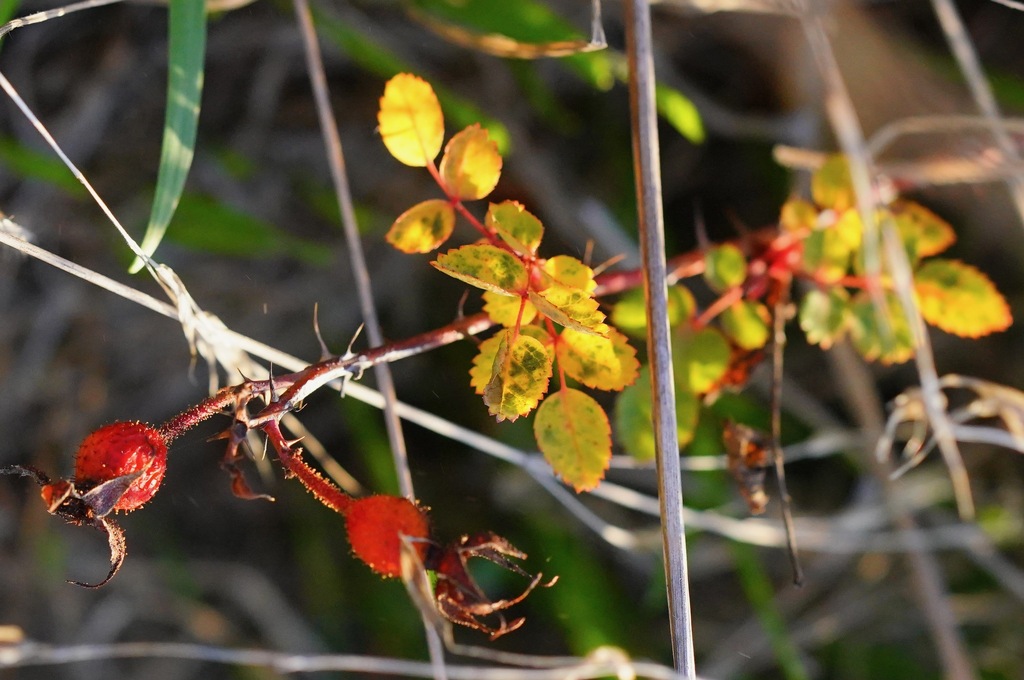
(c) Michael Warner, some rights reserved (CC BY) · licence
Family: Rosaceae · Type: Subshrub · Native
Rosa spithamea (Coast ground rose) is a native California subshrub in the Rosaceae family, recognized by . Key features: dwarf rhizomatous habit, post-fire specialist, colony-forming.
Coast ground rose is a California native shrub found in northwestern, central western, and mid-Peninsula bioregions in open forest and chaparral, especially in post-fire environments, at elevations of 150 to 1,550 meters. Flowering from April to August, this plant produces delicate pink to red flowers 10 to 15 millimeters long with multiple petals. Growing as a compact dwarf shrub less than 5 decimeters tall, it features scattered slender prickles 3 to 8 millimeters long. Its leaves have 5 to 7 leaflets arranged with 2 to 4 on each side, including a terminal leaflet 10 to 30 millimeters long that is widely elliptic with double-toothed margins. The fruit develops as a nearly spherical structure 7 to 12 millimeters wide, with persistent erect sepals.
Identification and appearance
Key characters: 15 sympatric species. Key features: dwarf rhizomatous habit, post-fire specialist, colony-forming.
Habitat and range
Habitat: Open forest, chaparral, especially after fire
Elevation: generally 150-1550(1950) m
California counties: Mendocino, Solano, San Luis Obispo, Napa, Trinity, Humboldt, Lake, Sonoma, Marin, Alameda, Contra Costa, Monterey, San Mateo, Santa Cruz, Siskiyou, Santa Clara, Butte, Shasta, Tehama, Yuba, Tulare, Del Norte, Tuolumne, El Dorado, San Benito
Outside California: Oregon
Bloom period
Rosa spithamea blooms Apr-Aug.
How to tell it apart
vs Camellia: Rosa has compound leaves with multiple leaflets; Camellia has single undivided glossy leaves.; vs Carpenteria: Rosa has thorny stems and compound leaves; Carpenteria is thornless with simple opposite leaves.; vs Hibiscus: Rosa has compound leaves and thorny stems; Hibiscus has simple palmate leaves, thornless.; vs Dahlia: Rosa is woody with thorns; Dahlia is herbaceous without thorns.; vs Cistus: Rosa has compound leaves with 5-9 leaflets; Cistus has simple undivided leaves.
Frequently asked questions
Is Rosa spithamea native to California?
Yes. Rosa spithamea is native to California (recorded as native).
When does Rosa spithamea bloom?
Rosa spithamea blooms Apr-Aug.
Where in California does Rosa spithamea grow?
Rosa spithamea occurs in Mendocino, Solano, San Luis Obispo, Napa, Trinity, Humboldt, Lake, Sonoma and other counties, at elevations of generally 150-1550(1950) m.
What plant family does Rosa spithamea belong to?
Rosa spithamea is in the Rosaceae family, genus Rosa.
What habitat does Rosa spithamea grow in?
Rosa spithamea grows in Open forest, chaparral, especially after fire.
Related species
Other California species in the same genus, family, or bioregion.
Sources: Jepson eFlora · Index of California Plant Names · CalPhotos
Last updated 2026-10-07
Data from The California Species Project — 14,000+ California species with verified data from CNPS, CDFW, USFWS, Cal-IPC, and more.