Rosa woodsii subsp. ultramontana
Interior rose, Interior Rose
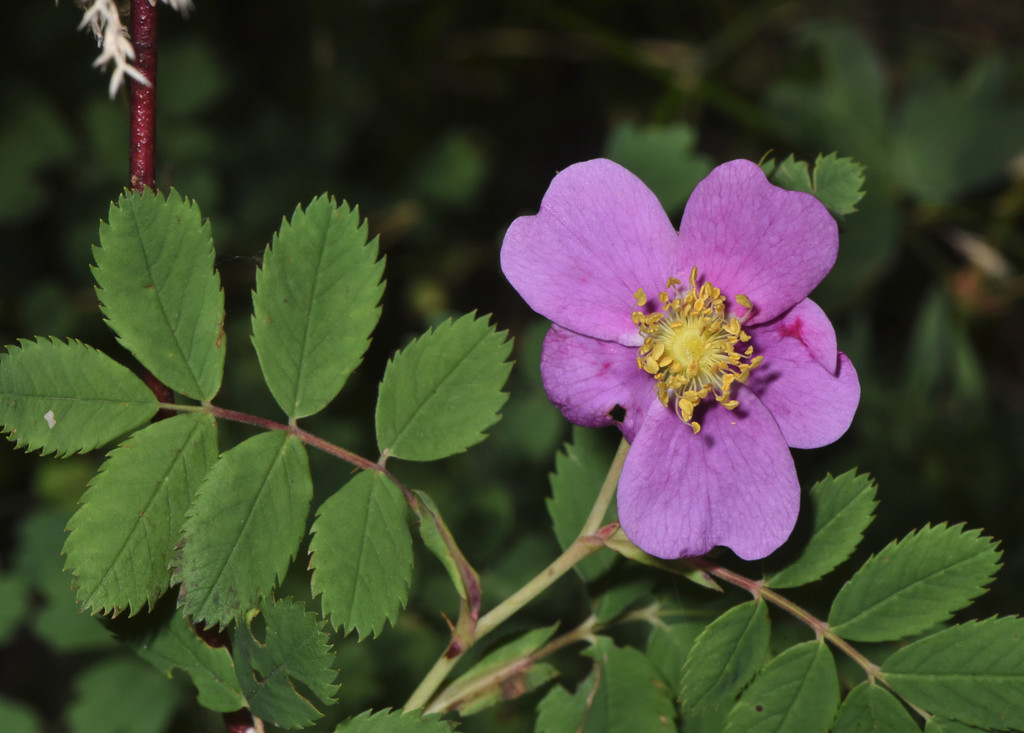
(c) Don Loarie, some rights reserved (CC BY), uploaded by Don Loarie · licence
Family: Rosaceae · Type: Subshrub · Native
Rosa woodsii subsp. ultramontana (Interior rose) is a native California subshrub in the Rosaceae family, recognized by . Key features: openly branched, few slender prickles, no internodal prickles in inflorescence.
Interior rose is a California native shrub found in northern Sierra Nevada, northern Sierra Nevada eastern slopes, Modoc Plateau, and northern Sierra Eastern areas in generally moist habitats at elevations of 1,000 to 2,500 meters. Flowering from May to July, this plant produces pale pink to white flowers in small clusters of 1 to 12 blossoms. Growing with openly branched stems 1 to 2 meters tall, it bears slender prickles 2 to 7 millimeters long that are sparse along the branches. Its leaves have multiple leaflets with serrated edges, characteristic of wild rose species. The fruit develops as a generally ovoid hip, typical of rose family shrubs.
Identification and appearance
Key characters: 16 sympatric species. Key features: openly branched, few slender prickles, no internodal prickles in inflorescence.
Habitat and range
Habitat: Generally +- moist areas
Elevation: 1000-2500 m
California counties: Modoc, Nevada, Mono, Inyo, Placer, Kern, Tulare, Plumas, Siskiyou, Lassen, Sierra, Trinity, Del Norte, Butte, Fresno, Madera, Alpine, Tehama, Ventura, San Diego, Tuolumne, El Dorado, Amador
Outside California: to British Columbia, Montana, Nevada
Bloom period
Rosa woodsii subsp. ultramontana blooms May-Jul.
How to tell it apart
vs Camellia: Rosa has compound leaves with multiple leaflets; Camellia has single undivided glossy leaves.; vs Carpenteria: Rosa has thorny stems and compound leaves; Carpenteria is thornless with simple opposite leaves.; vs Hibiscus: Rosa has compound leaves and thorny stems; Hibiscus has simple palmate leaves, thornless.; vs Dahlia: Rosa is woody with thorns; Dahlia is herbaceous without thorns.; vs Cistus: Rosa has compound leaves with 5-9 leaflets; Cistus has simple undivided leaves.
Frequently asked questions
Is Rosa woodsii subsp. ultramontana native to California?
Yes. Rosa woodsii subsp. ultramontana is native to California (recorded as native).
When does Rosa woodsii subsp. ultramontana bloom?
Rosa woodsii subsp. ultramontana blooms May-Jul.
Where in California does Rosa woodsii subsp. ultramontana grow?
Rosa woodsii subsp. ultramontana occurs in Modoc, Nevada, Mono, Inyo, Placer, Kern, Tulare, Plumas and other counties, at elevations of 1000-2500 m.
What plant family does Rosa woodsii subsp. ultramontana belong to?
Rosa woodsii subsp. ultramontana is in the Rosaceae family, genus Rosa.
What habitat does Rosa woodsii subsp. ultramontana grow in?
Rosa woodsii subsp. ultramontana grows in Generally +- moist areas.
Related species
Other California species in the same genus, family, or bioregion.
Sources: Jepson eFlora · Index of California Plant Names · CalPhotos
Last updated 2026-10-07
Data from The California Species Project — 14,000+ California species with verified data from CNPS, CDFW, USFWS, Cal-IPC, and more.