Rosa woodsii var. gratissima
Tehachapi rose
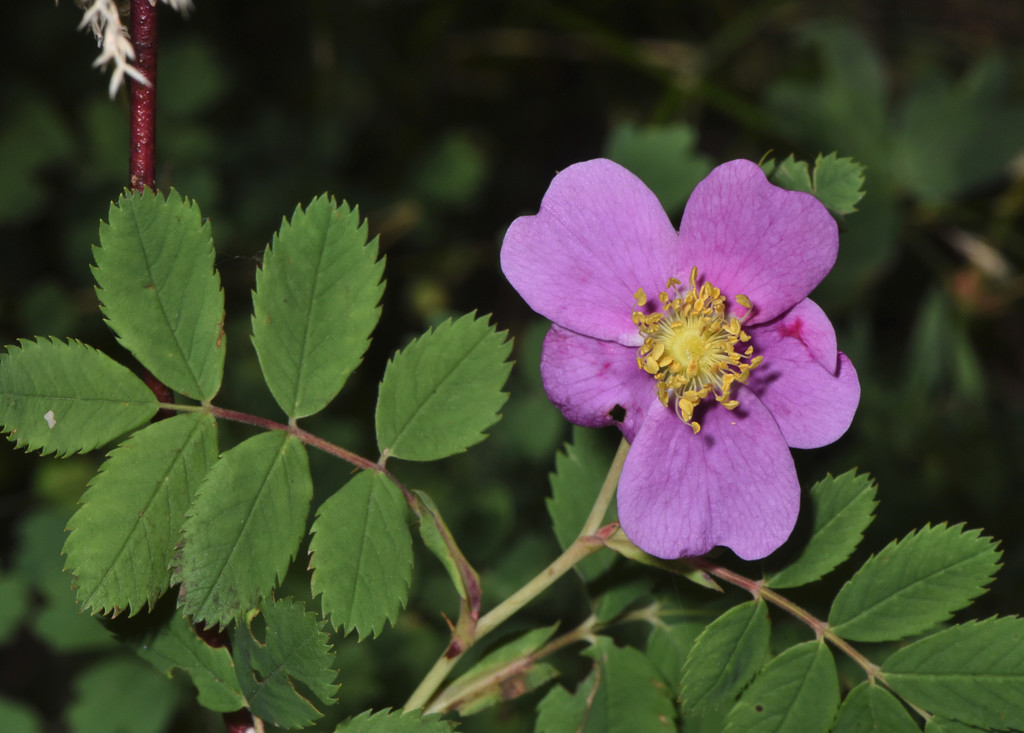
(c) Don Loarie, some rights reserved (CC BY), uploaded by Don Loarie · licence
Family: Rosaceae · Type: Subshrub · Native
Rosa woodsii var. gratissima (Tehachapi rose) is a native California subshrub in the Rosaceae family, recognized by . Key features: finely velvety leaf axis, glandless single-toothed leaflets.
Tehachapi rose is a California native shrub found in central Sierra Nevada Mountains, Tehachapi, Transverse Ranges, southern eastern Sierra Nevada, and desert mountains in generally moist areas at elevations of 800 to 3,400 meters. Flowering from May to August, this plant produces soft pink to white flowers with delicate, open petals. Growing with arching branches 1 to 2 meters tall, it forms dense thickets in mountain and desert transitional zones. Its compound leaves have fine, velvety leaf axes with multiple leaflets arranged along slender stems, giving the plant a soft, textured appearance. The plant produces small, rounded rose hips that persist after flowering, providing visual interest and food for wildlife.
Identification and appearance
Key characters: 11 sympatric species. Key features: finely velvety leaf axis, glandless single-toothed leaflets.
Habitat and range
Habitat: Generally +- moist areas
Elevation: 800-3400 m
Outside California: Nevada
Bloom period
Rosa woodsii var. gratissima blooms May-Aug.
How to tell it apart
vs Camellia: Rosa has compound leaves with multiple leaflets; Camellia has single undivided glossy leaves.; vs Carpenteria: Rosa has thorny stems and compound leaves; Carpenteria is thornless with simple opposite leaves.; vs Hibiscus: Rosa has compound leaves and thorny stems; Hibiscus has simple palmate leaves, thornless.; vs Dahlia: Rosa is woody with thorns; Dahlia is herbaceous without thorns.; vs Cistus: Rosa has compound leaves with 5-9 leaflets; Cistus has simple undivided leaves.
Frequently asked questions
Is Rosa woodsii var. gratissima native to California?
Yes. Rosa woodsii var. gratissima is native to California (recorded as native).
When does Rosa woodsii var. gratissima bloom?
Rosa woodsii var. gratissima blooms May-Aug.
What plant family does Rosa woodsii var. gratissima belong to?
Rosa woodsii var. gratissima is in the Rosaceae family, genus Rosa.
What habitat does Rosa woodsii var. gratissima grow in?
Rosa woodsii var. gratissima grows in Generally +- moist areas.
Related species
Other California species in the same genus, family, or bioregion.
- Rosa bridgesii — Sierran dwarf rose
- Rosa californica — California rose
- Rosa canina — Dog rose
- Rosa gymnocarpa — Wood rose
- Rosa gymnocarpa subsp. gymnocarpa
- Rosa gymnocarpa subsp. helleri
- Rosaceae sp. — Rose family
- Rubus armeniacus — Himalayan blackberry
- Rubus glaucifolius — Waxleaf raspberry
- Rubus glaucifolius var. ganderi — Cuyamaca raspberry
Sources: Jepson eFlora · CalPhotos
Last updated 2026-10-07
Data from The California Species Project — 14,000+ California species with verified data from CNPS, CDFW, USFWS, Cal-IPC, and more.