Rubus pensilvanicus
Pennsylvania blackberry
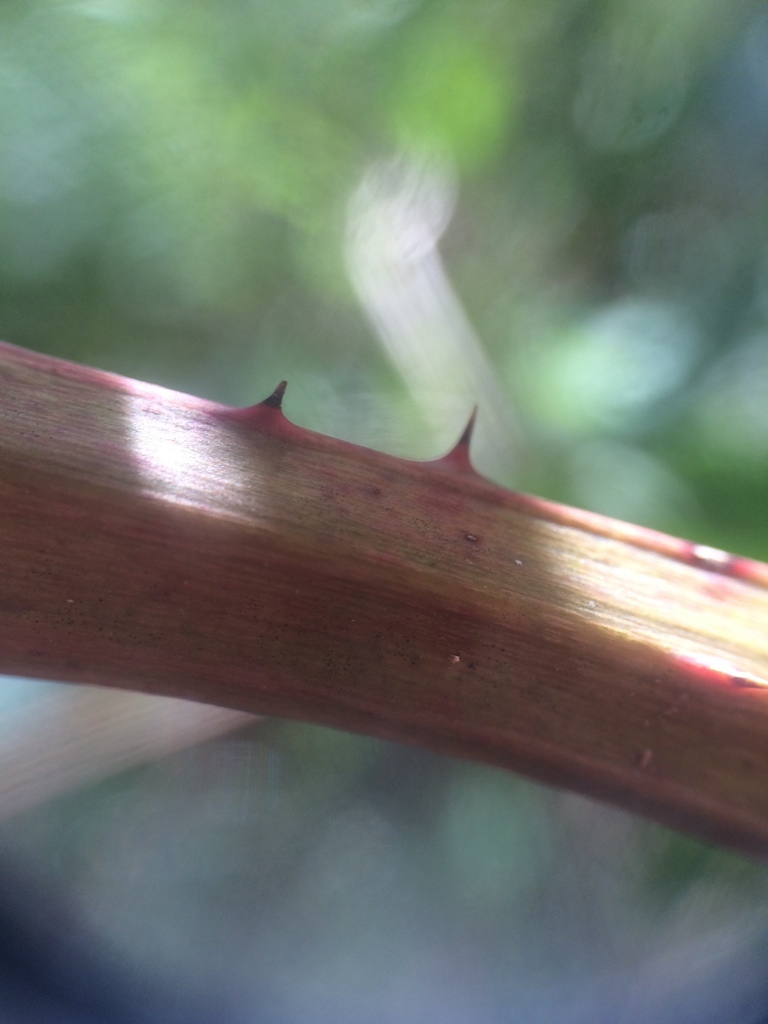
no rights reserved, uploaded by Étienne Lacroix-Carignan · CC0
Family: Rosaceae · Type: Subshrub · Not Native
Rubus pensilvanicus (Pennsylvania blackberry) is a non-native California subshrub in the Rosaceae family, recognized by strictly erect habit and thick stems.
Pennsylvania blackberry is a naturalized shrub found in the California Floristic Province in disturbed areas at elevations below 1,500 meters. Flowering from April to July, this plant produces white flowers 10 to 20 millimeters wide with rounded to obovate petals. Growing 1 to 3 meters tall with erect to arched stems, it has many stout, wide-based prickles that are straight or slightly curved. Its compound leaves feature 5 leaflets, with the terminal leaflet ovate-elliptic, sharply double-toothed, and covered in gray hair on the underside. The fruit develops as a classic blackberry, turning deep black when ripe.
Identification and appearance
Key characters: Co-occurs with 12 species; distinguished by strictly erect habit and thick stems
Habitat and range
Habitat: Disturbed areas
Elevation: < 1500 m
California counties: Humboldt, Fresno, Los Angeles, Santa Barbara, San Diego, Butte, San Bernardino, Riverside, Amador, Contra Costa, Kern, Mariposa, Monterey, Nevada, Plumas, San Francisco, Sutter, Ventura, Yuba, San Joaquin, Orange, Sacramento, Stanislaus, Yolo
Outside California: northeastern North America
Bloom period
Rubus pensilvanicus blooms Apr-Jul.
How to tell it apart
vs Toxicodendron: Rubus has palmate leaves with 3-5 leaflets spreading from one point; poison oak has 3 leaflets arranged along a stem.; vs Ribes: Rubus stems are thorny or bristly canes; currants/gooseberries are unarmed or have sharp spines at nodes only.; vs Rosa: Rubus leaves are palmate (fingers from palm); rose leaves are pinnate (leaflets along a central stem).; vs Acer: Rubus has compound leaves with separate leaflets; maple leaves are single lobed blades.; vs Fragaria: Rubus grows as tall, arching canes; strawberries form low runners with flower stalks rising from base.
Frequently asked questions
Is Rubus pensilvanicus native to California?
No. Rubus pensilvanicus is not native to California (recorded as not native).
When does Rubus pensilvanicus bloom?
Rubus pensilvanicus blooms Apr-Jul.
Where in California does Rubus pensilvanicus grow?
Rubus pensilvanicus occurs in Humboldt, Fresno, Los Angeles, Santa Barbara, San Diego, Butte, San Bernardino, Riverside and other counties, at elevations of < 1500 m.
What plant family does Rubus pensilvanicus belong to?
Rubus pensilvanicus is in the Rosaceae family, genus Rubus.
What habitat does Rubus pensilvanicus grow in?
Rubus pensilvanicus grows in Disturbed areas.
Related species
Other California species in the same genus, family, or bioregion.
Sources: Jepson eFlora · Index of California Plant Names · CalPhotos
Last updated 2026-10-07
Data from The California Species Project — 14,000+ California species with verified data from CNPS, CDFW, USFWS, Cal-IPC, and more.