Rubus ursinus
California blackberry
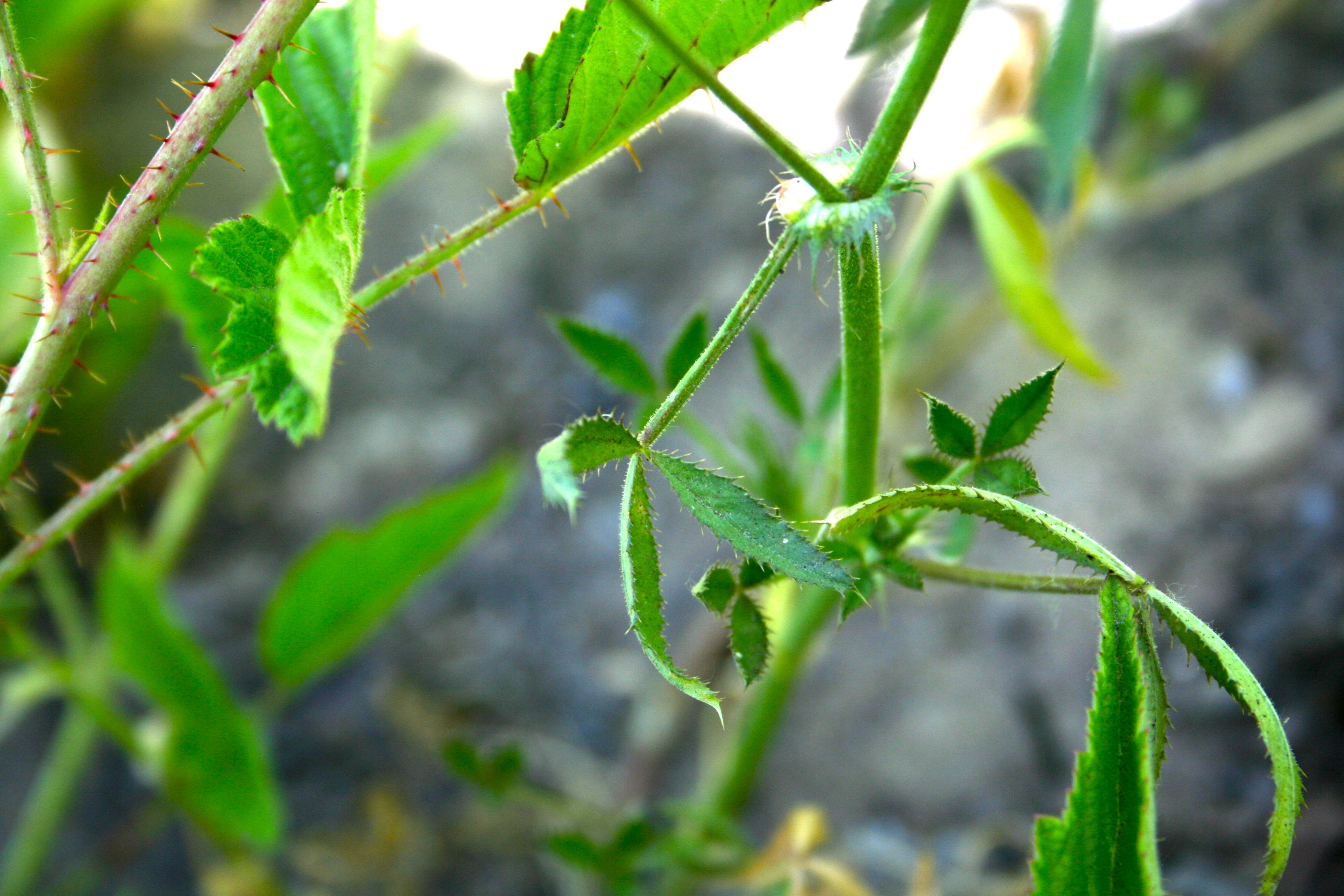
Photo by Chez Brungraber
Family: Rosaceae · Type: Subshrub · Native
Rubus ursinus (California blackberry) is a native California subshrub in the Rosaceae family, recognized by weak bristles and dioecious flowers.
California blackberry is a native shrub found in California's Central Coast and Coastal Foothills Ranges in open, disturbed areas at elevations below 1,500 meters. Flowering from March to July, this plant produces delicate white flowers 6 to 8 millimeters long with white petals. Growing with flexible stems 2 to 10 millimeters in diameter that can root at their tips, it spreads in prostrate to decumbent form with numerous weak, slender straight bristles. Its leaves typically have 3 to 5 leaflets with terminal leaflets that are triangular-ovate, irregularly coarse-toothed, and sparsely covered in gray hair on the underside. The fruit develops as a distinctive blackberry, turning deep black when mature.
Identification and appearance
Key characters: Co-occurs with 12 species; distinguished by weak bristles and dioecious flowers
Habitat and range
Habitat: Common. Open, disturbed areas
Elevation: < 1500 m
California counties: Humboldt, Santa Barbara, Los Angeles, Ventura, Riverside, Santa Clara, San Bernardino, San Mateo, Santa Cruz, Fresno, Placer, Orange, San Diego, Sonoma, Kern, San Luis Obispo, Butte, Monterey, Merced, Yuba, Tulare, Marin, Del Norte, San Francisco, Mendocino, Alameda, Siskiyou, Sutter, Colusa, El Dorado, Mariposa, Shasta, Solano, Tuolumne, Amador, Contra Costa, Lake, Napa, Plumas, San Benito, Trinity, Sacramento, San Joaquin, Yolo, Glenn, Sierra, Nevada, Calaveras, Stanislaus
Outside California: to British Columbia, Idaho, Baja California
Bloom period
Rubus ursinus blooms Mar-Jul.
How to tell it apart
vs Toxicodendron: Rubus has palmate leaves with 3-5 leaflets spreading from one point; poison oak has 3 leaflets arranged along a stem.; vs Ribes: Rubus stems are thorny or bristly canes; currants/gooseberries are unarmed or have sharp spines at nodes only.; vs Rosa: Rubus leaves are palmate (fingers from palm); rose leaves are pinnate (leaflets along a central stem).; vs Acer: Rubus has compound leaves with separate leaflets; maple leaves are single lobed blades.; vs Fragaria: Rubus grows as tall, arching canes; strawberries form low runners with flower stalks rising from base.
Frequently asked questions
Is Rubus ursinus native to California?
Yes. Rubus ursinus is native to California (recorded as native).
When does Rubus ursinus bloom?
Rubus ursinus blooms Mar-Jul.
Where in California does Rubus ursinus grow?
Rubus ursinus occurs in Humboldt, Santa Barbara, Los Angeles, Ventura, Riverside, Santa Clara, San Bernardino, San Mateo and other counties, at elevations of < 1500 m.
What plant family does Rubus ursinus belong to?
Rubus ursinus is in the Rosaceae family, genus Rubus.
What habitat does Rubus ursinus grow in?
Rubus ursinus grows in Common. Open, disturbed areas.
Related species
Other California species in the same genus, family, or bioregion.
- Rubus armeniacus — Himalayan blackberry
- Rubus glaucifolius — Waxleaf raspberry
- Rubus glaucifolius var. ganderi — Cuyamaca raspberry
- Rubus laciniatus — Cutleaf blackberry
- Rubus lasiococcus — Roughfruit raspberry
- Rubus leucodermis — Whitebark raspberry
- Sanguisorba officinalis — Great burnet
- Sanguisorba sp.
- Sibbaldia procumbens — Creeping sibbaldia
- Sibbaldia sp.
Sources: Jepson eFlora · Index of California Plant Names · CalPhotos
Last updated 2026-10-07
Data from The California Species Project — 14,000+ California species with verified data from CNPS, CDFW, USFWS, Cal-IPC, and more.