Rumex hymenosepalus
Canaigre, wild-rhubarb, Wild-Rhubarb
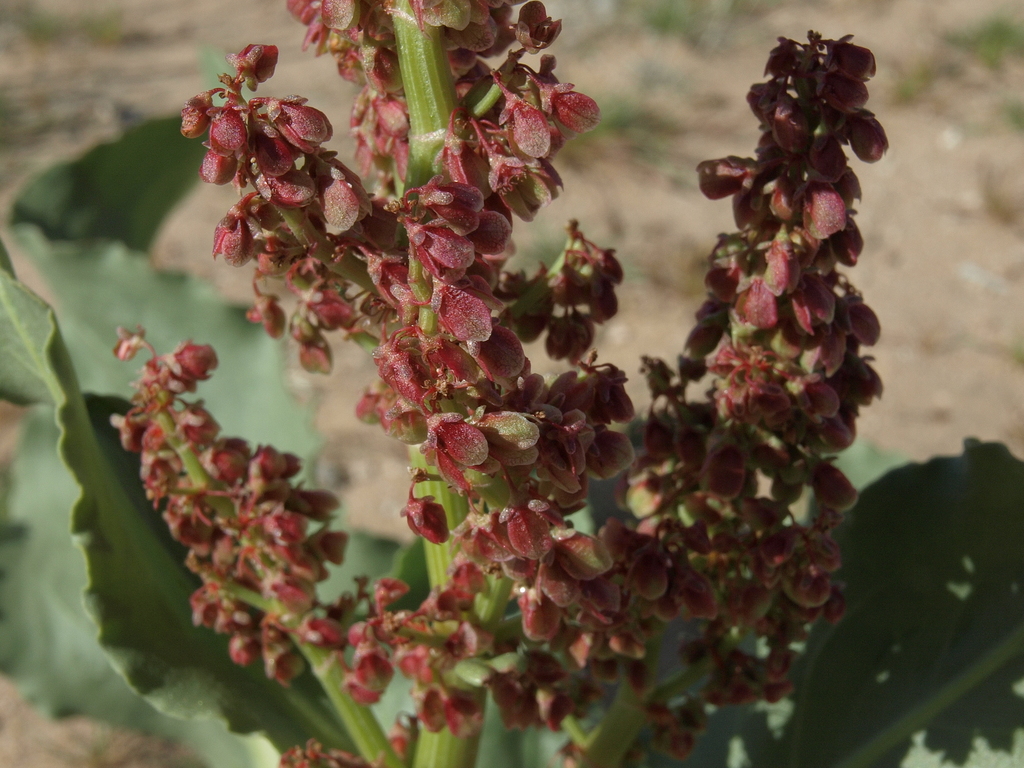
(c) Jim Morefield, some rights reserved (CC BY) · licence
Family: Polygonaceae · Type: Herb · Native
Rumex hymenosepalus (Canaigre) is a native California herb in the Polygonaceae family, recognized by . Exceptionally large fruiting structures.
Canaigre is a California native perennial found in the San Joaquin Valley, southwestern California, and Mojave Desert regions in sandy, rocky places, plains, slopes, and streambeds at elevations below 2,000 meters. Flowering from January to May, this plant produces small greenish to reddish flowers in dense terminal clusters. Growing with stout, fleshy stems 25 to 90 centimeters tall and short rhizomes with tuber-like roots, it develops a robust and distinctive growth form. Its large fleshy leaves measure 5 to 30 centimeters long and 2 to 8 centimeters wide, with lanceolate to oblong blades that have entire margins and acute to acuminate tips. The fruit is brown to red-brown, measuring 4 to 5 millimeters long.
Identification and appearance
Key characters: 14 sympatric species. Exceptionally large fruiting structures are diagnostic.
Habitat and range
Habitat: Sandy, rocky places, plains, slopes, streambeds, alkaline soils
Elevation: < 2000 m
California counties: San Bernardino, Los Angeles, Ventura, Riverside, Orange, Kern, Madera, San Diego, Fresno, Monterey, San Luis Obispo, Santa Barbara, Lassen, Merced, Yolo
Outside California: to Montana, Texas, Mexico (Baja California, Chihuahua)
Bloom period
Rumex hymenosepalus blooms Jan-May.
How to tell it apart
vs Anemopsis: Rumex has dense flower clusters; Anemopsis has a single white cone-like flower head.; vs Amaranthus: Rumex has papery three-winged fruits; Amaranthus has small round seeds with papery covers.; vs Plantago: Rumex has branching flower clusters; Plantago has flowers in dense cylindrical spikes.; vs Eriogonum: Rumex has large broad leaves; Eriogonum typically has small basal leaf rosettes or mats.; vs Limonium: Rumex has green to reddish flower clusters; Limonium has papery purple or pink flowers.
Frequently asked questions
Is Rumex hymenosepalus native to California?
Yes. Rumex hymenosepalus is native to California (recorded as native).
When does Rumex hymenosepalus bloom?
Rumex hymenosepalus blooms Jan-May.
Where in California does Rumex hymenosepalus grow?
Rumex hymenosepalus occurs in San Bernardino, Los Angeles, Ventura, Riverside, Orange, Kern, Madera, San Diego and other counties, at elevations of < 2000 m.
What plant family does Rumex hymenosepalus belong to?
Rumex hymenosepalus is in the Polygonaceae family, genus Rumex.
What habitat does Rumex hymenosepalus grow in?
Rumex hymenosepalus grows in Sandy, rocky places, plains, slopes, streambeds, alkaline soils.
Related species
Other California species in the same genus, family, or bioregion.
Sources: Jepson eFlora · Index of California Plant Names · CalPhotos
Last updated 2026-10-07
Data from The California Species Project — 14,000+ California species with verified data from CNPS, CDFW, USFWS, Cal-IPC, and more.