Rumex transitorius
Willow dock
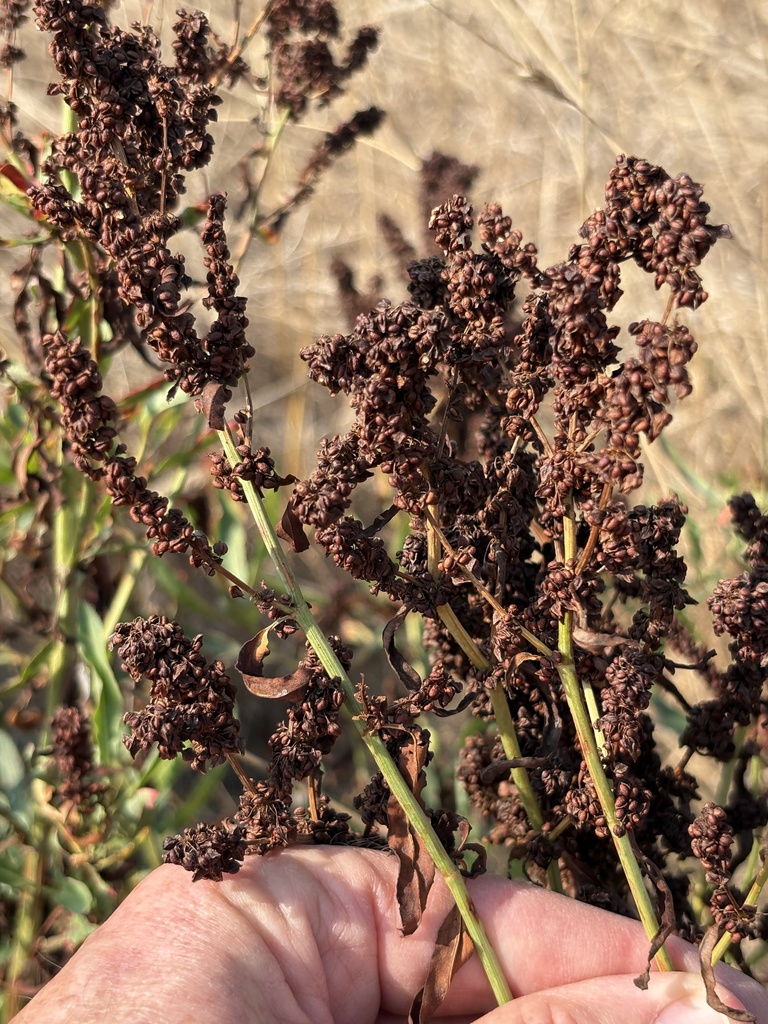
(c) Ed Alverson, some rights reserved (CC BY) · licence
Family: Polygonaceae · Type: Perennial · Native
Rumex transitorius (Willow dock) is a native California perennial in the Polygonaceae family, recognized by . Coastal/mountain distribution and unequal tubercles help distinguish from other willow docks.
Willow dock is a California native perennial found in coastal regions including North Coast, Sierra Nevada, Central Coast, and Sacramento Valley in coastal dunes and wet meadow margins at elevations up to 2,250 meters. Flowering from April to June, this plant produces small flowers in dense, interrupted whorls with thread-like pedicels. Growing with decumbent to erect stems 25 to 70 centimeters tall, it develops simple or branched stems with axillary shoots. Its lance-linear to lanceolate leaves measure 6 to 15 centimeters long, with entire to slightly wavy margins and tapered bases. The fruit is dark red-brown, approximately 2 millimeters long with three unequal tubercles.
Identification and appearance
Key characters: 15 sympatric species. Coastal/mountain distribution and unequal tubercles help distinguish from other willow docks.
Habitat and range
Habitat: Coastal dunes, wet margins of meadows
Elevation: < 2250 m
California counties: Contra Costa, Alameda, Butte, El Dorado, Lake, Lassen, Monterey, Napa, Nevada, Plumas, San Benito, San Francisco, Santa Barbara, Solano, Sutter, Trinity, Tuolumne, Ventura, Del Norte, Humboldt, Kern, Marin, Mendocino, San Mateo, Santa Clara, Sonoma, Modoc, Santa Cruz, San Luis Obispo, Alpine, Sacramento, Yolo, Fresno
Outside California: to Alaska
Bloom period
Rumex transitorius blooms Apr-Jun.
How to tell it apart
vs Anemopsis: Rumex has dense flower clusters; Anemopsis has a single white cone-like flower head.; vs Amaranthus: Rumex has papery three-winged fruits; Amaranthus has small round seeds with papery covers.; vs Plantago: Rumex has branching flower clusters; Plantago has flowers in dense cylindrical spikes.; vs Eriogonum: Rumex has large broad leaves; Eriogonum typically has small basal leaf rosettes or mats.; vs Limonium: Rumex has green to reddish flower clusters; Limonium has papery purple or pink flowers.
Frequently asked questions
Is Rumex transitorius native to California?
Yes. Rumex transitorius is native to California (recorded as native).
When does Rumex transitorius bloom?
Rumex transitorius blooms Apr-Jun.
Where in California does Rumex transitorius grow?
Rumex transitorius occurs in Contra Costa, Alameda, Butte, El Dorado, Lake, Lassen, Monterey, Napa and other counties, at elevations of < 2250 m.
What plant family does Rumex transitorius belong to?
Rumex transitorius is in the Polygonaceae family, genus Rumex.
What habitat does Rumex transitorius grow in?
Rumex transitorius grows in Coastal dunes, wet margins of meadows.
Related species
Other California species in the same genus, family, or bioregion.
Sources: Jepson eFlora · Index of California Plant Names · CalPhotos
Last updated 2026-09-30
Data from The California Species Project — 14,000+ California species with verified data from CNPS, CDFW, USFWS, Cal-IPC, and more.