Rupertia physodes
California tea
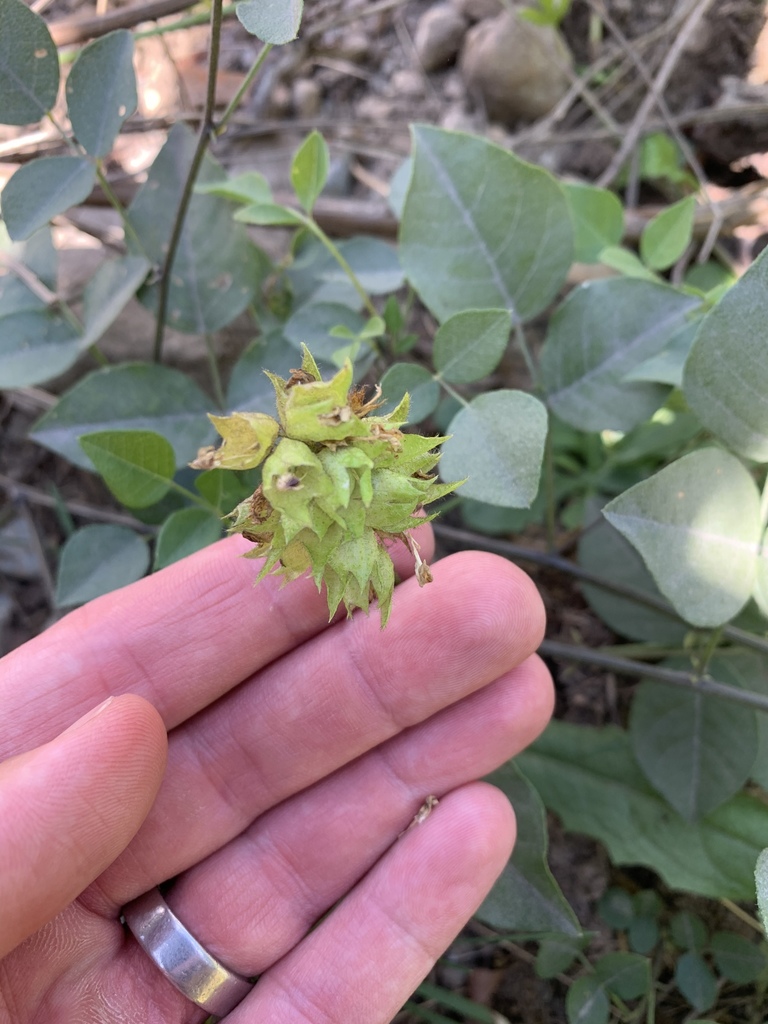
no rights reserved · CC0
Family: Fabaceae · Type: Herb · Native
Rupertia physodes (California tea) is a native California herb in the Fabaceae family, recognized by One sympatric species (R. rigida); distinguished by size differences and geographic range.
California tea is a California native perennial found in the Klamath Ranges, northern Coast Ranges, central western California, southern California coast, San Bernardino Mountains, and Peninsular Ranges in woodland habitats at elevations below 2,500 meters. Flowering from May to September, this plant produces small flowers with delicate petals in soft golden or reddish tones. Growing with erect or decumbent stems to half a meter tall, it develops sparse stolons and has a distinctive branching structure. Its leaves feature triangular to lanceolate leaflets 3.5 to 7 centimeters long, with sparse hairs on the upper surface and becoming nearly smooth underneath. The fruit is a distinctive golden-red, depressed-obovate structure with red-brown hairs, creating an attractive seed cluster.
Identification and appearance
Key characters: One sympatric species (R. rigida); distinguished by size differences and geographic range
Habitat and range
Habitat: Woodland
Elevation: < 2500 m
California counties: San Luis Obispo, Los Angeles, Lake, San Diego, Sonoma, Ventura, Santa Barbara, Santa Cruz, Orange, Humboldt, Riverside, San Bernardino, San Benito, Napa, San Mateo, Santa Clara, Monterey, Alameda, Contra Costa, Del Norte, Marin, Solano, Shasta, Mendocino, Trinity, Tehama
Outside California: to British Columbia, Idaho
Bloom period
Rupertia physodes blooms May-Sep.
How to tell it apart
vs Hoita: Rupertia flowers are cream-yellow; Hoita flowers are blue-purple.; vs Ptelea: Rupertia has pea flowers and inflated pods; hoptree (Ptelea) has 4-5 petaled flowers and flat winged fruits.; vs Bituminaria: Rupertia has separate bracts; Bituminaria has distinctive united fan-shaped bracts at nodes.; vs Acmispon: Rupertia has dramatically balloon-swollen fruiting calyxes; Acmispon fruits are ovate to oblong, not inflated.; vs Astragalus: Rupertia has cream-yellow flowers and dramatically inflated calyxes; Astragalus typically has purple/white flowers and inflated pods (not calyxes).
Frequently asked questions
Is Rupertia physodes native to California?
Yes. Rupertia physodes is native to California (recorded as native).
When does Rupertia physodes bloom?
Rupertia physodes blooms May-Sep.
Where in California does Rupertia physodes grow?
Rupertia physodes occurs in San Luis Obispo, Los Angeles, Lake, San Diego, Sonoma, Ventura, Santa Barbara, Santa Cruz and other counties, at elevations of < 2500 m.
What plant family does Rupertia physodes belong to?
Rupertia physodes is in the Fabaceae family, genus Rupertia.
What habitat does Rupertia physodes grow in?
Rupertia physodes grows in Woodland.
Related species
Other California species in the same genus, family, or bioregion.
Sources: Jepson eFlora · Index of California Plant Names · CalPhotos
Last updated 2026-10-07
Data from The California Species Project — 14,000+ California species with verified data from CNPS, CDFW, USFWS, Cal-IPC, and more.