Rupertia rigida
Parish's rupertia, Parish's Rupertia
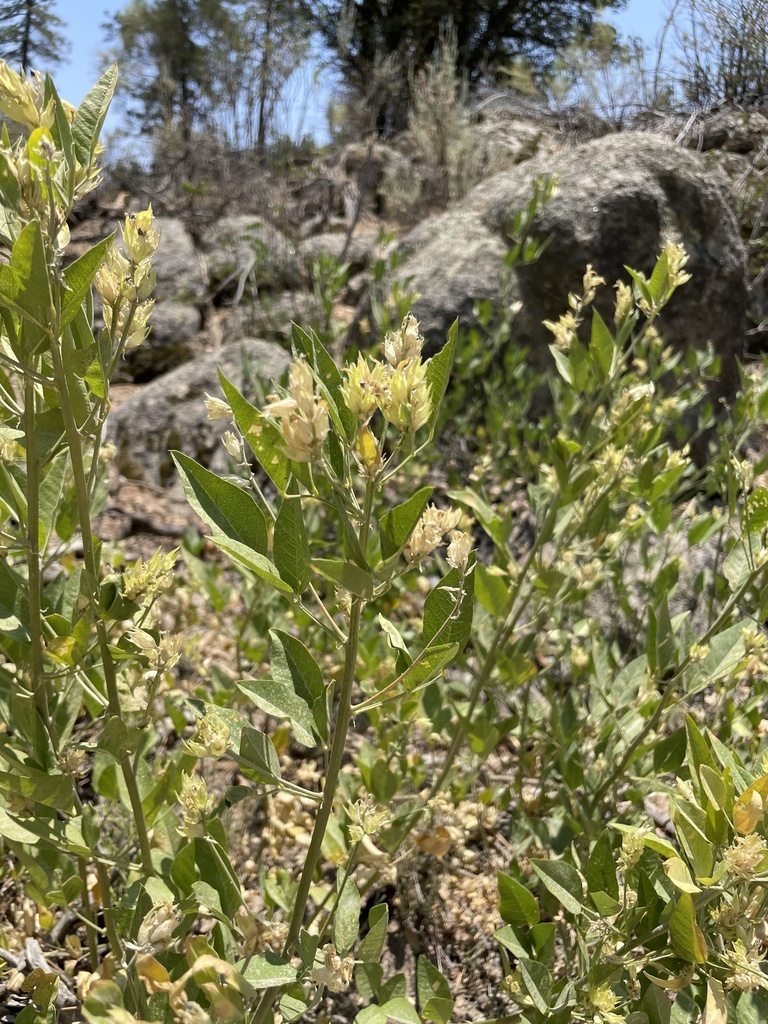
(c) Sula Vanderplank, some rights reserved (CC BY) · licence
Family: Fabaceae · Type: Herb · Native
Conservation status: CNPS 4.3
Rupertia rigida (Parish's rupertia) is a native California herb in the Fabaceae family, recognized by One sympatric species (R. physodes); distinguished by larger size, purple stem base, and southern California restriction.
Parish's rupertia is a California native perennial ranked 4.3 by CNPS, found in southern California coastal regions, San Bernardino Mountains, and Peninsular Ranges in woodland, chaparral, and lower montane conifer forest at elevations below 2,500 meters. Flowering from May to June, this plant produces small flowers with distinctive golden-brown and red-brown hairy fruits. Growing with erect stems less than 75 centimeters tall with a purple base, it has a woody caudex that supports its delicate structure. Its leaves feature lance-linear stipules and lanceolate leaflets 35 to 65 millimeters long, covered with glands and hairs that are particularly dense on the upper surface. The fruit is an elliptic, golden-brown structure 9 to 13 millimeters long, adorned with red-brown hairs and a beak less than 3 millimeters wide.
Identification and appearance
Key characters: One sympatric species (R. physodes); distinguished by larger size, purple stem base, and southern California restriction
Habitat and range
Habitat: Woodland, chaparral, lower montane conifer forest
Elevation: < 2500 m
California counties: San Diego, Riverside, San Bernardino, Los Angeles
Outside California: Baja California
Bloom period
Rupertia rigida blooms May-Jun.
Conservation status
CNPS 4.3
How to tell it apart
vs Hoita: Rupertia flowers are cream-yellow; Hoita flowers are blue-purple.; vs Ptelea: Rupertia has pea flowers and inflated pods; hoptree (Ptelea) has 4-5 petaled flowers and flat winged fruits.; vs Bituminaria: Rupertia has separate bracts; Bituminaria has distinctive united fan-shaped bracts at nodes.; vs Acmispon: Rupertia has dramatically balloon-swollen fruiting calyxes; Acmispon fruits are ovate to oblong, not inflated.; vs Astragalus: Rupertia has cream-yellow flowers and dramatically inflated calyxes; Astragalus typically has purple/white flowers and inflated pods (not calyxes).
Frequently asked questions
Is Rupertia rigida native to California?
Yes. Rupertia rigida is native to California (recorded as native).
When does Rupertia rigida bloom?
Rupertia rigida blooms May-Jun.
Where in California does Rupertia rigida grow?
Rupertia rigida occurs in San Diego, Riverside, San Bernardino, Los Angeles, at elevations of < 2500 m.
What plant family does Rupertia rigida belong to?
Rupertia rigida is in the Fabaceae family, genus Rupertia.
Is Rupertia rigida rare or endangered?
Rupertia rigida carries California Rare Plant Rank 4.3, state rank S4.
Related species
Other California species in the same genus, family, or bioregion.
Sources: Jepson eFlora · CNPS Rare Plant Inventory · Index of California Plant Names · CalPhotos · CDFW CNDDB
Last updated 2026-10-07
Data from The California Species Project — 14,000+ California species with verified data from CNPS, CDFW, USFWS, Cal-IPC, and more.