Rytidosperma caespitosum
Tufted wallaby grass
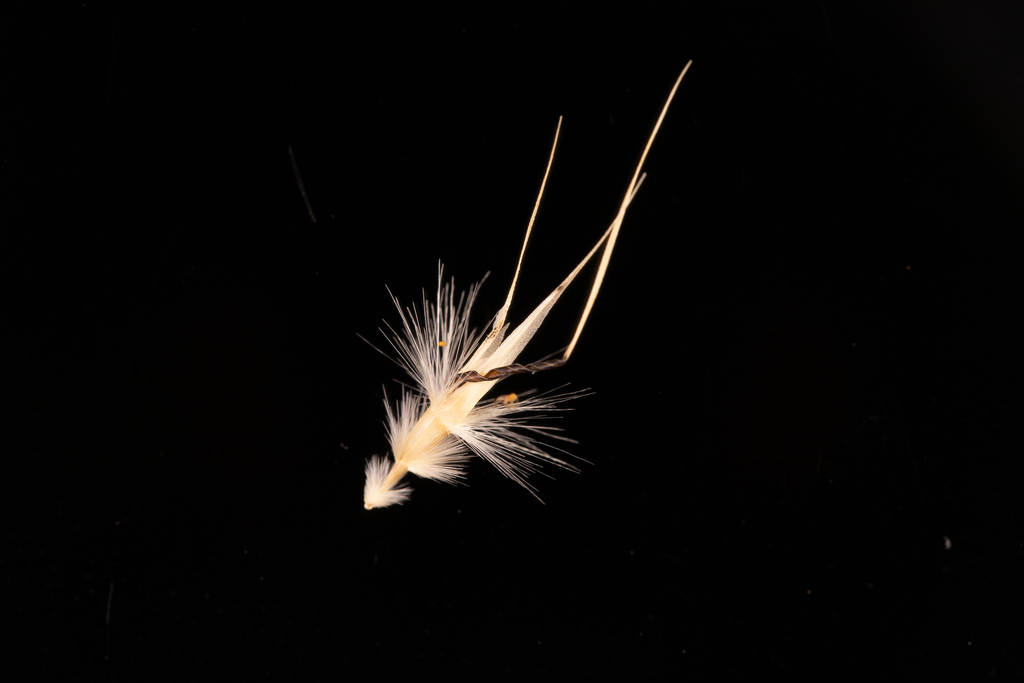
(c) Kym Nicolson, some rights reserved (CC BY), uploaded by Kym Nicolson · licence
Family: Poaceae · Type: Grass · Not Native
Conservation status: Cal-IPC Yes
Rytidosperma caespitosum (Tufted wallaby grass) is a non-native California grass in the Poaceae family, recognized by stem height, hair tuft density, and awn length.
Tufted wallaby grass is a naturalized perennial found in northern Coast Ranges and southern Southern California coastal areas in disturbed areas at elevations below 200 meters. Flowering from February to August, this grass produces pale flowers in compact clusters 5 to 10 centimeters long. Growing with stems 50 to 70 centimeters tall, occasionally developing short rhizomes, it forms dense tufted clumps. Its leaves are narrow, less than 17 centimeters long, either tightly rolled or slightly flattened, with dense marginal hair tufts. The grass develops distinctive twisted central awns 10 to 20 millimeters long with lateral lobes that taper to long, delicate extensions.
Identification and appearance
Key characters: 2 sympatric species; key features are stem height, hair tuft density, and awn length
Habitat and range
Habitat: Disturbed areas
Elevation: < 200 m
California counties: San Diego, San Mateo, Alameda
Outside California: native to Australia, naturalized in New Zealand
Bloom period
Rytidosperma caespitosum blooms Feb-Aug.
Conservation status
Cal-IPC Yes
How to tell it apart
vs Melica: Rytidosperma has banded hairs in rows on seeds; Melica has a club-shaped cluster of sterile florets at spikelet tip.; vs Aira: Rytidosperma has large seeds with banded hairs; Aira is tiny with smooth or uniformly hairy seeds.; vs Vahlodea: Rytidosperma has hairs in distinct transverse rows; Vahlodea has scattered hairs without banded pattern.; vs Deschampsia: Rytidosperma has seeds with horizontal hair bands; Deschampsia has hairy spikelet axis extensions, not banded seed hairs.; vs Trisetum: Rytidosperma has banded seed hairs; Trisetum has uniformly hairy seeds and conspicuous bent awns.
Frequently asked questions
Is Rytidosperma caespitosum native to California?
No. Rytidosperma caespitosum is not native to California (recorded as not native).
When does Rytidosperma caespitosum bloom?
Rytidosperma caespitosum blooms Feb-Aug.
Where in California does Rytidosperma caespitosum grow?
Rytidosperma caespitosum occurs in San Diego, San Mateo, Alameda, at elevations of < 200 m.
What plant family does Rytidosperma caespitosum belong to?
Rytidosperma caespitosum is in the Poaceae family, genus Rytidosperma.
Is Rytidosperma caespitosum invasive in California?
Rytidosperma caespitosum is listed by Cal-IPC with an invasiveness rating of Yes.
Related species
Other California species in the same genus, family, or bioregion.
Sources: Jepson eFlora · Index of California Plant Names · CalPhotos
Last updated 2026-10-07
Data from The California Species Project — 14,000+ California species with verified data from CNPS, CDFW, USFWS, Cal-IPC, and more.