Rytidosperma penicillatum
Hairy oat grass, poverty grass, Poverty Grass
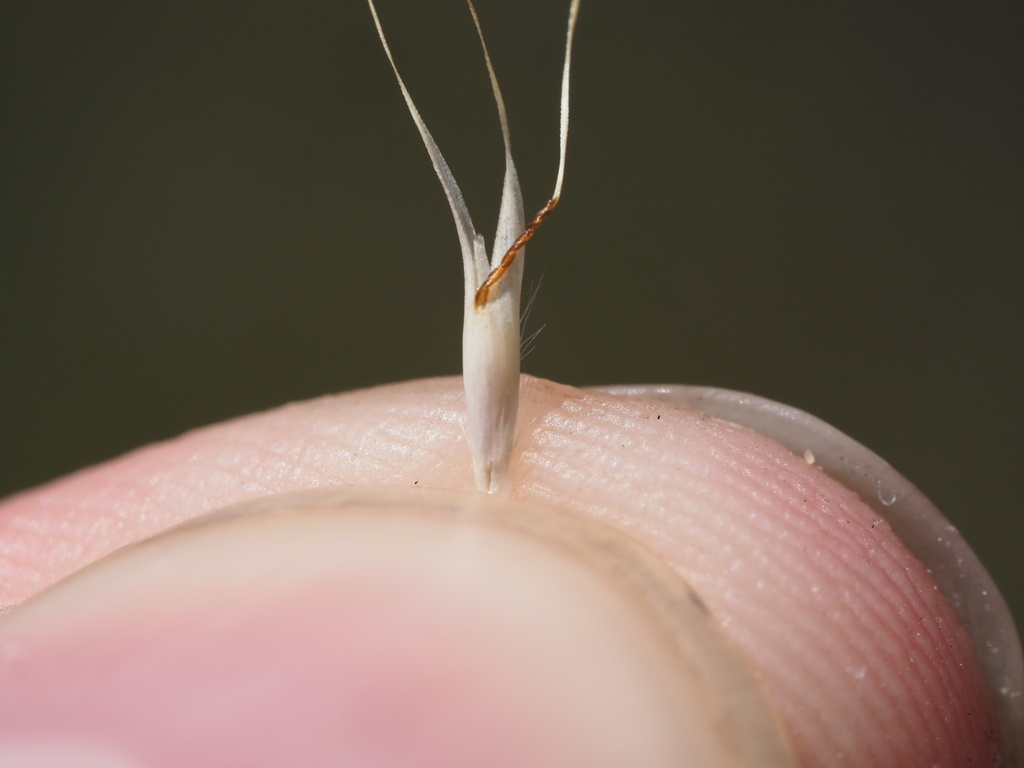
(c) Kevin Faccenda, some rights reserved (CC BY), uploaded by Kevin Faccenda · licence
Family: Poaceae · Type: Grass · Not Native
Conservation status: Cal-IPC Yes
Rytidosperma penicillatum (Hairy oat grass) is a non-native California grass in the Poaceae family, recognized by geographic range, elevation tolerance, and lobe tapering.
Hairy oat grass is a naturalized perennial found in coastal regions including Northern California Coast, Central Coast, and Western Transverse Ranges in the Santa Ynez Mountains at elevations below 800 meters in disturbed areas. Flowering from June to July, this grass produces pale green to straw-colored spikelets 10 to 15 millimeters long with delicate hair tufts. Growing with stems 30 to 90 centimeters tall and short rhizomes, it forms dense clumps with primarily basal leaves. Its leaves are flat or inrolled, generally less than 30 centimeters long, with distinctive marginal hair tufts that overlap the lemma base. The grass has an intricate inflorescence with lateral lobes 5 to 13 millimeters long and a central awn that reflexes to reveal the palea tip.
Identification and appearance
Key characters: 2 sympatric species; key features are geographic range, elevation tolerance, and lobe tapering
Habitat and range
Habitat: Disturbed areas
Elevation: < 800 m
California counties: Humboldt, Sonoma, Santa Barbara, Alameda, Marin, Mendocino, San Mateo, Santa Clara, Siskiyou
Outside California: to Oregon, Hawaii, native to Australia, naturalized in New Zealand
Bloom period
Rytidosperma penicillatum blooms Jun-Jul.
Conservation status
Cal-IPC Yes
How to tell it apart
vs Melica: Rytidosperma has banded hairs in rows on seeds; Melica has a club-shaped cluster of sterile florets at spikelet tip.; vs Aira: Rytidosperma has large seeds with banded hairs; Aira is tiny with smooth or uniformly hairy seeds.; vs Vahlodea: Rytidosperma has hairs in distinct transverse rows; Vahlodea has scattered hairs without banded pattern.; vs Deschampsia: Rytidosperma has seeds with horizontal hair bands; Deschampsia has hairy spikelet axis extensions, not banded seed hairs.; vs Trisetum: Rytidosperma has banded seed hairs; Trisetum has uniformly hairy seeds and conspicuous bent awns.
Frequently asked questions
Is Rytidosperma penicillatum native to California?
No. Rytidosperma penicillatum is not native to California (recorded as not native).
When does Rytidosperma penicillatum bloom?
Rytidosperma penicillatum blooms Jun-Jul.
Where in California does Rytidosperma penicillatum grow?
Rytidosperma penicillatum occurs in Humboldt, Sonoma, Santa Barbara, Alameda, Marin, Mendocino, San Mateo, Santa Clara and other counties, at elevations of < 800 m.
What plant family does Rytidosperma penicillatum belong to?
Rytidosperma penicillatum is in the Poaceae family, genus Rytidosperma.
Is Rytidosperma penicillatum invasive in California?
Rytidosperma penicillatum is listed by Cal-IPC with an invasiveness rating of Yes.
Related species
Other California species in the same genus, family, or bioregion.
Sources: Jepson eFlora · Index of California Plant Names · CalPhotos
Last updated 2026-10-07
Data from The California Species Project — 14,000+ California species with verified data from CNPS, CDFW, USFWS, Cal-IPC, and more.