Sabulina californica
California sandwort
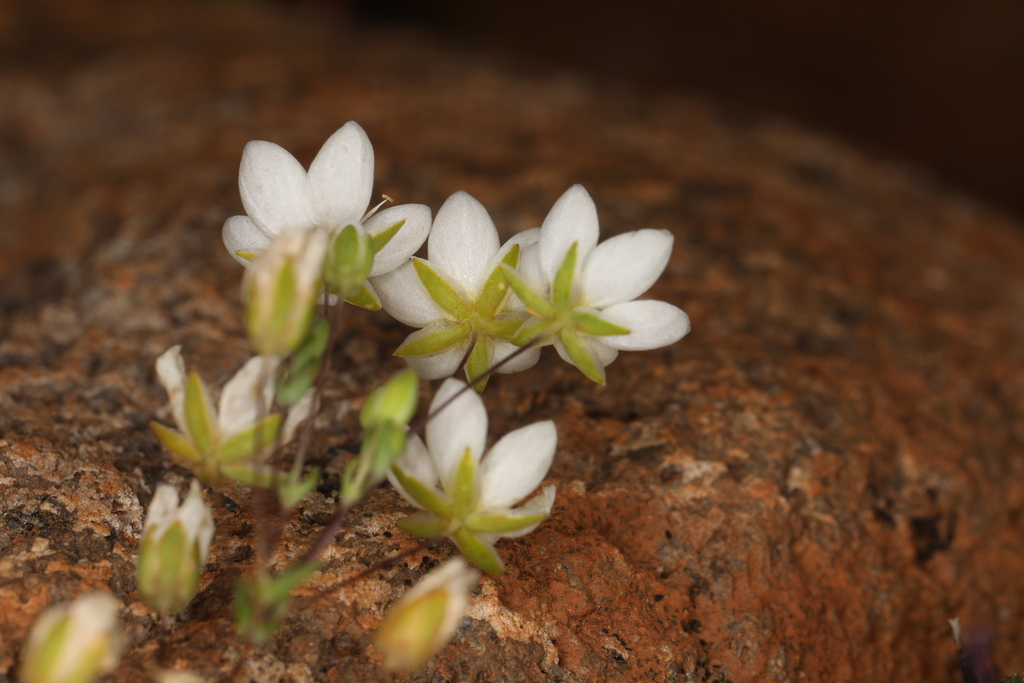
(c) Steve Matson, some rights reserved (CC BY) · licence
Family: Caryophyllaceae · Type: Herb · Native
Sabulina californica (California sandwort) is a native California herb in the Caryophyllaceae family, recognized by small petal-to-sepal ratio and annual habit.
California sandwort is a native annual found in northwestern California, the Cascade Range, Sierra Nevada, central Sierra Nevada, Sacramento Valley, and central western California in gravelly, sandy slopes, grassy ridges, and chaparral habitats at elevations below 1,500 meters. Flowering from spring to summer, this delicate plant produces small white flowers with petals slightly shorter than its broadly lanceolate sepals. Growing with widely spreading to erect stems 2 to 12 centimeters tall, it forms a slender, thread-like taproot with green, flexible stems. Its leaves are tiny and linear, measuring 2 to 5 millimeters long and less than 1.5 millimeters wide, arranged evenly along the stem without axillary leaves. The tiny seeds are reddish-brown, with a distinctively thick margin measuring just 0.4 to 0.5 millimeters long.
Identification and appearance
Key characters: 10 sympatric species; distinguished by small petal-to-sepal ratio and annual habit
Habitat and range
Habitat: Gravelly, sandy slopes, grassy ridges, chaparral, serpentine or not
Elevation: < 1500 m
California counties: Mendocino, Lake, Tulare, Orange, Butte, Fresno, Kern, Mariposa, Monterey, Napa, Placer, Sacramento, San Luis Obispo, Santa Cruz, Shasta, Sonoma, Sutter, Tehama, Yolo, El Dorado, Los Angeles, Alameda, Amador, Calaveras, Del Norte, Marin, Yuba, Nevada, San Francisco, San Mateo, Santa Clara, Stanislaus, Tuolumne, San Joaquin, Merced, Humboldt, Contra Costa, Solano, Trinity, Madera, Ventura
Outside California: southern Oregon
Bloom period
Sabulina californica blooms Spring-summer.
Frequently asked questions
Is Sabulina californica native to California?
Yes. Sabulina californica is native to California (recorded as native).
When does Sabulina californica bloom?
Sabulina californica blooms Spring-summer.
Where in California does Sabulina californica grow?
Sabulina californica occurs in Mendocino, Lake, Tulare, Orange, Butte, Fresno, Kern, Mariposa and other counties, at elevations of < 1500 m.
What plant family does Sabulina californica belong to?
Sabulina californica is in the Caryophyllaceae family, genus Sabulina.
What habitat does Sabulina californica grow in?
Sabulina californica grows in Gravelly, sandy slopes, grassy ridges, chaparral, serpentine or not.
Related species
Other California species in the same genus, family, or bioregion.
Sources: Jepson eFlora · CalPhotos
Last updated 2026-10-07
Data from The California Species Project — 14,000+ California species with verified data from CNPS, CDFW, USFWS, Cal-IPC, and more.