Sabulina cismontana
Cismontane minuartia
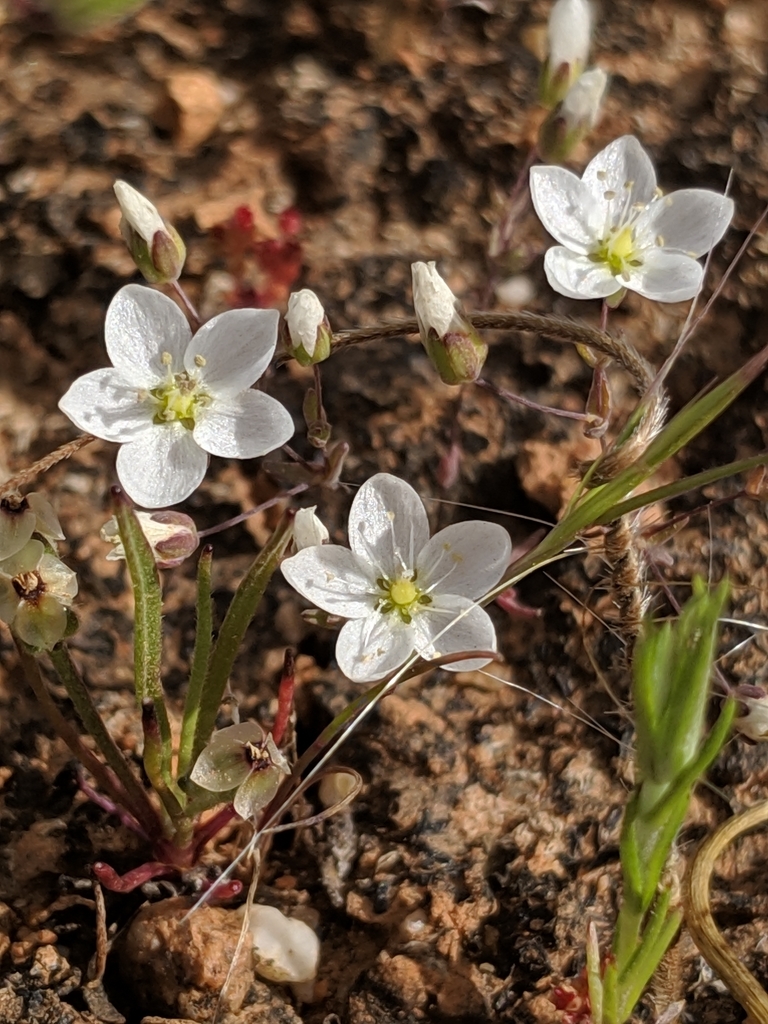
no rights reserved, uploaded by Alex Heyman · CC0
Family: Caryophyllaceae · Type: Herb · Native
Sabulina cismontana (Cismontane minuartia) is a native California herb in the Caryophyllaceae family, recognized by leaves longer than internodes plus annual habit.
Cismontane minuartia is a California native annual found in the Klamath Ranges, northern Coast Ranges, northern California Coast Ranges, eastern California, northern Sierra Nevada foothills, northern and central Sierra Nevada, San Joaquin Valley, and southern Coast Ranges in dry woodland and chaparral, often on serpentine soils at elevations of 400 to 1,700 meters. Flowering from spring to summer, this delicate plant produces small white flowers with lance-linear sepals and petals that are slightly shorter than the sepals. Growing 8 to 20 centimeters tall with widely spreading to erect green or red-purple stems, it forms a much-branched habit with a thread-like taproot. Its slender leaves are 2 to 7 millimeters long, narrow and flexible, ranging from lanceolate to linear, and sometimes slightly curved outward. The tiny brown to reddish seeds are less than 1 millimeter long with a thick margin.
Identification and appearance
Key characters: 9 sympatric species; key feature is leaves longer than internodes plus annual habit
Habitat and range
Habitat: dry woodland, chaparral, often serpentine
Elevation: (100)400-1700 m
Outside California: Oregon
Bloom period
Sabulina cismontana blooms Spring-summer.
Frequently asked questions
Is Sabulina cismontana native to California?
Yes. Sabulina cismontana is native to California (recorded as native).
When does Sabulina cismontana bloom?
Sabulina cismontana blooms Spring-summer.
What plant family does Sabulina cismontana belong to?
Sabulina cismontana is in the Caryophyllaceae family, genus Sabulina.
What habitat does Sabulina cismontana grow in?
Sabulina cismontana grows in dry woodland, chaparral, often serpentine.
Related species
Other California species in the same genus, family, or bioregion.
Sources: Jepson eFlora · CalPhotos
Last updated 2026-10-07
Data from The California Species Project — 14,000+ California species with verified data from CNPS, CDFW, USFWS, Cal-IPC, and more.