Sabulina decumbens
The lassics sandwort
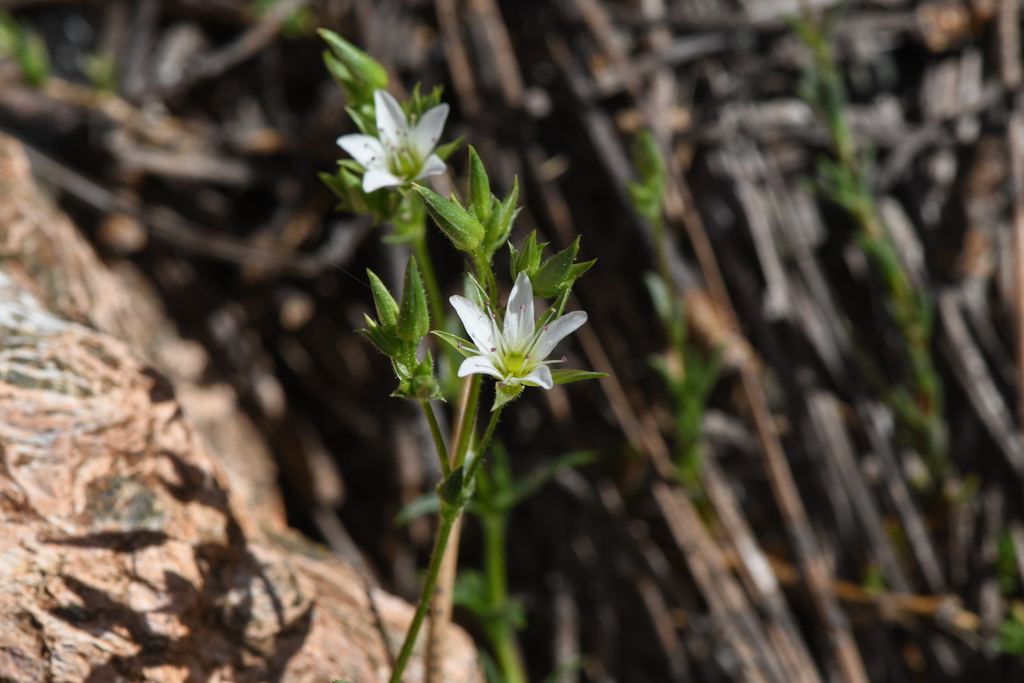
(c) Trevor Van Loon, some rights reserved (CC BY) · licence
Family: Caryophyllaceae · Type: Herb · Native
Conservation status: CNPS 1B.2
Sabulina decumbens (The lassics sandwort) is a native California herb in the Caryophyllaceae family, recognized by but very restricted range; endemic to specific location.
The lassics sandwort is a rare (CNPS 1B.2) California native perennial found in northern Coast Ranges in Jeffrey-pine forest on serpentine soils at elevations of 1,500 to 1,600 meters. Flowering from spring to summer, this plant produces white flowers with delicate petals slightly shorter than its sepals. Growing as a mat-forming herb with ascending stems 4 to 15 centimeters tall, it spreads through trailing stems up to 30 centimeters long. Its leaves are needle-like, rigid, and precisely spaced, measuring 3 to 6 millimeters long and less than 2 millimeters wide. The seeds are distinctive, with thick margins in a rich purple-brown color.
Identification and appearance
Key characters: 4 sympatric species but very restricted range; endemic to specific location
Habitat and range
Habitat: Serpentine soils in Jeffrey-pine forest
Elevation: 1500-1600 m
Bloom period
Sabulina decumbens blooms Spring-summer.
Conservation status
CNPS 1B.2
Frequently asked questions
Is Sabulina decumbens native to California?
Yes. Sabulina decumbens is native to California (recorded as native).
When does Sabulina decumbens bloom?
Sabulina decumbens blooms Spring-summer.
What plant family does Sabulina decumbens belong to?
Sabulina decumbens is in the Caryophyllaceae family, genus Sabulina.
Is Sabulina decumbens rare or endangered?
Sabulina decumbens carries California Rare Plant Rank 1B.2, state rank S1.
What habitat does Sabulina decumbens grow in?
Sabulina decumbens grows in Serpentine soils in Jeffrey-pine forest.
Related species
Other California species in the same genus, family, or bioregion.
Sources: Jepson eFlora · CalPhotos · CDFW CNDDB
Last updated 2026-10-07
Data from The California Species Project — 14,000+ California species with verified data from CNPS, CDFW, USFWS, Cal-IPC, and more.