Saccharum ravennae
Ravenna grass, Ravenna Grass
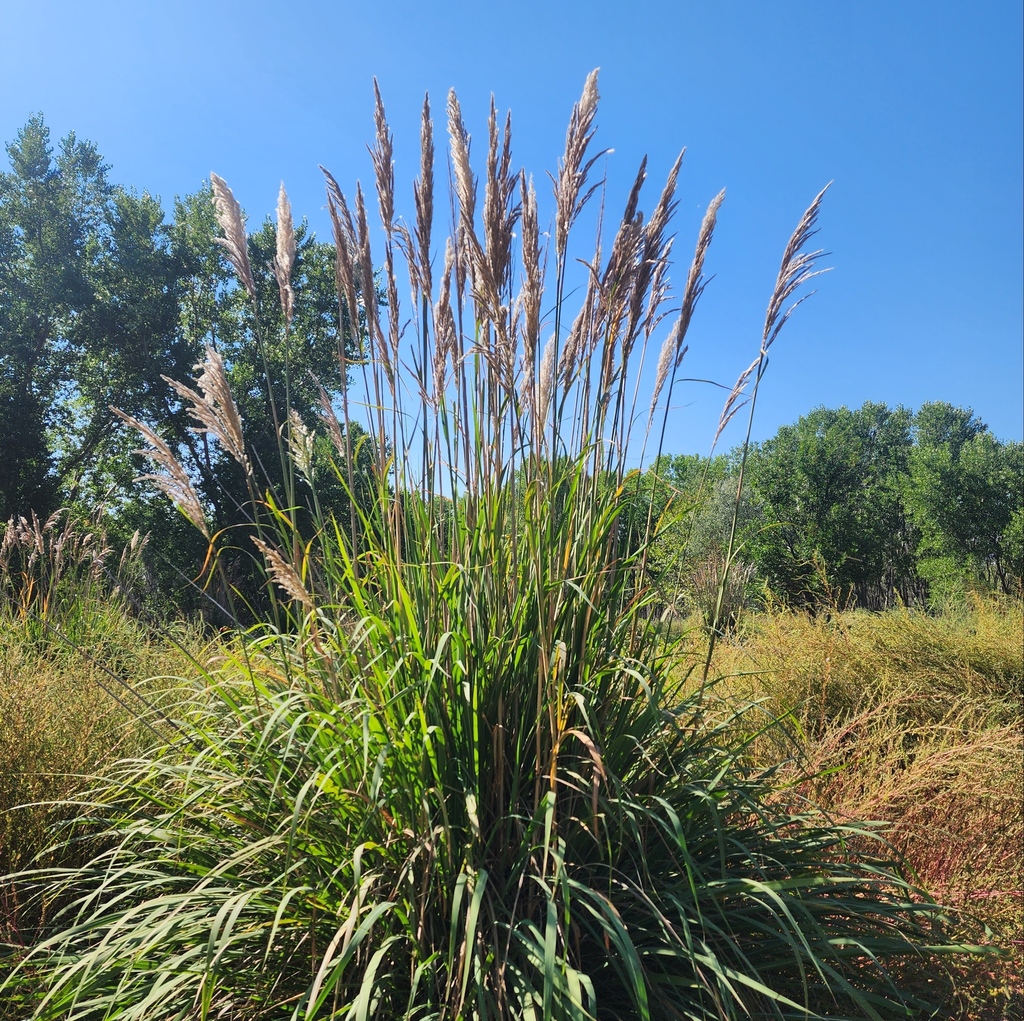
(c) Lyrae, some rights reserved (CC BY) · licence
Family: Poaceae · Type: Grass · Not Native
Conservation status: Cal-IPC Yes
Saccharum ravennae (Ravenna grass) is a non-native California grass in the Poaceae family, recognized by Only Saccharum species in California, representing a genus best known for sugar cane.
Ravenna grass is a naturalized perennial grass found in the northern California Coast Ranges, Central Valley, and southern desert regions of Imperial County in low-elevation ditch banks and marshes below 300 meters. Flowering from July to September, this grass produces feathery plume-like inflorescences 2.5 to 6 decimeters long with spikelets densely covered in silky hairs. Growing in dense tufts 2 to 4 meters tall with strongly serrated leaves, the grass forms impressive clumps with blade-like foliage. Its leaves are narrow, typically 5 to 10 decimeters long and less than 12 millimeters wide, with dense hairs near the base and a tiny ligule less than 1 millimeter long. The grass produces delicate spikelets 3.5 to 7 millimeters long with lance-shaped glumes and awned lemmas 3 to 5 millimeters in length.
Identification and appearance
Key characters: Only Saccharum species in California, representing a genus best known for sugar cane
Habitat and range
Habitat: Ditch banks, marshes
Elevation: < 300 m
California counties: Imperial, Fresno, Yolo, Colusa, Sutter, Napa, Lake, Sacramento
Outside California: scattered across United States, native to Eurasia
Bloom period
Saccharum ravennae blooms Jul-Sep.
Conservation status
Cal-IPC Yes
How to tell it apart
vs Arundo: Saccharum has solid stems and paired spikelets; Arundo has hollow stems and single spikelets.; vs Phyllostachys: Saccharum has solid unbranched stems with plumes; Phyllostachys has woody branching bamboo structure.; vs Cortaderia: Saccharum has paired spikelets and solid stems; Cortaderia has single spikelets and hollow stems.; vs Phragmites: Saccharum has solid stems with paired spikelets; Phragmites has hollow stems with single spikelets.; vs Imperata: Saccharum has paired spikelets breaking apart at maturity; Imperata has paired spikelets staying intact.
Frequently asked questions
Is Saccharum ravennae native to California?
No. Saccharum ravennae is not native to California (recorded as not native).
When does Saccharum ravennae bloom?
Saccharum ravennae blooms Jul-Sep.
Where in California does Saccharum ravennae grow?
Saccharum ravennae occurs in Imperial, Fresno, Yolo, Colusa, Sutter, Napa, Lake, Sacramento, at elevations of < 300 m.
What plant family does Saccharum ravennae belong to?
Saccharum ravennae is in the Poaceae family, genus Saccharum.
Is Saccharum ravennae invasive in California?
Saccharum ravennae is listed by Cal-IPC with an invasiveness rating of Yes.
Related species
Other California species in the same genus, family, or bioregion.
Sources: Jepson eFlora · Index of California Plant Names · CalPhotos
Last updated 2026-10-07
Data from The California Species Project — 14,000+ California species with verified data from CNPS, CDFW, USFWS, Cal-IPC, and more.