Sagina saginoides
Arctic pearlwort, Arctic Pearlwort
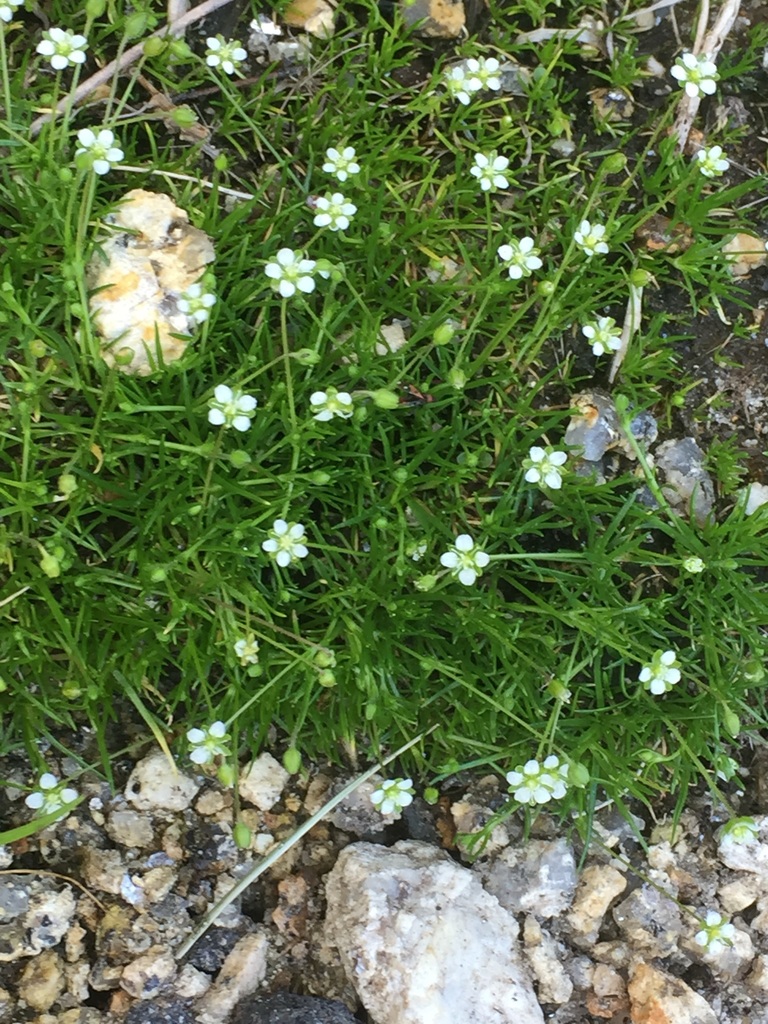
(c) Andre Hosper, some rights reserved (CC BY), uploaded by Andre Hosper · licence
Family: Caryophyllaceae · Type: Herb · Native
Sagina saginoides (Arctic pearlwort) is a native California herb in the Caryophyllaceae family, recognized by high elevation range and 5 petals with 10 stamens.
Arctic pearlwort is a California native perennial found in the Klamath Ranges, northern California Coast Ranges, Sierra Nevada, Transverse Ranges, Peninsular Ranges, and Great Basin in moist banks, streamsides, and dry creeks at elevations of 1,000 to 3,800 meters. Flowering from May to September, this delicate plant produces small white flowers on thread-like pedicels that curve gracefully during blooming. Growing with slender, ascending or decumbent stems 2 to 12 centimeters tall, it forms distinctive sterile basal rosettes that spread close to the ground. Its leaves are narrow and linear, measuring 5 to 15 millimeters long, creating a fine, delicate texture across moist ground surfaces. The tiny seeds are brown, with a subtle grooved back, measuring just 0.2 to 0.4 millimeters in size.
Identification and appearance
Key characters: 2 sympatric species; key features are high elevation range and 5 petals with 10 stamens
Habitat and range
Habitat: Moist banks, streamsides, dry creeks
Elevation: (100)1000-3800 m
California counties: San Bernardino, Mono, Butte, Alpine, Amador, Calaveras, Fresno, Inyo, Kern, Los Angeles, Madera, Mariposa, Modoc, Nevada, Orange, Plumas, Riverside, Siskiyou, Tehama, Trinity, Tulare, Tuolumne, Ventura, Placer, Shasta, Yuba, Sierra, Mendocino, Lassen, Glenn, Lake, El Dorado, Humboldt, Del Norte, Colusa
Outside California: to Alaska, Montana, Wyoming, New Mexico, Mexico, circumboreal
Bloom period
Sagina saginoides blooms May-Sep.
How to tell it apart
vs Erigeron: Sagina forms moss-like mats with thread leaves; Erigeron has narrow but broader leaves and daisy-like flowers.; vs Sabulina: Sagina has extremely thread-like leaves forming dense mats; Sabulina has slightly wider, less moss-like leaves.; vs Soliva: Sagina forms green moss-like mats with tiny white flowers; Soliva forms flattened rosettes with no petals.; vs Spergula: Sagina has thread-like leaves in pairs; Spergula has leaves in whorls around the stem.; vs Holosteum: Sagina has tiny scattered flowers in loose clusters; Holosteum has umbrella-shaped flower clusters.
Frequently asked questions
Is Sagina saginoides native to California?
Yes. Sagina saginoides is native to California (recorded as native).
When does Sagina saginoides bloom?
Sagina saginoides blooms May-Sep.
Where in California does Sagina saginoides grow?
Sagina saginoides occurs in San Bernardino, Mono, Butte, Alpine, Amador, Calaveras, Fresno, Inyo and other counties, at elevations of (100)1000-3800 m.
What plant family does Sagina saginoides belong to?
Sagina saginoides is in the Caryophyllaceae family, genus Sagina.
What habitat does Sagina saginoides grow in?
Sagina saginoides grows in Moist banks, streamsides, dry creeks.
Related species
Other California species in the same genus, family, or bioregion.
Sources: Jepson eFlora · Index of California Plant Names · CalPhotos
Last updated 2026-10-07
Data from The California Species Project — 14,000+ California species with verified data from CNPS, CDFW, USFWS, Cal-IPC, and more.