Salix brachycarpa var. brachycarpa
Short-fruited willow
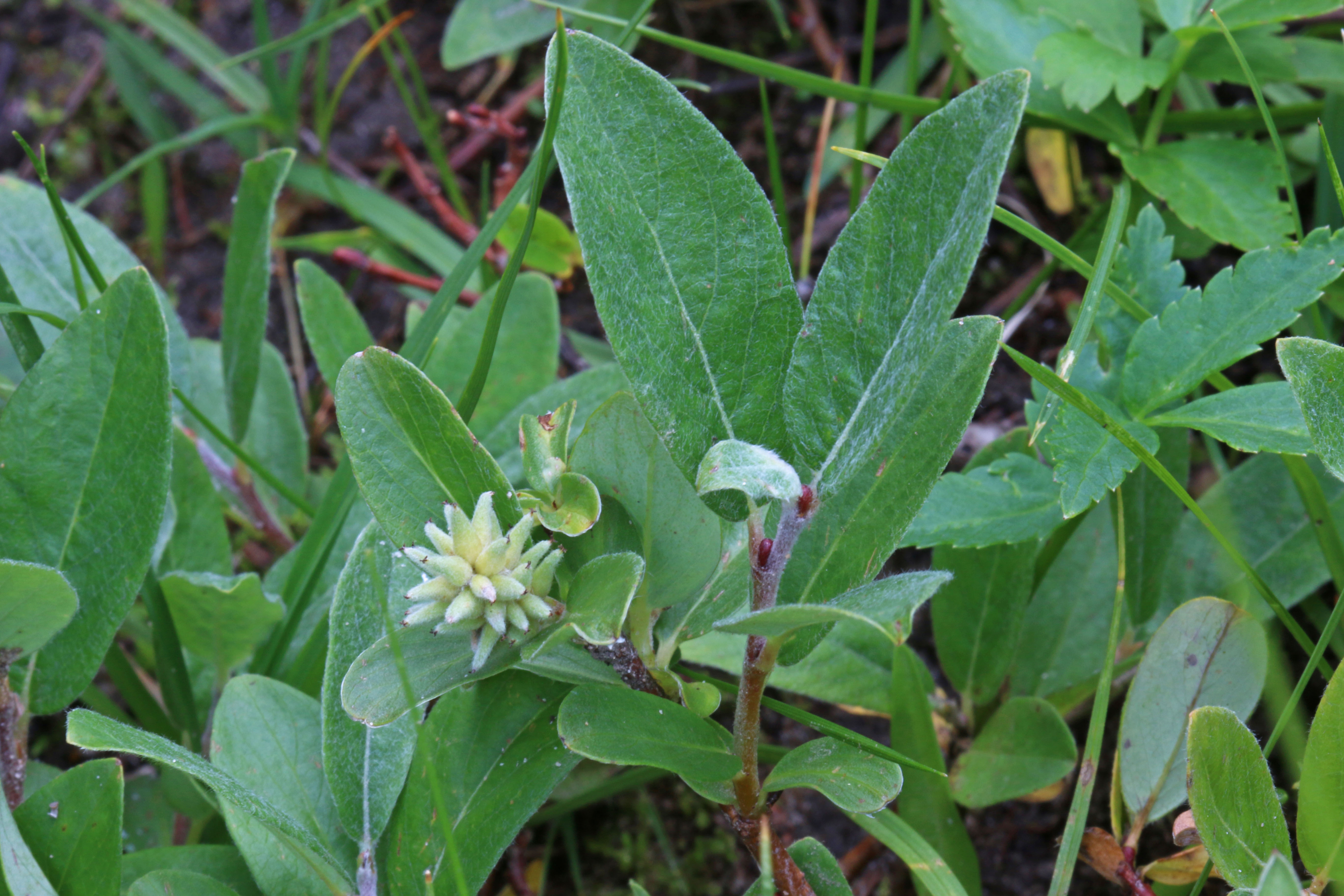
Andrey Zharkikh from Salt Lake City, USA (via Wikimedia Commons) · CC BY
Family: Salicaceae · Type: Shrub · Native
Conservation status: CNPS 2B.3
Salix brachycarpa var. brachycarpa (Short-fruited willow) is a native California shrub in the Salicaceae family, recognized by very low stature and woolly ovary distinctive.
Short-fruited willow is a rare (CNPS 2B.3) California native shrub found in central Sierra Nevada Mountains (eastern slope, Mono County) in subalpine limestone meadows at elevations of 3,200 to 3,500 meters. Flowering from June to August, this shrub produces delicate flowers in dense, spheric clusters on leafy shoots. Growing to less than 0.5 meters tall with distinctive red-brown twigs that become glabrous with age, it develops silky young stems that mature to smooth branches. Its leaves are approximately elliptic, 10 to 20 millimeters long with dense, soft, fine hairs on the underside and convex bases. Its ovaries are densely woolly, with small nectaries and short styles measuring 0.5 to 1.5 millimeters long.
Identification and appearance
Key characters: 18 sympatric species; very low stature and woolly ovary distinctive
Habitat and range
Habitat: Subalpine meadows (especially on limestone)
Elevation: 3200-3500 m
Outside California: to northern and eastern Canada, Colorado
Bloom period
Salix brachycarpa var. brachycarpa blooms Jun-Aug.
Conservation status
CNPS 2B.3
How to tell it apart
vs Umbellularia: Willows have narrow leaves with no scent; crush bay laurel leaf for intense spicy aroma.; vs Baccharis: Willows have catkins; baccharis has fuzzy white seed heads and resinous stems.; vs Acacia: Willow leaves have one central vein; acacia leaves are compound with many small leaflets or modified into flat phyllodes.; vs Quercus: Willows have narrow flexible leaves; oaks have broader stiff leaves and produce acorns.; vs Schinus: Willow leaves are simple; pepper tree has compound leaves with 15-40 leaflets and peppery-scented crushed foliage.
Frequently asked questions
Is Salix brachycarpa var. brachycarpa native to California?
Yes. Salix brachycarpa var. brachycarpa is native to California (recorded as native).
When does Salix brachycarpa var. brachycarpa bloom?
Salix brachycarpa var. brachycarpa blooms Jun-Aug.
What plant family does Salix brachycarpa var. brachycarpa belong to?
Salix brachycarpa var. brachycarpa is in the Salicaceae family, genus Salix.
Is Salix brachycarpa var. brachycarpa rare or endangered?
Salix brachycarpa var. brachycarpa carries California Rare Plant Rank 2B.3, state rank S2.
What habitat does Salix brachycarpa var. brachycarpa grow in?
Salix brachycarpa var. brachycarpa grows in Subalpine meadows (especially on limestone).
Related species
Other California species in the same genus, family, or bioregion.
Sources: Jepson eFlora · CalPhotos · CDFW CNDDB
Last updated 2026-10-07
Data from The California Species Project — 14,000+ California species with verified data from CNPS, CDFW, USFWS, Cal-IPC, and more.