Salix lutea
Yellow willow
no rights reserved · CC0
Family: Salicaceae · Type: Shrub / Tree · Native
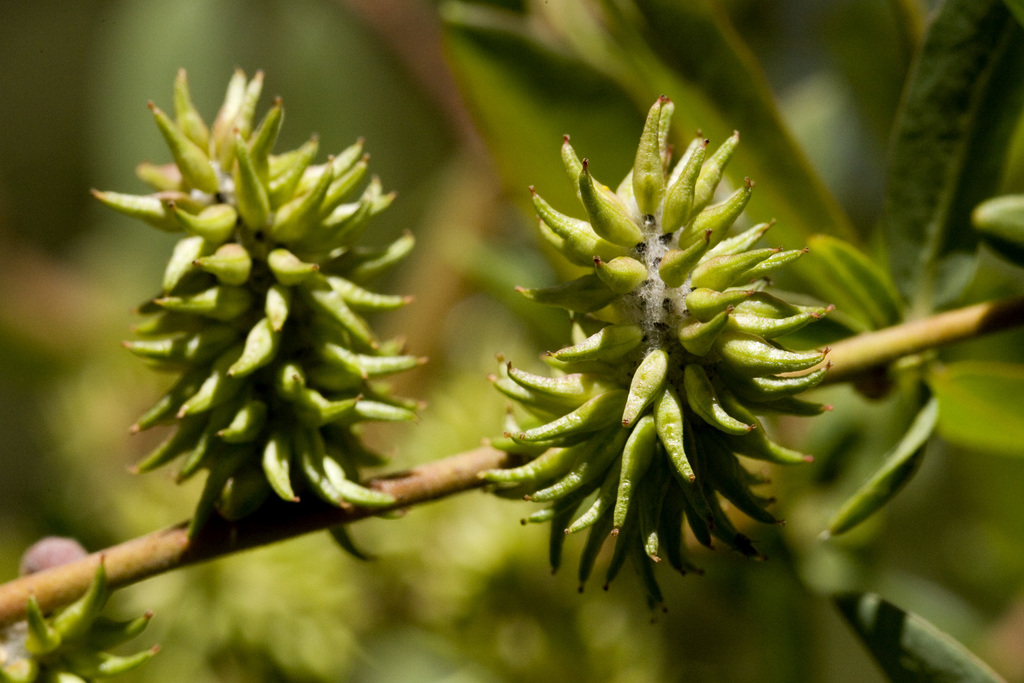
Salix lutea (Yellow willow) is a native California shrub / tree in the Salicaceae family, recognized by pale bracts with curly hairs and glabrous ovary key.
Yellow willow is a California native shrub found in central and eastern Sierra Nevada, San Bernardino Mountains, San Jacinto Mountains, Great Basin, and western Mojave Desert on river and creek margins, wet meadows at elevations of 640 to 3,100 meters. Flowering from March to May, this plant produces yellow-tinged catkins on leafy shoots, emerging just before or with the plant's leaves. Growing up to 7 meters tall with yellow-gray or yellow-brown twigs, it has a distinctive shrubby form with spreading branches. Its leaves are strap-shaped to elliptic, 42 to 90 millimeters long, with slightly serrated edges and soft, shaggy undersides that range from glabrous to silky in texture. The shrub bears distinctive leaf-like stipules and produces separate male and female flowers with two stamens in the male blossoms.
Identification and appearance
Key characters: 18 sympatric species; pale bracts with curly hairs and glabrous ovary key
Habitat and range
Habitat: River, creek margins, wet meadows
Elevation: 640-3100 m
California counties: San Bernardino, Mono, Tulare, Inyo, Kern, Modoc, El Dorado, Nevada, Riverside, Mariposa, Madera, Humboldt, Alpine, Marin, Plumas, Glenn, Butte, Lassen, Monterey
Outside California: to Oregon, Montana, Wyoming, Arizona
Bloom period
Salix lutea blooms Mar-May.
How to tell it apart
vs Umbellularia: Willows have narrow leaves with no scent; crush bay laurel leaf for intense spicy aroma.; vs Baccharis: Willows have catkins; baccharis has fuzzy white seed heads and resinous stems.; vs Acacia: Willow leaves have one central vein; acacia leaves are compound with many small leaflets or modified into flat phyllodes.; vs Quercus: Willows have narrow flexible leaves; oaks have broader stiff leaves and produce acorns.; vs Schinus: Willow leaves are simple; pepper tree has compound leaves with 15-40 leaflets and peppery-scented crushed foliage.
Frequently asked questions
Is Salix lutea native to California?
Yes. Salix lutea is native to California (recorded as native).
When does Salix lutea bloom?
Salix lutea blooms Mar-May.
Where in California does Salix lutea grow?
Salix lutea occurs in San Bernardino, Mono, Tulare, Inyo, Kern, Modoc, El Dorado, Nevada and other counties, at elevations of 640-3100 m.
What plant family does Salix lutea belong to?
Salix lutea is in the Salicaceae family, genus Salix.
What habitat does Salix lutea grow in?
Salix lutea grows in River, creek margins, wet meadows.
Related species
Other California species in the same genus, family, or bioregion.
Sources: Jepson eFlora · Index of California Plant Names · CalPhotos
Last updated 2026-10-07
Data from The California Species Project — 14,000+ California species with verified data from CNPS, CDFW, USFWS, Cal-IPC, and more.