Salpichroa origanifolia
Lily-of-the-valley vine, cock's eggs
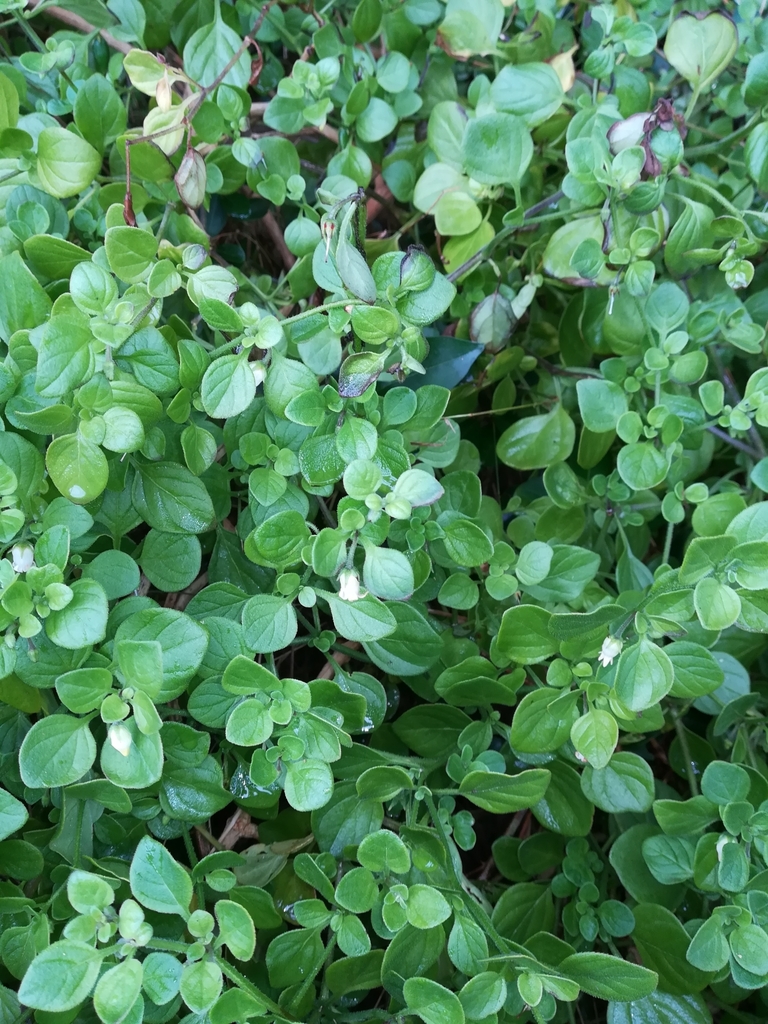
(c) Julien Renoult, some rights reserved (CC BY), uploaded by Julien Renoult · licence
Family: Solanaceae · Type: Vine · Not Native
Conservation status: Cal-IPC Yes
Salpichroa origanifolia (Lily-of-the-valley vine) is a non-native California vine in the Solanaceae family, recognized by Only Salpichroa species in California, representing a South American genus in the nightshade family.
Lily-of-the-valley vine is a naturalized perennial found in the northern California Coast, western Central Western California, and southern California Coast regions in disturbed places, brushy sites, and riparian areas at elevations below 400 meters. Flowering from July to October, this plant produces white to greenish nodding flowers 3.5 to 10 millimeters long with a distinctive brick-red disk and a densely woolly inner ring. Growing as a decumbent to climbing vine up to 2 meters tall with densely puberulent stems, it spreads with a flexible habit. Its leaves are widely elliptic to ovate, 10 to 40 millimeters long with a 5 to 10 millimeter petiole, creating a soft green backdrop for the delicate flowers. The fruit is a white to pale yellow, somewhat translucent ovoid berry 10 to 15 millimeters long with a notably ill-smelling characteristic.
Identification and appearance
Key characters: Only Salpichroa species in California, representing a South American genus in the nightshade family
Habitat and range
Habitat: Disturbed places, brushy sites, riparian areas
Elevation: < 400 m
Outside California: to Texas, northern Mexico, Europe, Africa, Australia, native to South America
Bloom period
Salpichroa origanifolia blooms Jul-Oct.
Conservation status
Cal-IPC Yes
How to tell it apart
vs Solanum: Salpichroa is a trailing vine with urn flowers; Solanum is typically upright with star flowers and yellow anther cone.; vs Cestrum: Salpichroa trails or climbs; Cestrum is an erect shrub.; vs Lycium: Salpichroa is a thornless vine; Lycium is a thorny upright shrub.; vs Chamaesaracha: Salpichroa is a climbing vine; Chamaesaracha is a low spreading herb with flat star flowers.; vs Physalis: Salpichroa has urn-shaped flowers on a vine; Physalis has open flowers and papery lantern around fruit.
Frequently asked questions
Is Salpichroa origanifolia native to California?
No. Salpichroa origanifolia is not native to California (recorded as not native).
When does Salpichroa origanifolia bloom?
Salpichroa origanifolia blooms Jul-Oct.
What plant family does Salpichroa origanifolia belong to?
Salpichroa origanifolia is in the Solanaceae family, genus Salpichroa.
Is Salpichroa origanifolia invasive in California?
Salpichroa origanifolia is listed by Cal-IPC with an invasiveness rating of Yes.
What habitat does Salpichroa origanifolia grow in?
Salpichroa origanifolia grows in Disturbed places, brushy sites, riparian areas.
Related species
Other California species in the same genus, family, or bioregion.
Sources: Jepson eFlora · CalPhotos
Last updated 2026-10-07
Data from The California Species Project — 14,000+ California species with verified data from CNPS, CDFW, USFWS, Cal-IPC, and more.