Salsola paulsenii
Barbwire russian thistle
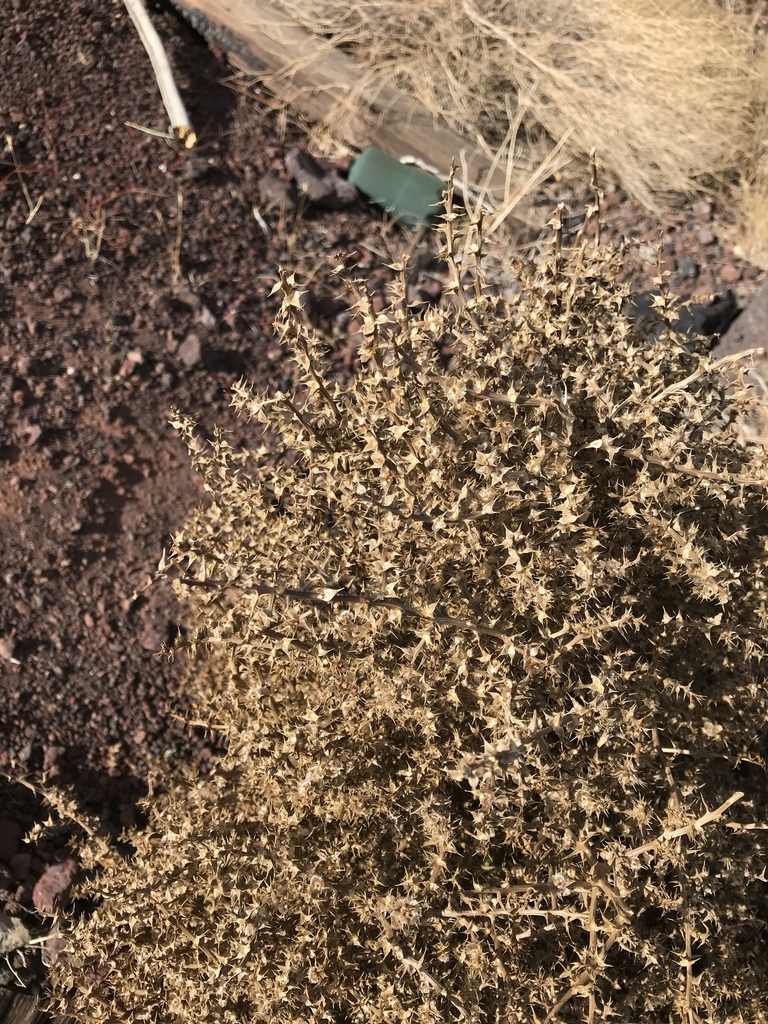
(c) Emily Chebul, some rights reserved (CC BY-SA) · licence
Family: Chenopodiaceae · Type: Herb · Not Native
Conservation status: Cal-IPC Yes
Salsola paulsenii (Barbwire russian thistle) is a non-native California herb in the Chenopodiaceae family, recognized by variable wing number (3-5), spiny sepal tips.
Barbwire russian thistle is a naturalized annual found in northern Transverse Ranges in the southeastern Cuyama Valley and desert regions at elevations below 1,000 meters in sandy, disturbed places. Flowering from July to October, this plant produces white to translucent flowers with spiny margins in cylindric inflorescences. Growing up to 1.5 meters tall with a cone-like shape, it develops branched stems that are longitudinally ribbed and occasionally red-striped. Its leaves transition from opposite to alternate, becoming leathery and yellow-green with a wider base, ranging from 5 to 32 millimeters long. The fruit develops distinctive translucent wings, with 3 to 5 wings that have pale veins and yellow to pink-spotted bases.
Identification and appearance
Key characters: 3 sympatric species; key features are variable wing number (3-5), spiny sepal tips
Habitat and range
Habitat: Common. Sandy, disturbed places
Elevation: < 1000 m
California counties: Inyo, Riverside, Kern, San Bernardino, Imperial, Mono, Modoc, Lassen, Los Angeles, Santa Barbara, Ventura, San Diego, Plumas
Outside California: to Utah, native to southeastern Europe, central Asia
Bloom period
Salsola paulsenii blooms Jul-Oct.
Conservation status
Cal-IPC Yes
How to tell it apart
vs Suaeda: Salsola leaves taper to sharp spine tips; Suaeda leaves have soft rounded tips.; vs Amaranthus: Salsola has spine-tipped thread-like leaves; Amaranthus has broad soft leaves without spines.; vs Artemisia: Salsola has spine-tipped succulent leaves; Artemisia has soft, aromatic, often divided gray leaves.; vs Dittrichia: Salsola has spine-tipped cylindrical leaves; Dittrichia has soft sticky leaves and yellow daisy flowers.; vs Eriogonum: Salsola has spine-tipped thread-like leaves; Eriogonum has soft leaves clustered at base with woolly undersides.
Frequently asked questions
Is Salsola paulsenii native to California?
No. Salsola paulsenii is not native to California (recorded as not native).
When does Salsola paulsenii bloom?
Salsola paulsenii blooms Jul-Oct.
Where in California does Salsola paulsenii grow?
Salsola paulsenii occurs in Inyo, Riverside, Kern, San Bernardino, Imperial, Mono, Modoc, Lassen and other counties, at elevations of < 1000 m.
What plant family does Salsola paulsenii belong to?
Salsola paulsenii is in the Chenopodiaceae family, genus Salsola.
Is Salsola paulsenii invasive in California?
Salsola paulsenii is listed by Cal-IPC with an invasiveness rating of Yes.
Related species
Other California species in the same genus, family, or bioregion.
Sources: Jepson eFlora · Index of California Plant Names · CalPhotos
Last updated 2026-10-07
Data from The California Species Project — 14,000+ California species with verified data from CNPS, CDFW, USFWS, Cal-IPC, and more.