Salvia funerea
Death valley sage, Death Valley Sage
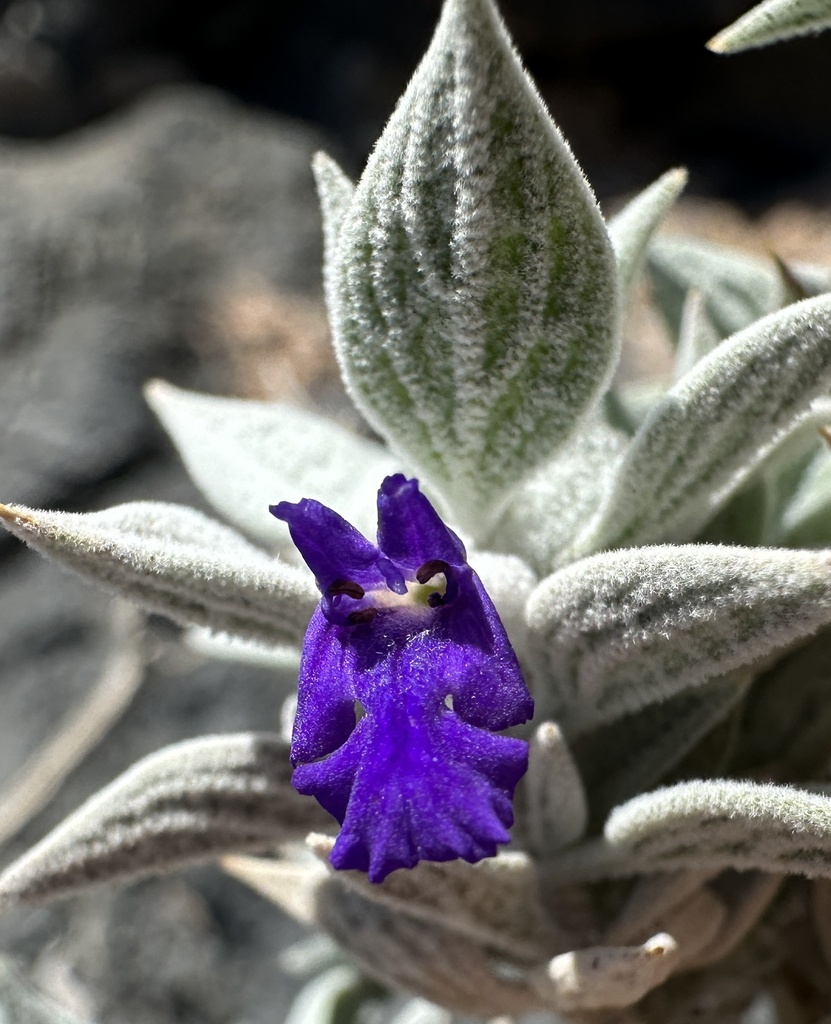
(c) Matt Berger, some rights reserved (CC BY), uploaded by Matt Berger · licence
Family: Lamiaceae · Type: Shrub · Native
Conservation status: CNPS 4.3
Salvia funerea (Death valley sage) is a native California shrub in the Lamiaceae family, recognized by distinctive spiny leaves and dense branching.
Death valley sage is a California native shrub ranked 4.3 by CNPS, found in the northeastern Death Valley, Amargosa and Panamint ranges in dry washes and canyons at elevations below 1,700 meters. Flowering from March to June, this plant produces violet to blue flowers in small clusters of three, with a corolla tube 12 to 16 millimeters long. Growing 50 to 120 centimeters tall with densely branched, white-woolly stems, it forms a compact and textured shrub. Its leaves are short-petioled, approximately ovate, with occasional spines at the leaf tip, typically 9 to 20 millimeters long and often deciduous. The small brown fruits are approximately 3 millimeters long, contributing to the plant's delicate structural appearance.
Identification and appearance
Key characters: Geographically isolated; distinctive spiny leaves and dense branching
Habitat and range
Habitat: dry washes and canyons
Elevation: < 1700 m
California counties: San Bernardino, Inyo
Bloom period
Salvia funerea blooms Mar-Jun.
Conservation status
CNPS 4.3
How to tell it apart
vs Gambelia: Salvia has opposite leaves and square stems (mint family), while Gambelia has alternate leaves.; vs Encelia: Salvia has tubular two-lipped flowers, while Encelia has yellow daisy-like flower heads.; vs Artemisia: Salvia has showy tubular flowers, while Artemisia has tiny inconspicuous flowers in narrow spikes.; vs Trichostema: Salvia has flowers in interrupted whorls, while Trichostema has long curved stamens protruding from flowers.; vs Stachys: Salvia typically has grayish aromatic leaves, while Stachys has green wrinkled leaves and denser flower spikes.
Frequently asked questions
Is Salvia funerea native to California?
Yes. Salvia funerea is native to California (recorded as native).
When does Salvia funerea bloom?
Salvia funerea blooms Mar-Jun.
Where in California does Salvia funerea grow?
Salvia funerea occurs in San Bernardino, Inyo, at elevations of < 1700 m.
What plant family does Salvia funerea belong to?
Salvia funerea is in the Lamiaceae family, genus Salvia.
Is Salvia funerea rare or endangered?
Salvia funerea carries California Rare Plant Rank 4.3, state rank S4.
Related species
Other California species in the same genus, family, or bioregion.
Sources: Jepson eFlora · CNPS Rare Plant Inventory · Index of California Plant Names · CalPhotos · CDFW CNDDB
Last updated 2026-10-07
Data from The California Species Project — 14,000+ California species with verified data from CNPS, CDFW, USFWS, Cal-IPC, and more.