Sambucus mexicana
Blue elderberry, Blue Elderberry
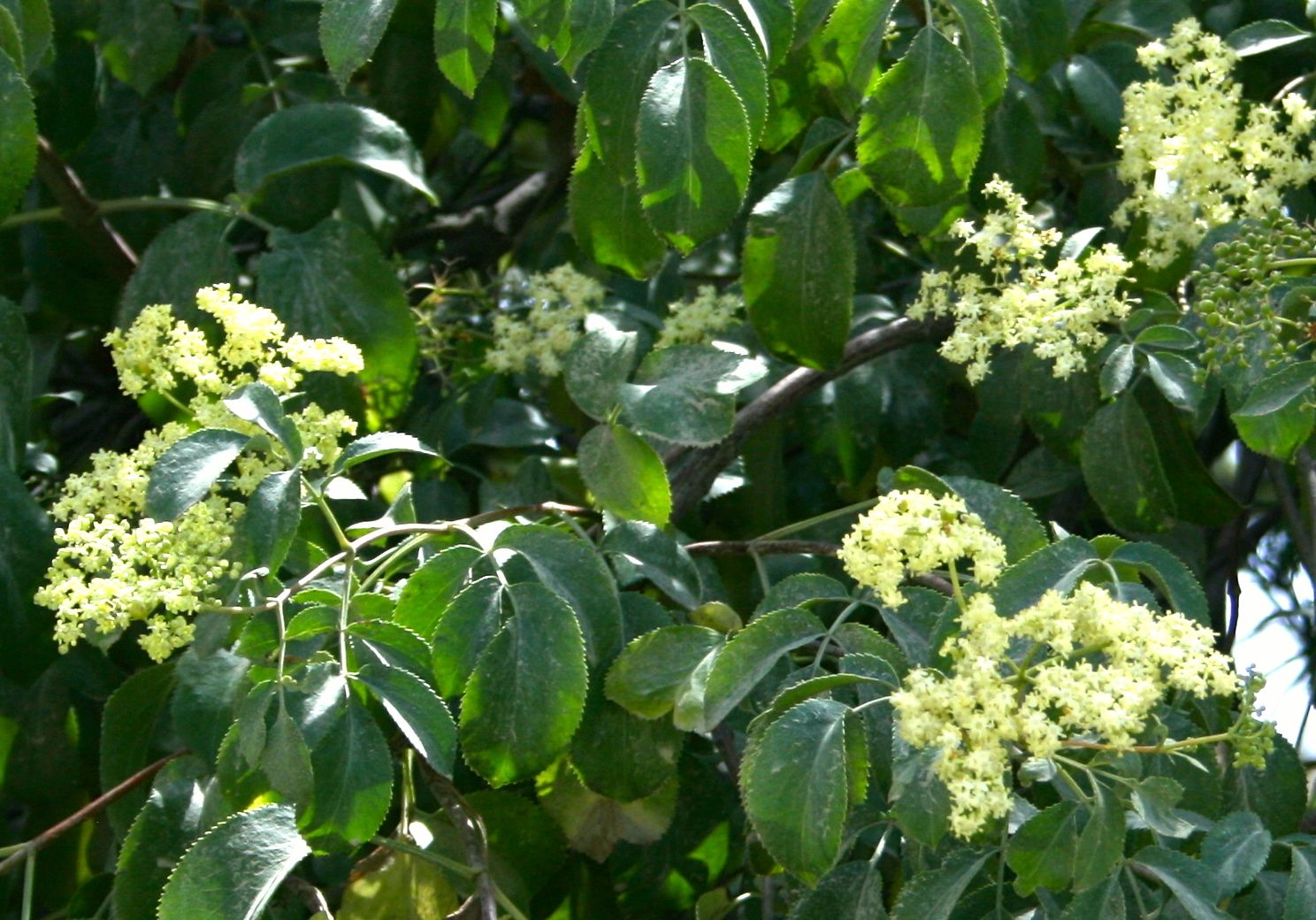
Photo by Chez Brungraber
Family: Viburnaceae · Type: Shrub · Native
Sambucus mexicana (Blue elderberry) is a native California shrub in the Viburnaceae family, recognized by flat vs dome-shaped inflorescence, glaucous blue-black vs red/purple-black fruit.
Blue elderberry is a California native shrub found in the Central California Floristic Province, Great Basin, and Desert Mountains in streambanks and open forest places at elevations to 3,000 meters. Flowering from March to September, this plant produces creamy white flowers in broad, flat-topped clusters up to 33 centimeters wide. Growing as a substantial shrub 2 to 8 meters tall and equally wide, it develops with multiple spreading branches. Its compound leaves have 3 to 9 elliptic to ovate leaflets 3 to 20 centimeters long, with asymmetric bases and acute tips. The fruit develops as a distinctive dark blue-black berry densely covered in white waxy coating, giving it a bluish appearance.
Identification and appearance
Key characters: 2 sympatric species; distinguished by flat vs dome-shaped inflorescence, glaucous blue-black vs red/purple-black fruit
Habitat and range
Habitat: Common. Streambanks, open places in forest
Elevation: < 3000 m
California counties: Los Angeles, Butte, Kern, San Diego, Monterey, San Luis Obispo, Riverside, San Bernardino, Ventura, Inyo, Orange, Mono, Santa Barbara, Tulare, Calaveras, Alameda, Amador, Del Norte, Glenn, Lassen, Merced, Napa, San Joaquin, Sutter, Tehama, Colusa, Contra Costa, El Dorado, Fresno, Humboldt, Lake, Madera, Marin, Mariposa, Mendocino, Modoc, San Benito, Nevada, Placer, Plumas, San Francisco, Santa Clara, San Mateo, Sonoma, Trinity, Santa Cruz, Shasta, Sierra, Siskiyou, Tuolumne, Yolo, Sacramento, Alpine, Solano, Kings, Yuba, Stanislaus
Outside California: to British Columbia, Utah, New Mexico
Bloom period
Sambucus mexicana blooms Mar-Sep.
How to tell it apart
vs Fraxinus: Flowers in showy flat-topped clusters vs. ash's inconspicuous wind-pollinated flowers appearing before leaves.; vs Aralia: Leaflets arranged simply along one stalk vs. Aralia's twice-compound leaves with leaflets branching off branches.; vs Ligustrum: Compound leaves with multiple leaflets vs. privet's simple, undivided leaves.; vs Heteromeles: Leaflets toothed all around vs. toyon's simple leaves with teeth only on outer half.; vs Rosa: Leaflets without stipules at base vs. rose's paired stipules flanking each leaf stem.
Frequently asked questions
Is Sambucus mexicana native to California?
Yes. Sambucus mexicana is native to California (recorded as native).
When does Sambucus mexicana bloom?
Sambucus mexicana blooms Mar-Sep.
Where in California does Sambucus mexicana grow?
Sambucus mexicana occurs in Los Angeles, Butte, Kern, San Diego, Monterey, San Luis Obispo, Riverside, San Bernardino and other counties, at elevations of < 3000 m.
What plant family does Sambucus mexicana belong to?
Sambucus mexicana is in the Viburnaceae family, genus Sambucus.
What habitat does Sambucus mexicana grow in?
Sambucus mexicana grows in Common. Streambanks, open places in forest.
Related species
Other California species in the same genus, family, or bioregion.
Sources: Jepson eFlora · Index of California Plant Names · CalPhotos
Last updated 2026-09-30
Data from The California Species Project — 14,000+ California species with verified data from CNPS, CDFW, USFWS, Cal-IPC, and more.