Sambucus racemosa
Red elderberry
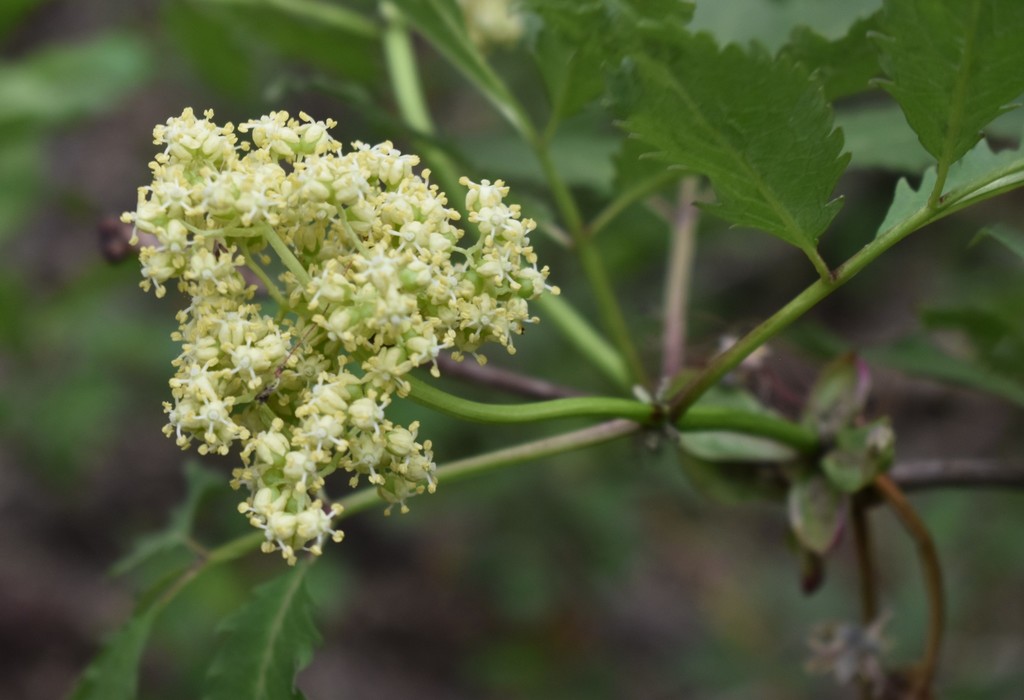
(c) Eric Lamb, some rights reserved (CC BY), uploaded by Eric Lamb · licence
Family: Viburnaceae · Type: Shrub / Tree · Native
Sambucus racemosa (Red elderberry) is a native California shrub / tree in the Viburnaceae family, recognized by dome-shaped inflorescence and non-glaucous red or purple-black fruit.
Red elderberry is a California native shrub found in northern coastal, northern central, and Sierra Nevada Mountains in mixed evergreen forest, riparian woodland, and conifer forest at elevations of 500 to 2,500 meters. Flowering from April to June, this plant produces cream to white flowers in large dome-shaped clusters up to 12 centimeters wide. Growing 1 to 6 meters tall with multiple spreading branches, it forms a dense, multi-stemmed thicket. Its compound leaves have 5 to 7 lance-shaped leaflets 4 to 16 centimeters long, with slightly asymmetric bases and pointed tips. The fruit develops as bright red or deep purple-black clusters, attracting wildlife and providing important ecological value.
Identification and appearance
Key characters: Geographically isolated; dome-shaped inflorescence and non-glaucous red or purple-black fruit
Habitat and range
California counties: Mariposa, Inyo, San Bernardino, Madera, Tulare, Modoc, El Dorado, Fresno, Humboldt, Tuolumne, Mono, San Mateo, Siskiyou, Butte, Shasta, San Diego, Placer
How to tell it apart
vs Fraxinus: Flowers in showy flat-topped clusters vs. ash's inconspicuous wind-pollinated flowers appearing before leaves.; vs Aralia: Leaflets arranged simply along one stalk vs. Aralia's twice-compound leaves with leaflets branching off branches.; vs Ligustrum: Compound leaves with multiple leaflets vs. privet's simple, undivided leaves.; vs Heteromeles: Leaflets toothed all around vs. toyon's simple leaves with teeth only on outer half.; vs Rosa: Leaflets without stipules at base vs. rose's paired stipules flanking each leaf stem.
Frequently asked questions
Is Sambucus racemosa native to California?
Yes. Sambucus racemosa is native to California (recorded as native).
Where in California does Sambucus racemosa grow?
Sambucus racemosa occurs in Mariposa, Inyo, San Bernardino, Madera, Tulare, Modoc, El Dorado, Fresno and other counties.
What plant family does Sambucus racemosa belong to?
Sambucus racemosa is in the Viburnaceae family, genus Sambucus.
Related species
Other California species in the same genus, family, or bioregion.
Sources: Jepson eFlora · Index of California Plant Names · CalPhotos
Last updated 2026-10-07
Data from The California Species Project — 14,000+ California species with verified data from CNPS, CDFW, USFWS, Cal-IPC, and more.