Sanicula tuberosa
Tuberous sanicle
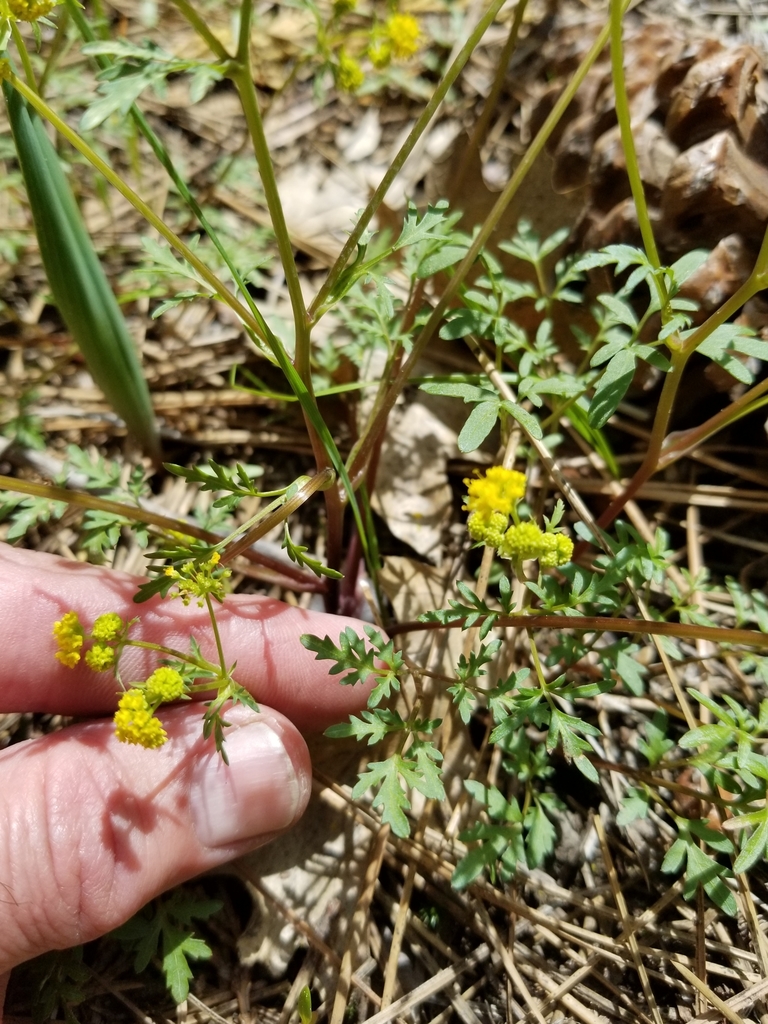
(c) Justin, some rights reserved (CC BY) · licence
Family: Apiaceae · Type: Herb · Native
Sanicula tuberosa (Tuberous sanicle) is a native California herb in the Apiaceae family, recognized by small spherical tuber and smooth rounded fruit tubercles diagnostic.
Tuberous sanicle is a California native perennial found in northwestern California, the Cascade Range, Sierra Nevada, Sutter Buttes, San Francisco Bay Area, southern Coast Ranges, Transverse Ranges, and Peninsular Ranges in open gravelly meadows, chaparral, woodland, and pine forest at elevations of 30 to 2,700 meters. Flowering from March to July, this plant produces yellow flowers in small clusters with delicate, fused bracts. Growing with slender stems 5 to 80 centimeters tall and a spherical underground tuber 5 to 15 millimeters wide, it develops a distinctive branching structure. Its compound leaves are triangular to ovate, divided into intricate leaflets that can range from entire to deeply pinnately lobed, typically green or slightly purple in coloration. The small fruits are ovate to nearly round with rounded, unarmed tubercles, each measuring 1.5 to 2 millimeters long.
Identification and appearance
Key characters: 9 sympatric species; small spherical tuber and smooth rounded fruit tubercles diagnostic
Habitat and range
Habitat: Open gravelly meadows, chaparral, woodland, pine forest
Elevation: 30-2700 m
California counties: Mendocino, San Luis Obispo, El Dorado, Napa, Lake, Santa Barbara, Trinity, Contra Costa, Los Angeles, Nevada, Fresno, Tuolumne, Placer, Plumas, Monterey, Butte, San Bernardino, Riverside, San Diego, Alpine, Lassen, Kern, Madera, Calaveras, Siskiyou, Alameda, Tulare, Orange, Ventura, Santa Clara, Tehama, Mariposa, San Benito, Humboldt, Amador, Marin, Shasta, Sonoma, Sutter, Colusa, Sierra, Yuba, Glenn, Solano, Stanislaus, Del Norte, San Mateo, Yolo
Outside California: Baja California
Bloom period
Sanicula tuberosa blooms Mar-Jul.
How to tell it apart
vs Lomatium: Sanicula has dense round flower heads; Lomatium has flat-topped umbrella-shaped flower clusters.; vs Tauschia: Sanicula flowers are in tight round heads; Tauschia has open umbrella-shaped clusters.; vs Trifolium: Sanicula fruits are covered in hooked bristles; clover has smooth pods and distinctive three-part leaves.; vs Ranunculus: Sanicula has dense ball-like flower heads; buttercup has individual flowers on separate stalks.; vs Delphinium: Sanicula has round green flower heads; Delphinium has tall spikes of blue/purple spurred flowers.
Frequently asked questions
Is Sanicula tuberosa native to California?
Yes. Sanicula tuberosa is native to California (recorded as native).
When does Sanicula tuberosa bloom?
Sanicula tuberosa blooms Mar-Jul.
Where in California does Sanicula tuberosa grow?
Sanicula tuberosa occurs in Mendocino, San Luis Obispo, El Dorado, Napa, Lake, Santa Barbara, Trinity, Contra Costa and other counties, at elevations of 30-2700 m.
What plant family does Sanicula tuberosa belong to?
Sanicula tuberosa is in the Apiaceae family, genus Sanicula.
What habitat does Sanicula tuberosa grow in?
Sanicula tuberosa grows in Open gravelly meadows, chaparral, woodland, pine forest.
Related species
Other California species in the same genus, family, or bioregion.
- Sanicula arctopoides — Footsteps of spring
- Sanicula arguta — Sharp toothed sanicle
- Sanicula bipinnata — Poison sanicle
- Sanicula bipinnatifida — Purple sanicle
- Sanicula crassicaulis — Gamble weed
- Sanicula graveolens — Northern sanicle
- Scandix pecten-veneris — Venus' needle
- Scandix sp.
- Sium sp.
- Sium suave — Hemlock water parsnip
Sources: Jepson eFlora · Index of California Plant Names · CalPhotos
Last updated 2026-10-07
Data from The California Species Project — 14,000+ California species with verified data from CNPS, CDFW, USFWS, Cal-IPC, and more.