Santolina chamaecyparissus
Lavender-cotton
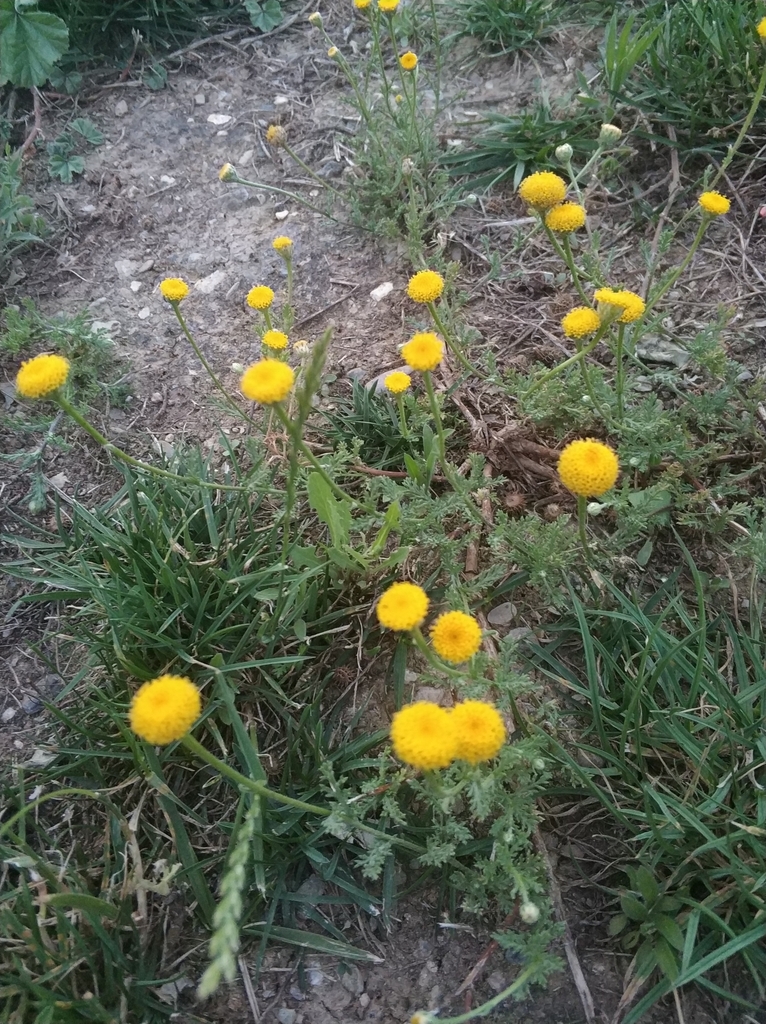
(c) Víctor Gómez, some rights reserved (CC BY) · licence
Family: Asteraceae · Type: Shrub · Not Native
Santolina chamaecyparissus (Lavender-cotton) is a non-native California shrub in the Asteraceae family, recognized by Only Santolina species in California, occasionally escaping cultivation from Mediterranean gardens.
Lavender-cotton is a naturalized shrub found in southern California and the Santa Catalina Islands in disturbed areas at elevations below 1,200 meters. Flowering from May to July, this plant produces small spherical flower heads approximately 1.5 to 2 centimeters in diameter with silvery-white blossoms. Growing 20 to 60 centimeters tall with a much-branched evergreen form, it displays a dense, silvery-gray to white tomentose appearance. Its leaves are pinnately dissected, three-dimensional, 2.5 to 4 centimeters long and 4 to 5 millimeters wide, creating a distinctive compact and intricate foliage structure. The fruit is 2.5 to 3 millimeters long with 5 distinct angles, contributing to its unique botanical character.
Identification and appearance
Key characters: Only Santolina species in California, occasionally escaping cultivation from Mediterranean gardens
Habitat and range
Habitat: Uncommon. Escape from cultivation in disturbed areas
Elevation: < 1200 m
Outside California: native to Mediterranean
Bloom period
Santolina chamaecyparissus blooms May-Jul.
How to tell it apart
vs Achillea: Santolina has cylindrical beaded leaves; Achillea has flat, fern-like pinnately divided leaves.; vs Eriophyllum: Santolina has cylindrical many-lobed leaves; Eriophyllum has flat woolly lobed leaves.; vs Tanacetum: Santolina has cylindrical beaded leaves; Tanacetum has flat pinnately divided aromatic leaves.; vs Eriogonum: Santolina has cylindrical many-lobed leaves up the stem; Eriogonum has simple leaves in basal rosettes.; vs Cotula: Santolina is a woody shrub with cylindrical leaves; Cotula is a low mat-forming herb with flat divided leaves.
Frequently asked questions
Is Santolina chamaecyparissus native to California?
No. Santolina chamaecyparissus is not native to California (recorded as not native).
When does Santolina chamaecyparissus bloom?
Santolina chamaecyparissus blooms May-Jul.
What plant family does Santolina chamaecyparissus belong to?
Santolina chamaecyparissus is in the Asteraceae family, genus Santolina.
What habitat does Santolina chamaecyparissus grow in?
Santolina chamaecyparissus grows in Uncommon. Escape from cultivation in disturbed areas.
Related species
Other California species in the same genus, family, or bioregion.
Sources: Jepson eFlora · Index of California Plant Names · CalPhotos
Last updated 2026-10-07
Data from The California Species Project — 14,000+ California species with verified data from CNPS, CDFW, USFWS, Cal-IPC, and more.