Saponaria officinalis
Bouncing bet
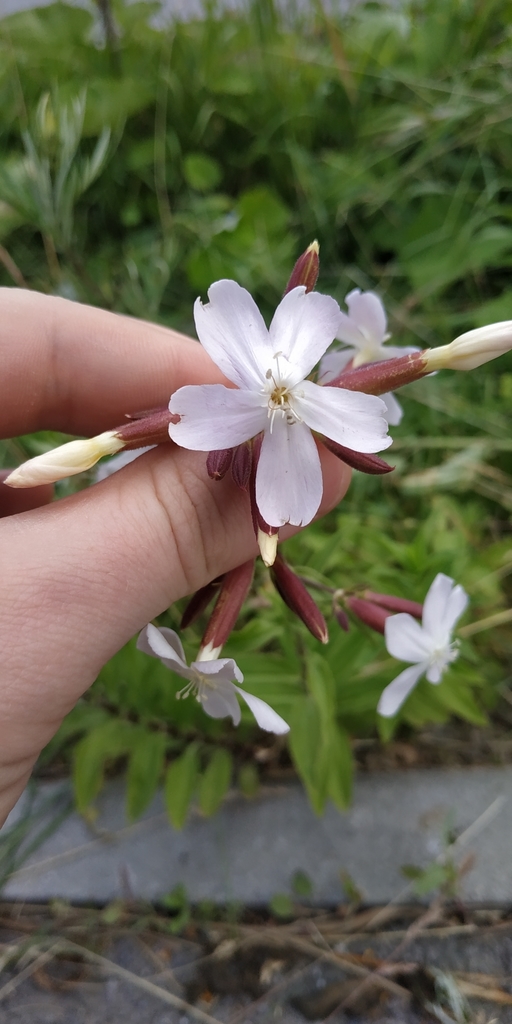
(c) Yurii Basov, some rights reserved (CC BY) · licence
Family: Caryophyllaceae · Type: Herb · Not Native
Conservation status: Cal-IPC Yes
Saponaria officinalis (Bouncing bet) is a non-native California herb in the Caryophyllaceae family, recognized by 0 congeners in CA; naturalized pink-flowered soapwort of disturbed ground.
Bouncing bet is a naturalized perennial found in northwestern California, the high Cascade Range, northern Sierra Nevada Foothill, San Francisco Bay Area, southern Coastal Range, southern California, Peninsular Ranges, and Great Basin in roadsides, oak woodland, streambeds, and disturbed areas at elevations below 1,850 meters. Flowering from June to September, this plant produces pink flowers with white-edged petals 8 to 12 millimeters wide, featuring delicate lance-linear appendages. Growing with erect or branching stems 30 to 90 centimeters tall that are mostly smooth and hairless, it forms robust clumps in disturbed landscapes. Its opposite leaves are 3 to 10 centimeters long, creating a dense green backdrop for the flower clusters. The small seeds are nearly spherical, about 1.5 to 2 millimeters in size, with a distinctive notched surface.
Identification and appearance
Key characters: 0 congeners in CA; naturalized pink-flowered soapwort of disturbed ground
Habitat and range
Habitat: Roadsides, oak woodland, streambeds, disturbed areas
Elevation: < 1850 m
California counties: Humboldt, Inyo, Modoc, San Bernardino, San Diego, Santa Clara, Shasta, Siskiyou, Los Angeles, Sacramento, Del Norte, Mono, El Dorado, Sonoma, Plumas, Butte, Tehama, Sierra, Lassen, San Luis Obispo, Tuolumne, Yuba, Alpine, Alameda, Trinity, Santa Barbara, Monterey, Nevada, Stanislaus, Merced, Santa Cruz
Outside California: North America, native to southern Europe
Bloom period
Saponaria officinalis blooms Jun-Sep.
Conservation status
Cal-IPC Yes
How to tell it apart
vs Pelargonium: Saponaria has dense clusters of radially symmetric flowers; Pelargonium has umbrella-like clusters with bilaterally symmetric flowers.; vs Phlox: Saponaria has tubular flowers with petal appendages and opposite leaves; Phlox has flat-faced flowers without appendages.; vs Lantana: Saponaria has pink tubular flowers and opposite simple leaves; Lantana has tight heads of small flowers with wrinkled, toothed leaves.; vs Gypsophila: Saponaria has large flowers (tube 9-25mm) in dense clusters; Gypsophila has tiny flowers (tube under 5mm) in airy masses.; vs Vaccaria: Saponaria is a spreading perennial with stalkless flowers; Vaccaria is an upright annual with flowers on long stalks.
Frequently asked questions
Is Saponaria officinalis native to California?
No. Saponaria officinalis is not native to California (recorded as not native).
When does Saponaria officinalis bloom?
Saponaria officinalis blooms Jun-Sep.
Where in California does Saponaria officinalis grow?
Saponaria officinalis occurs in Humboldt, Inyo, Modoc, San Bernardino, San Diego, Santa Clara, Shasta, Siskiyou and other counties, at elevations of < 1850 m.
What plant family does Saponaria officinalis belong to?
Saponaria officinalis is in the Caryophyllaceae family, genus Saponaria.
Is Saponaria officinalis invasive in California?
Saponaria officinalis is listed by Cal-IPC with an invasiveness rating of Yes.
Related species
Other California species in the same genus, family, or bioregion.
Sources: Jepson eFlora · Index of California Plant Names · CalPhotos
Last updated 2026-10-07
Data from The California Species Project — 14,000+ California species with verified data from CNPS, CDFW, USFWS, Cal-IPC, and more.