Sarcodes sanguinea
Snow plant
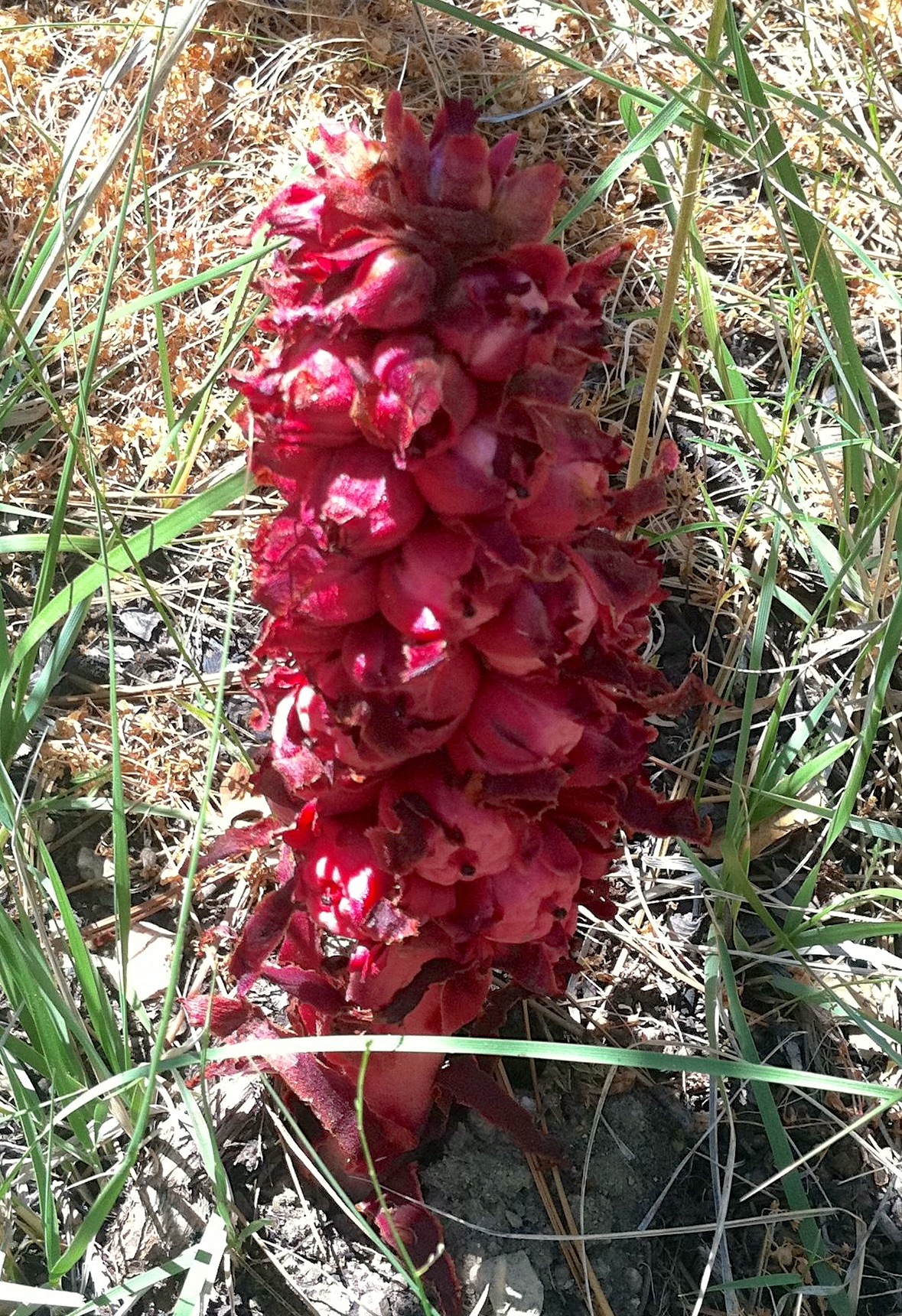
Photo by Chez Brungraber
Family: Ericaceae · Type: Herb · Native
Sarcodes sanguinea (Snow plant) is a native California herb in the Ericaceae family, recognized by Monotypic genus endemic to western North America, representing a unique parasitic lineage in the heath family.
Snow plant is a California native perennial found in the Klamath Ranges, northern coastal regions, high Cascades, Sierra Nevada, southern coastal ranges, Transverse Ranges, Peninsular Ranges, and Modoc Plateau in conifer or mixed forest at elevations of 700 to 3,100 meters. Flowering from May to July, this unusual non-green plant produces bright red to orange-red flowers in dense racemes emerging directly from the ground, with urn-shaped blossoms 12 to 18 millimeters long. Growing as a fleshy, glandular-hairy plant without traditional stems or leaves, it emerges as a striking bright red structure with thick, brittle roots. Its distinctive red structure features five-petaled flowers that are mostly fused, creating a unique appearance in the forest understory. The plant produces small capsules less than 2.5 centimeters wide, containing numerous tiny unwinged seeds, and remains persistent in the forest floor after seed dispersal.
Identification and appearance
Key characters: Monotypic genus endemic to western North America, representing a unique parasitic lineage in the heath family
Habitat and range
Habitat: Conifer or mixed forest
Elevation: 700-3100 m
California counties: Los Angeles, Mariposa, Tuolumne, Tulare, Fresno, Marin, Riverside, Plumas, Kern, San Bernardino, Inyo, El Dorado, Ventura, Sierra, Placer, Madera, Butte, Nevada, Amador, Alpine, Calaveras, Lassen, Shasta, Siskiyou, Tehama, Trinity, Humboldt, Del Norte, Mono, Santa Barbara, Sacramento
Outside California: southwestern Oregon, Nevada, northern Baja California
Bloom period
Sarcodes sanguinea blooms May-Jul.
How to tell it apart
vs Pterospora: Sarcodes is thick and entirely bright red; Pterospora is thin, brownish-pink, and much taller.; vs Corallorhiza: Sarcodes has dense red bell-flowers on thick fleshy stem; Corallorhiza has sparse bilateral orchid flowers.; vs Kopsiopsis: Sarcodes has bell-shaped flowers and thick red stem; Kopsiopsis has tubular two-lipped flowers.; vs Pedicularis: Sarcodes is fleshy red without leaves; Pedicularis has green fernlike leaves and beaked flowers.; vs Allotropa: Sarcodes is solid bright red; Allotropa has distinctive red-and-white candy-cane stripes.
Frequently asked questions
Is Sarcodes sanguinea native to California?
Yes. Sarcodes sanguinea is native to California (recorded as native).
When does Sarcodes sanguinea bloom?
Sarcodes sanguinea blooms May-Jul.
Where in California does Sarcodes sanguinea grow?
Sarcodes sanguinea occurs in Los Angeles, Mariposa, Tuolumne, Tulare, Fresno, Marin, Riverside, Plumas and other counties, at elevations of 700-3100 m.
What plant family does Sarcodes sanguinea belong to?
Sarcodes sanguinea is in the Ericaceae family, genus Sarcodes.
What habitat does Sarcodes sanguinea grow in?
Sarcodes sanguinea grows in Conifer or mixed forest.
Related species
Other California species in the same genus, family, or bioregion.
Sources: Jepson eFlora · Index of California Plant Names · CalPhotos
Last updated 2026-10-07
Data from The California Species Project — 14,000+ California species with verified data from CNPS, CDFW, USFWS, Cal-IPC, and more.