Schismus barbatus
Common mediterranean grass
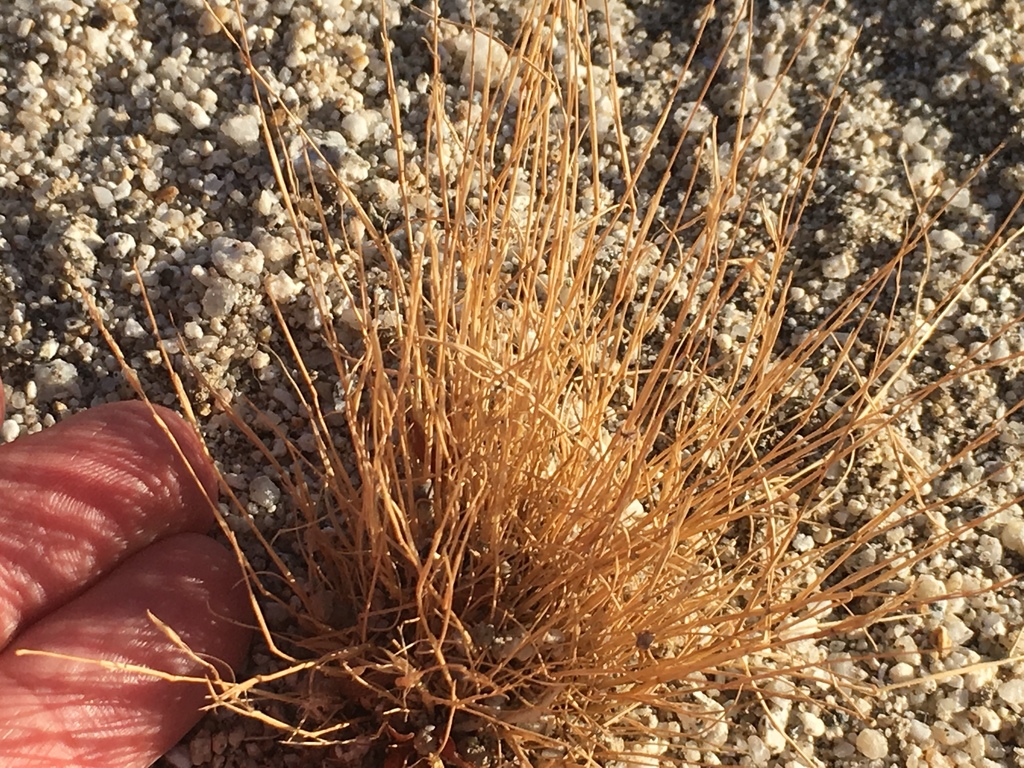
(c) W. Terry Hunefeld, some rights reserved (CC BY) · licence
Family: Poaceae · Type: Grass · Not Native
Conservation status: Cal-IPC Yes
Schismus barbatus (Common mediterranean grass) is a non-native California grass in the Poaceae family, recognized by (S. arabicus). Clear morphological separation based on spikelet measurements and plant stature.
Common mediterranean grass is a naturalized annual grass found in the Tehama, San Joaquin Valley, southern Coast Ranges, southwestern California, and desert regions in dry, open, generally disturbed areas at elevations below 1,200 meters. Flowering from March to April, this grass produces small, delicate flowers in slender, thread-like spikelets. Growing with thin stems 2 to 16 centimeters tall, it forms dense, low-growing clusters in disturbed landscapes. Its leaves are extremely narrow, less than 2 millimeters wide, creating a fine, hair-like appearance across the ground. The grass produces compact spikelets with glumes 4 to 5 millimeters long and lemmas 2 to 2.5 millimeters in length.
Identification and appearance
Key characters: 1 sympatric species (S. arabicus). Clear morphological separation based on spikelet measurements and plant stature.
Habitat and range
Habitat: Dry, open, generally disturbed areas
Elevation: < 1200 m
California counties: Kern, San Bernardino, Riverside, Orange, San Diego, Los Angeles, San Luis Obispo, Imperial, Inyo, Santa Barbara, Ventura, Marin, Mendocino, San Benito, Kings, Fresno, Monterey
Outside California: to Texas, northern Mexico, native to southern Europe, Africa
Bloom period
Schismus barbatus blooms Mar-Apr.
Conservation status
Cal-IPC Yes
How to tell it apart
vs Stipellula: Schismus has dense flower heads with no awns; Stipellula has awned lemmas.; vs Bromus: Schismus is tiny (under 6 inches) with dense heads; Bromus is taller with drooping spikelets.; vs Aristida: Schismus completely lacks awns; Aristida has three distinctive awns per seed.; vs Festuca: Schismus forms desert carpets with compact heads; Festuca has looser, more open flower clusters.; vs Catapodium: Schismus has spikelets 4.5-7mm; Catapodium has smaller spikelets under 4mm.
Frequently asked questions
Is Schismus barbatus native to California?
No. Schismus barbatus is not native to California (recorded as not native).
When does Schismus barbatus bloom?
Schismus barbatus blooms Mar-Apr.
Where in California does Schismus barbatus grow?
Schismus barbatus occurs in Kern, San Bernardino, Riverside, Orange, San Diego, Los Angeles, San Luis Obispo, Imperial and other counties, at elevations of < 1200 m.
What plant family does Schismus barbatus belong to?
Schismus barbatus is in the Poaceae family, genus Schismus.
Is Schismus barbatus invasive in California?
Schismus barbatus is listed by Cal-IPC with an invasiveness rating of Yes.
Related species
Other California species in the same genus, family, or bioregion.
Sources: Jepson eFlora · Index of California Plant Names · CalPhotos
Last updated 2026-10-07
Data from The California Species Project — 14,000+ California species with verified data from CNPS, CDFW, USFWS, Cal-IPC, and more.