Schoenoplectus pungens var. longispicatus
Common three-square bulrush
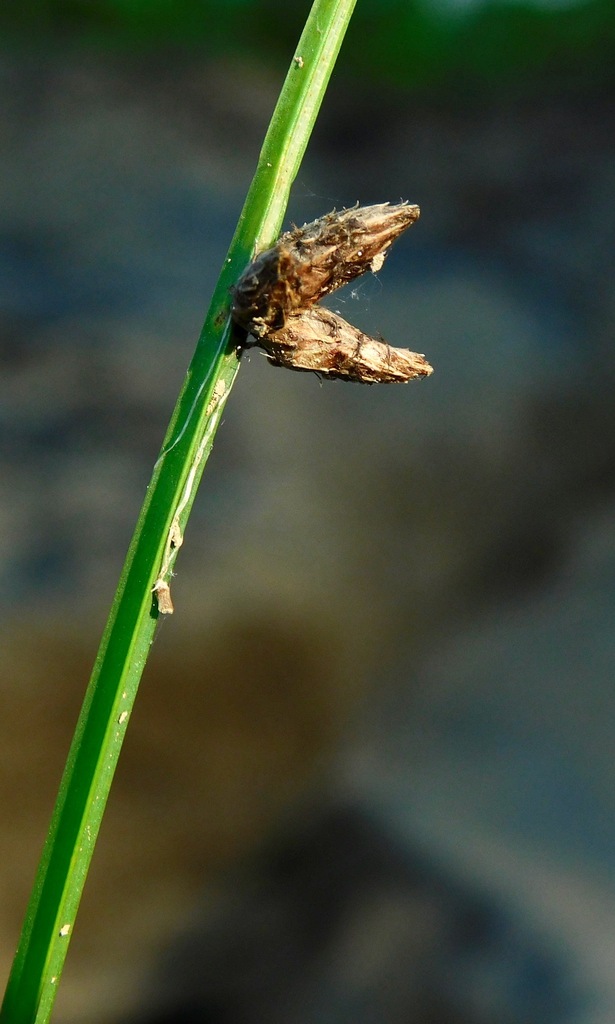
(c) Michael J. Papay, some rights reserved (CC BY), uploaded by Michael J. Papay · licence
Family: Cyperaceae · Type: Grass · Native
Schoenoplectus pungens var. longispicatus (Common three-square bulrush) is a native California grass in the Cyperaceae family, recognized by similar species by flat-sided (not deep-concave) triangular stems and long leaf blades.
Common three-square bulrush is a native perennial found in northern coastal, Sierra Nevada, San Joaquin Valley, central western, southern coastal, Great Basin, and desert bioregions in fresh or brackish marshes and shores at elevations up to 2,400 meters. Flowering from late spring to summer, this plant produces small brownish to greenish flower spikelets in dense, upright clusters. Growing with distinctive three-sided stems 10 to 200 centimeters tall, it spreads via long rhizomes that are 1 to 6 millimeters in diameter. Its leaves are two to six per stem, roughly three-sided to flat, with blades 2 to 9 millimeters wide that partially extend beyond the stem sheath. The fruit is a small, smooth, three-sided structure 2.5 to 3.5 millimeters long, typically accompanied by six vestigial perianth bristles.
Identification and appearance
Key characters: 7 sympatric species; distinguished from similar species by flat-sided (not deep-concave) triangular stems and long leaf blades
Habitat and range
Habitat: Fresh or brackish marshes, shores, fens
Elevation: < 2400 m
California counties: Kern, San Bernardino, San Diego, Inyo, Riverside, San Luis Obispo, Mono, Imperial, Modoc, Santa Barbara, Tulare, San Mateo, Los Angeles, San Benito, Colusa, Sierra, Ventura, Humboldt, Marin, Lake, Lassen, Alameda, Contra Costa, Napa, Yolo, Monterey
Outside California: to eastern United States, southeastern Canada, Mexico, also South America, Europe, Australia, New Zealand
Bloom period
Schoenoplectus pungens var. longispicatus blooms Late spring-summer.
How to tell it apart
vs Juncus: Schoenoplectus has flowers in spikelets with overlapping scales; Juncus has separate flowers with 6 perianth parts.; vs Typha: Schoenoplectus has small spikelets of tiny flowers; Typha has dense brown cylindrical flower spikes (cattails).; vs Bolboschoenus: Schoenoplectus has smooth flower scales; Bolboschoenus scales are fuzzy-hairy.; vs Carex: Schoenoplectus has bisexual flowers in open spikelets; Carex has separate male/female flowers in enclosed sacs.; vs Scirpus: Schoenoplectus has dull bracts with notched tips; Scirpus bracts are pointed and often reddish-tinged.
Frequently asked questions
Is Schoenoplectus pungens var. longispicatus native to California?
Yes. Schoenoplectus pungens var. longispicatus is native to California (recorded as native).
When does Schoenoplectus pungens var. longispicatus bloom?
Schoenoplectus pungens var. longispicatus blooms Late spring-summer.
Where in California does Schoenoplectus pungens var. longispicatus grow?
Schoenoplectus pungens var. longispicatus occurs in Kern, San Bernardino, San Diego, Inyo, Riverside, San Luis Obispo, Mono, Imperial and other counties, at elevations of < 2400 m.
What plant family does Schoenoplectus pungens var. longispicatus belong to?
Schoenoplectus pungens var. longispicatus is in the Cyperaceae family, genus Schoenoplectus.
What habitat does Schoenoplectus pungens var. longispicatus grow in?
Schoenoplectus pungens var. longispicatus grows in Fresh or brackish marshes, shores, fens.
Related species
Other California species in the same genus, family, or bioregion.
Sources: Jepson eFlora · Index of California Plant Names · CalPhotos
Last updated 2026-10-07
Data from The California Species Project — 14,000+ California species with verified data from CNPS, CDFW, USFWS, Cal-IPC, and more.