Schoenoplectus saximontanus
Rocky mountain bulrush, Rocky Mountain Bulrush
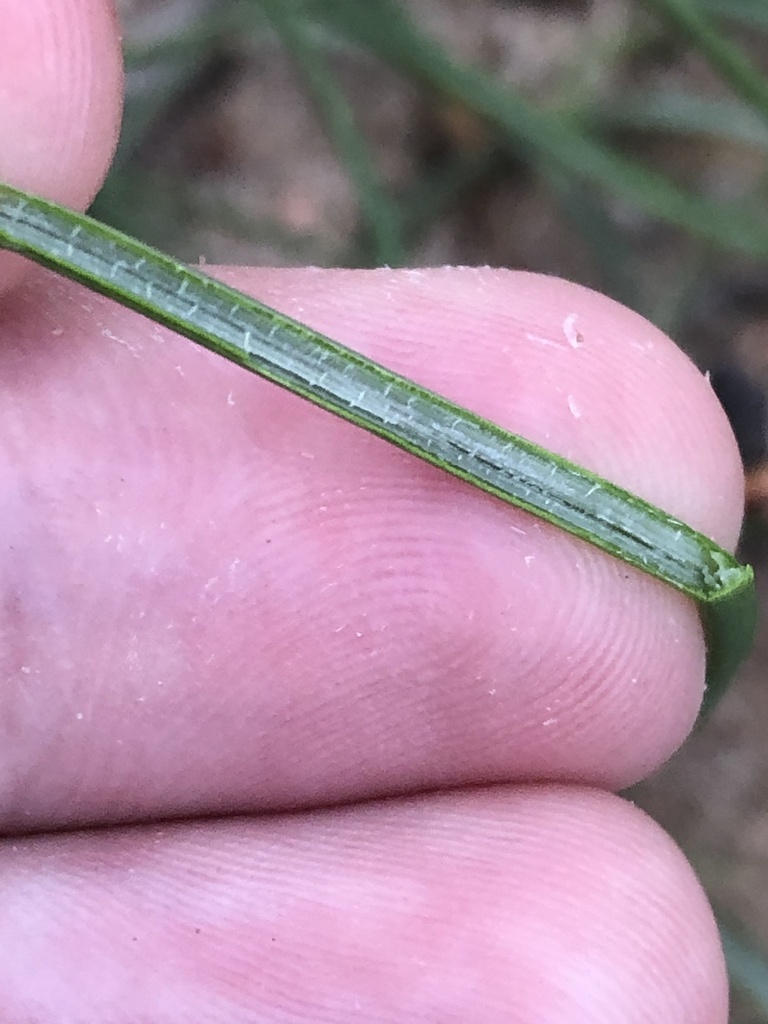
(c) Jared Shorma, some rights reserved (CC BY) · licence
Family: Cyperaceae · Type: Grass · Native
Schoenoplectus saximontanus (Rocky mountain bulrush) is a native California grass in the Cyperaceae family, recognized by uniquely annual with very small size and thin cylindrical stems.
Rocky mountain bulrush is a California native annual found in the San Joaquin Valley, southern Coast Ranges, western Transverse Ranges, and Peninsular Ranges in fresh shoreline and pond habitats at elevations below 2,200 meters. Flowering during summer, this plant produces small, clustered spikelets 6 to 20 millimeters long in head-like clusters. Growing with thin cylindrical stems 1 to 60 centimeters tall, it has short, mostly inconspicuous rhizomes. Its leaves are narrow, with blades 1 to 200 millimeters long and less than 1 millimeter wide, positioned at the base and occasionally along the stem. The fruit is small and sharp-sided, approximately 1.3 to 1.9 millimeters long with distinctive wavy transverse ridges.
Identification and appearance
Key characters: 6 sympatric species; uniquely annual with very small size and thin cylindrical stems
Habitat and range
Habitat: Rare in California. Fresh shores, ponds, often drying, often sandy
Elevation: < 2200 m
California counties: Kern, Riverside, Ventura, San Luis Obispo, Fresno, Los Angeles
Outside California: to British Columbia, Ohio, Texas, Mexico
Bloom period
Schoenoplectus saximontanus blooms Summer.
How to tell it apart
vs Juncus: Schoenoplectus has flowers in spikelets with overlapping scales; Juncus has separate flowers with 6 perianth parts.; vs Typha: Schoenoplectus has small spikelets of tiny flowers; Typha has dense brown cylindrical flower spikes (cattails).; vs Bolboschoenus: Schoenoplectus has smooth flower scales; Bolboschoenus scales are fuzzy-hairy.; vs Carex: Schoenoplectus has bisexual flowers in open spikelets; Carex has separate male/female flowers in enclosed sacs.; vs Scirpus: Schoenoplectus has dull bracts with notched tips; Scirpus bracts are pointed and often reddish-tinged.
Frequently asked questions
Is Schoenoplectus saximontanus native to California?
Yes. Schoenoplectus saximontanus is native to California (recorded as native).
When does Schoenoplectus saximontanus bloom?
Schoenoplectus saximontanus blooms Summer.
Where in California does Schoenoplectus saximontanus grow?
Schoenoplectus saximontanus occurs in Kern, Riverside, Ventura, San Luis Obispo, Fresno, Los Angeles, at elevations of < 2200 m.
What plant family does Schoenoplectus saximontanus belong to?
Schoenoplectus saximontanus is in the Cyperaceae family, genus Schoenoplectus.
What habitat does Schoenoplectus saximontanus grow in?
Schoenoplectus saximontanus grows in Rare in California. Fresh shores, ponds, often drying, often sandy.
Related species
Other California species in the same genus, family, or bioregion.
Sources: Jepson eFlora · CNPS Rare Plant Inventory · Index of California Plant Names · CalPhotos
Last updated 2026-10-07
Data from The California Species Project — 14,000+ California species with verified data from CNPS, CDFW, USFWS, Cal-IPC, and more.