Scoliopus bigelovii
California fetid adderstongue
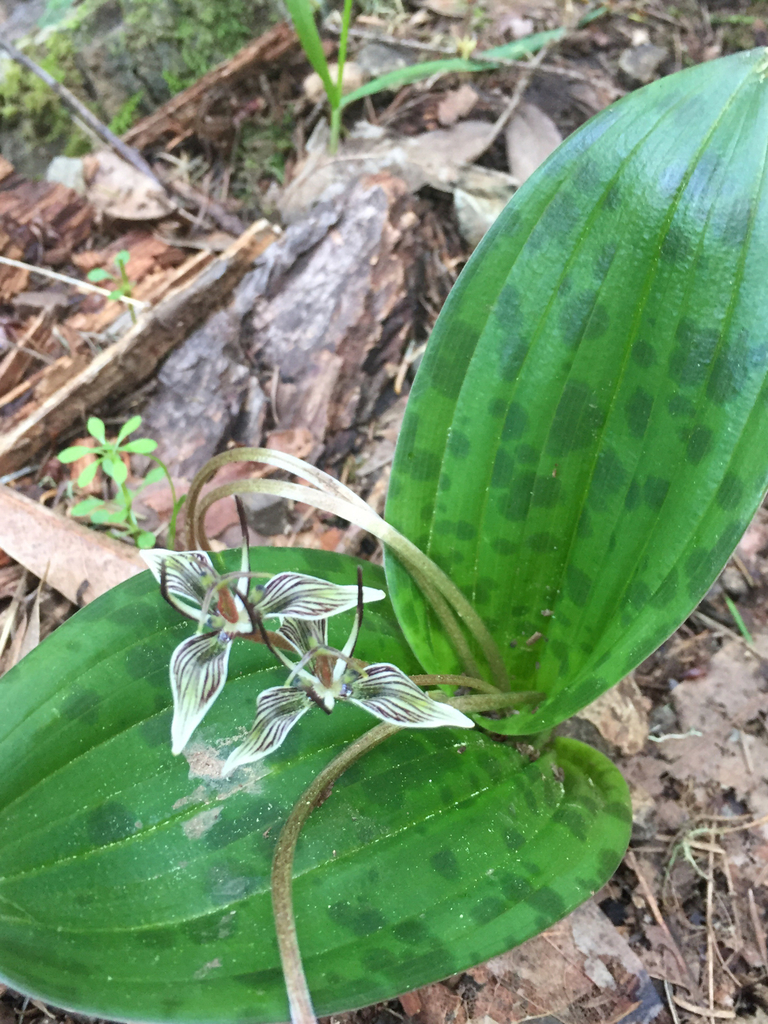
no rights reserved · CC0
Family: Liliaceae · Type: Herb · Native
Scoliopus bigelovii (California fetid adderstongue) is a native California herb in the Liliaceae family, recognized by Scoliopus is an ancient, relictual genus endemic to the Pacific Coast, representing a primitive lineage within the lily family.
California fetid adderstongue is a California native perennial found in northern coastal California regions including northern Coast Ranges, northern Central Coast, and San Francisco Bay Area in moist, shady redwood forest at elevations below 1,100 meters. Flowering from February to March, this plant produces green or yellow flowers heavily lined with purple or dark brown, with six perianth parts in two distinctly different whorls. Growing with a short, underground stem emerging from a slender rhizome, it develops two to three basal leaves that are 5 to 20 centimeters long and 5 to 10 centimeters wide, with a distinctive mottled appearance and many veins. Its leaves are elliptic to oblong, sheathing at the base, and create an intriguing ground-level display in the forest understory. When flowering, its unusual peduncles emerge underground and twist to recurve, causing the developing fruit to touch the soil in a remarkable reproductive strategy.
Identification and appearance
Key characters: Scoliopus is an ancient, relictual genus endemic to the Pacific Coast, representing a primitive lineage within the lily family
Habitat and range
Habitat: Moist, shady redwood forest
Elevation: < 1100 m
California counties: San Mateo, Humboldt, Marin, Mendocino, Santa Cruz, Sonoma, San Luis Obispo, Napa, San Benito, Alameda
Bloom period
Scoliopus bigelovii blooms Feb-Mar.
How to tell it apart
vs Erythronium: Scoliopus has 3 stamens and striped sepals; Erythronium has 6 stamens and plain sepals.; vs Trillium: Scoliopus has 2 mottled leaves and 3 stamens; Trillium has 3 plain leaves in a whorl and 6 stamens.; vs Epipactis: Scoliopus has 3 separate stamens; Epipactis has stamens fused to style in central column (orchid).; vs Platanthera: Scoliopus has 3 separate stamens and lily flowers; Platanthera has fused column and spurred orchid flowers.; vs Cypripedium: Scoliopus has narrow petals and 3 stamens; Cypripedium has pouched lip and fused column.
Frequently asked questions
Is Scoliopus bigelovii native to California?
Yes. Scoliopus bigelovii is native to California (recorded as native).
When does Scoliopus bigelovii bloom?
Scoliopus bigelovii blooms Feb-Mar.
Where in California does Scoliopus bigelovii grow?
Scoliopus bigelovii occurs in San Mateo, Humboldt, Marin, Mendocino, Santa Cruz, Sonoma, San Luis Obispo, Napa and other counties, at elevations of < 1100 m.
What plant family does Scoliopus bigelovii belong to?
Scoliopus bigelovii is in the Liliaceae family, genus Scoliopus.
What habitat does Scoliopus bigelovii grow in?
Scoliopus bigelovii grows in Moist, shady redwood forest.
Related species
Other California species in the same genus, family, or bioregion.
Sources: Jepson eFlora · Index of California Plant Names · CalPhotos
Last updated 2026-10-07
Data from The California Species Project — 14,000+ California species with verified data from CNPS, CDFW, USFWS, Cal-IPC, and more.