Scrophularia lanceolata
Lanceleaf figwort
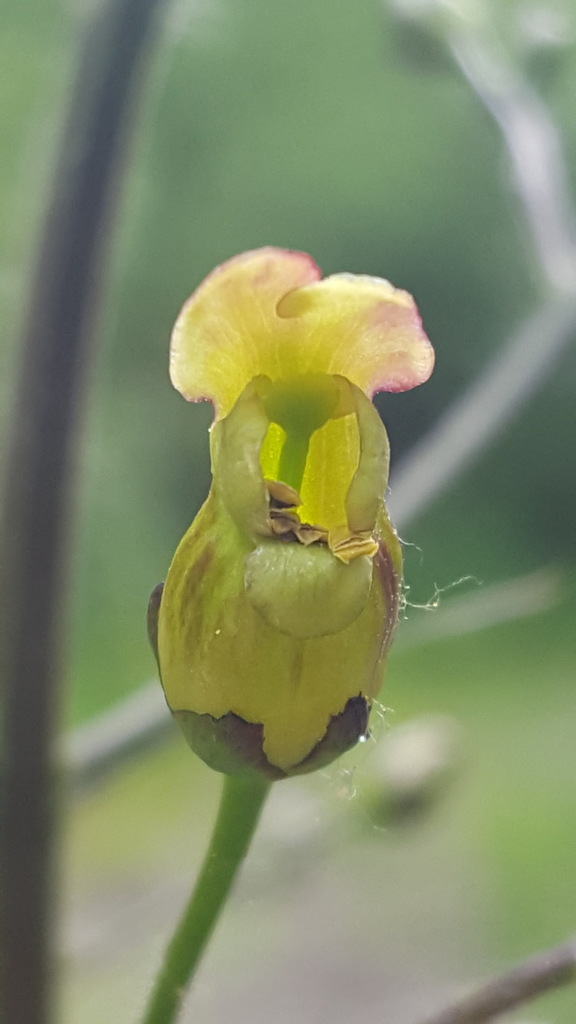
(c) Alex Abair, some rights reserved (CC BY), uploaded by Alex Abair · licence
Family: Scrophulariaceae · Type: Herb · Native
Scrophularia lanceolata (Lanceleaf figwort) is a native California herb in the Scrophulariaceae family, recognized by fan-shaped staminode and northern montane habitat.
Lanceleaf figwort is a California native perennial found in the Klamath Ranges, Cascade Range, and North Coast Ranges in moist streambanks, meadows, and woodland thickets at elevations of 1,000 to 2,800 meters. Flowering from May to July, this plant produces red to maroon flowers 8 to 14 millimeters long with an inflated, slightly constricted mouth. Growing with robust stems 80 to 150 centimeters tall that are glandular-puberulent, it forms an impressive woodland presence. Its leaves are dark to light green, with larger blades 9 to 13 centimeters long, featuring a heart-shaped to truncate base and occasionally wedge-shaped edges. The distinctive flower has green triangular-ovate calyx lobes with a broad, fan-shaped staminode that adds visual complexity to its woodland habitat.
Identification and appearance
Key characters: 2 sympatric species; diagnostic fan-shaped staminode and northern montane habitat
Habitat and range
Habitat: Moist streambanks, meadows, thickets, woodland
Elevation: 1000-2800 m
California counties: Lake, Modoc, Mono, Lassen, Siskiyou, Sierra, Shasta
Outside California: northern and central United States, Canada
Bloom period
Scrophularia lanceolata blooms May-Jul.
How to tell it apart
vs Blitum: Scrophularia has bilateral flowers with petals; Blitum has tiny flowers without petals.; vs Urtica: Scrophularia has showy bilateral flowers; Urtica has stinging hairs and tiny greenish flowers.; vs Stachys: Scrophularia has urn-shaped flowers in branched clusters; Stachys has flowers in dense whorled spikes.; vs Hesperocnide: Scrophularia has bilateral tubular flowers; Hesperocnide has tiny greenish flowers without petals.; vs Melissa: Scrophularia has greenish to dark red flowers; Melissa has white to pale pink flowers and lemon scent.
Frequently asked questions
Is Scrophularia lanceolata native to California?
Yes. Scrophularia lanceolata is native to California (recorded as native).
When does Scrophularia lanceolata bloom?
Scrophularia lanceolata blooms May-Jul.
Where in California does Scrophularia lanceolata grow?
Scrophularia lanceolata occurs in Lake, Modoc, Mono, Lassen, Siskiyou, Sierra, Shasta, at elevations of 1000-2800 m.
What plant family does Scrophularia lanceolata belong to?
Scrophularia lanceolata is in the Scrophulariaceae family, genus Scrophularia.
What habitat does Scrophularia lanceolata grow in?
Scrophularia lanceolata grows in Moist streambanks, meadows, thickets, woodland.
Related species
Other California species in the same genus, family, or bioregion.
Sources: Jepson eFlora · Index of California Plant Names · CalPhotos
Last updated 2026-10-07
Data from The California Species Project — 14,000+ California species with verified data from CNPS, CDFW, USFWS, Cal-IPC, and more.