Scrophularia villosa
Santa catalina figwort, Santa Catalina Figwort
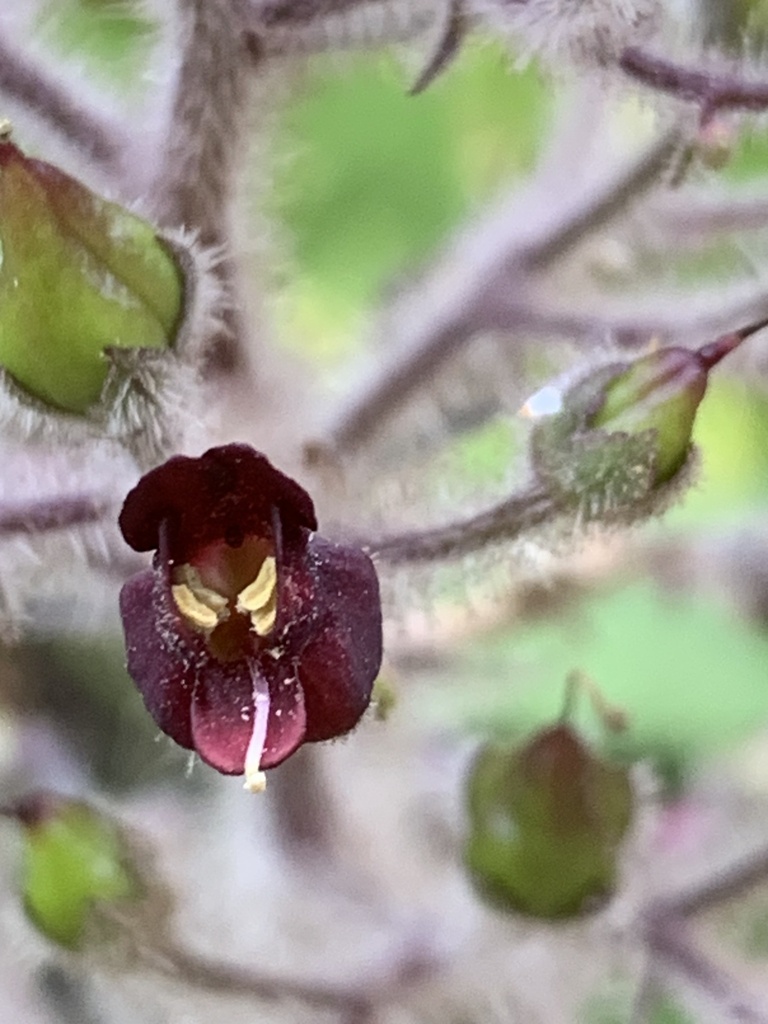
(c) Cayman Lanzone, some rights reserved (CC BY) · licence
Family: Scrophulariaceae · Type: Subshrub · Native
Conservation status: CNPS 1B.2
Scrophularia villosa (Santa catalina figwort) is a native California subshrub in the Scrophulariaceae family.
Santa catalina figwort is a rare (CNPS 1B.2) California native perennial found on southern Channel Islands including Santa Catalina and San Clemente in canyon bottoms, coastal scrub, and chaparral at elevations below 400 meters. Flowering from February to May, this plant produces dark maroon to nearly black flowers with paler lower lobes, approximately 8 to 11 millimeters long. Growing with tall, shrubby stems 120 to 180 centimeters high that become increasingly woody with age, the plant has an occasionally glandular-hairy appearance. Its leaves are dark to light green, with larger blades 8 to 15 centimeters long, arranged along the stems in a distinctive pattern. The plant's calyx features triangular-ovate green lobes with acute to rounded tips, giving it a unique structural character.
Identification and appearance
Key characters: 1 sympatric species; geographically isolated to Channel Islands with distinctive hairy inflorescence
Habitat and range
Habitat: Canyon bottoms, coastal scrub, chaparral
Elevation: < 400 m
California counties: Los Angeles, San Luis Obispo
Outside California: Baja California (Guadalupe Island)
Bloom period
Scrophularia villosa blooms Feb-May.
Conservation status
CNPS 1B.2
How to tell it apart
vs Blitum: Scrophularia has bilateral flowers with petals; Blitum has tiny flowers without petals.; vs Urtica: Scrophularia has showy bilateral flowers; Urtica has stinging hairs and tiny greenish flowers.; vs Stachys: Scrophularia has urn-shaped flowers in branched clusters; Stachys has flowers in dense whorled spikes.; vs Hesperocnide: Scrophularia has bilateral tubular flowers; Hesperocnide has tiny greenish flowers without petals.; vs Melissa: Scrophularia has greenish to dark red flowers; Melissa has white to pale pink flowers and lemon scent.
Frequently asked questions
Is Scrophularia villosa native to California?
Yes. Scrophularia villosa is native to California (recorded as native).
When does Scrophularia villosa bloom?
Scrophularia villosa blooms Feb-May.
Where in California does Scrophularia villosa grow?
Scrophularia villosa occurs in Los Angeles, San Luis Obispo, at elevations of < 400 m.
What plant family does Scrophularia villosa belong to?
Scrophularia villosa is in the Scrophulariaceae family, genus Scrophularia.
Is Scrophularia villosa rare or endangered?
Scrophularia villosa carries California Rare Plant Rank 1B.2, state rank S3.
Related species
Other California species in the same genus, family, or bioregion.
- Scrophularia atrata — Black-flowered figwort
- Scrophularia californica — California figwort
- Scrophularia desertorum — Desert figwort
- Scrophularia lanceolata — Lanceleaf figwort
- Scrophularia peregrina — Mediterranean figwort
- Scrophularia sp. — Figwort
- Scrophulariaceae sp. — Figwort family
- Verbascum blattaria — Moth mullein
- Verbascum bombyciferum — Giant silver mullein
- Verbascum sp. — Mullein
Sources: Jepson eFlora · CNPS Rare Plant Inventory · Index of California Plant Names · CalPhotos · CDFW CNDDB
Last updated 2026-10-07
Data from The California Species Project — 14,000+ California species with verified data from CNPS, CDFW, USFWS, Cal-IPC, and more.