Scutellaria bolanderi subsp. austromontana
Southern mountains skullcap, Southern Mountains Skullcap
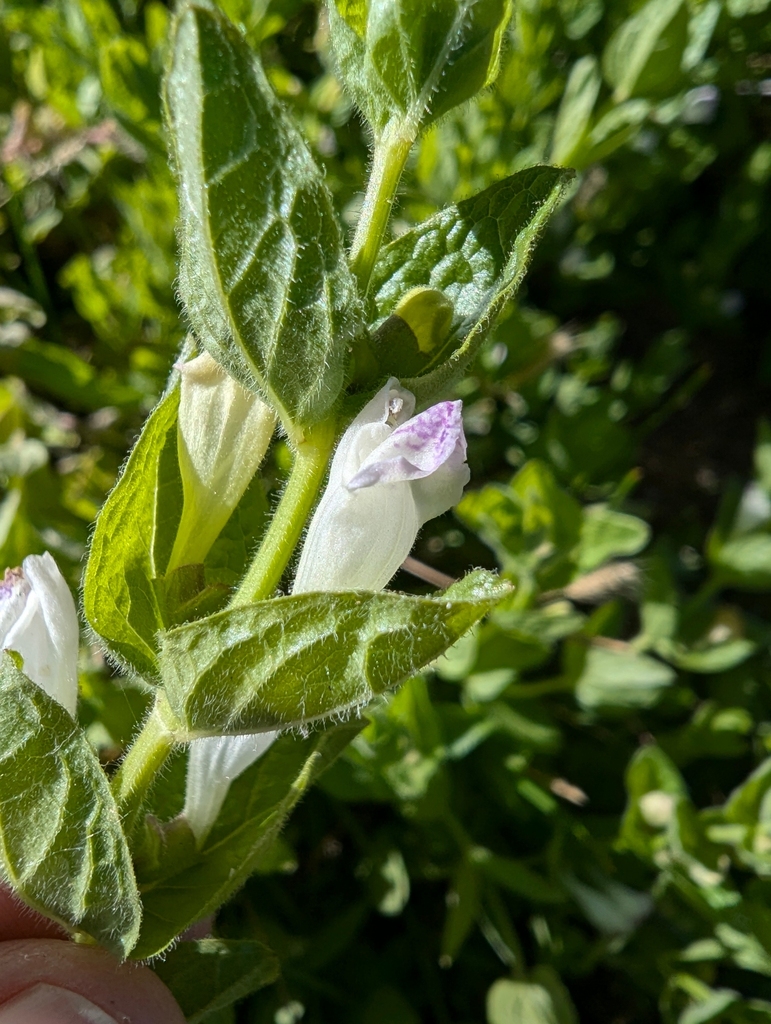
Photo: parent species Scutellaria bolanderi · (c) joergmlpts, some rights reserved (CC BY) · licence
Family: Lamiaceae · Type: Herb · Native
Conservation status: CNPS 1B.2
Scutellaria bolanderi subsp. austromontana (Southern mountains skullcap) is a native California herb in the Lamiaceae family, recognized by leaf shape ratio and flower size.
Southern mountains skullcap is a rare (CNPS 1B.2) California native perennial found in southern Borderland, Peninsular Ranges, and southern desert mountains in gravelly soils, stream banks, and oak or pine woodland at elevations of 600 to 2,000 meters. Flowering from June to July, this plant produces blue to purple flowers with corollas 12 to 14 millimeters long. Growing with delicate stems up to 30 centimeters tall, it forms a compact clumping habit. Its leaves are distinctively longer than twice their width, with an elongated shape that helps distinguish this skullcap from other species. In rocky, well-drained habitats, this skullcap provides a subtle but important botanical presence in southern California's montane ecosystems.
Identification and appearance
Key characters: 4 sympatric species; key features are leaf shape ratio and flower size
Habitat and range
Habitat: Gravelly soils, stream banks, oak or pine woodland
Elevation: 600-2000 m
Bloom period
Scutellaria bolanderi subsp. austromontana blooms Jun-Jul.
Conservation status
CNPS 1B.2
How to tell it apart
vs Salvia: Salvia has only 2 stamens with a see-saw lever connective and often aromatic foliage; Scutellaria has 4 stamens and a smooth rounded crest (the 'skullcap') on top of the calyx.; vs Stachys: Stachys is hairy and aromatic with flowers in whorled clusters above a 5-toothed bell calyx; Scutellaria bears flowers in axillary pairs and a 2-lipped calyx with a distinctive dorsal hump.; vs Prunella: Prunella packs its flowers into a dense terminal head with leafy bracts and a flat-topped calyx; Scutellaria has paired axillary flowers and a crested, lidded calyx.; vs Monardella: Monardella is strongly aromatic with flowers in dense terminal heads; Scutellaria is scarcely aromatic with solitary paired flowers and the crested calyx.; vs Marrubium: Horehound has wrinkled woolly leaves and a 10-toothed hooked calyx in dense whorls; Scutellaria has the smooth 2-lipped crested calyx and paired flowers.
Frequently asked questions
Is Scutellaria bolanderi subsp. austromontana native to California?
Yes. Scutellaria bolanderi subsp. austromontana is native to California (recorded as native).
When does Scutellaria bolanderi subsp. austromontana bloom?
Scutellaria bolanderi subsp. austromontana blooms Jun-Jul.
What plant family does Scutellaria bolanderi subsp. austromontana belong to?
Scutellaria bolanderi subsp. austromontana is in the Lamiaceae family, genus Scutellaria.
Is Scutellaria bolanderi subsp. austromontana rare or endangered?
Scutellaria bolanderi subsp. austromontana carries California Rare Plant Rank 1B.2, state rank S3.
What habitat does Scutellaria bolanderi subsp. austromontana grow in?
Scutellaria bolanderi subsp. austromontana grows in Gravelly soils, stream banks, oak or pine woodland.
Related species
Other California species in the same genus, family, or bioregion.
Sources: Jepson eFlora · CalPhotos · CDFW CNDDB
Last updated 2026-10-07
Data from The California Species Project — 14,000+ California species with verified data from CNPS, CDFW, USFWS, Cal-IPC, and more.