Scutellaria tuberosa
Danny's skullcap
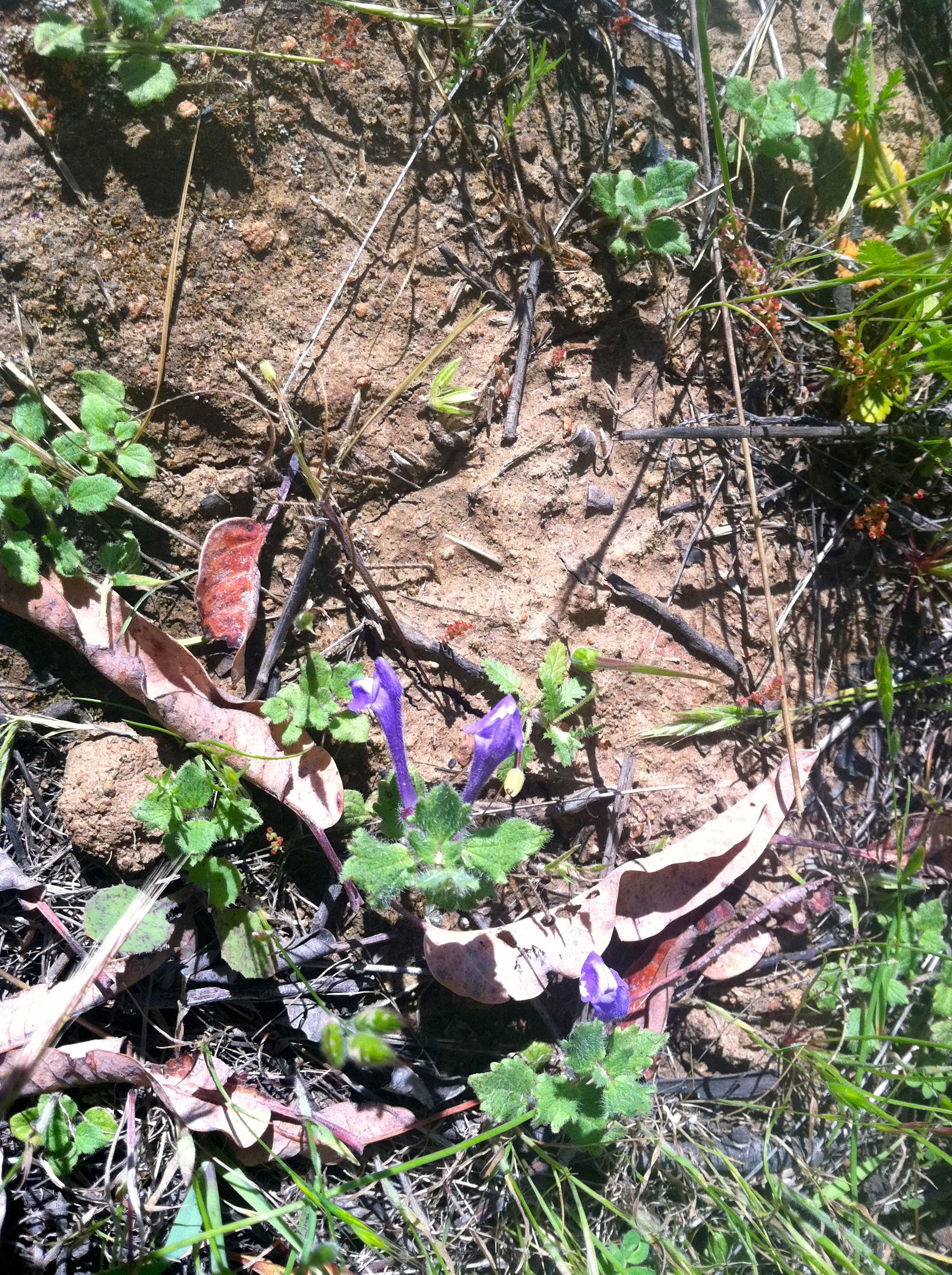
Photo by Chez Brungraber
Family: Lamiaceae · Type: Herb · Native
Scutellaria tuberosa (Danny's skullcap) is a native California herb in the Lamiaceae family, recognized by tuberous base and spreading stem hairs.
Danny's skullcap is a California native perennial found in the Great Valley, specifically in the Sutter Buttes, inhabiting dry sites in chaparral and oak woodland at elevations below 1,450 meters. Flowering from March to July, this plant produces striking violet-blue flowers with white-patched lower lips, approximately 13 to 20 millimeters long. Growing with delicate stems less than 25 centimeters tall and spreading hairs 1 to 3 millimeters long, it emerges from small underground tubers 5 to 20 millimeters in size. Its leaves have basal petioles 5 to 20 millimeters long, with upper stem leaves displaying ovate blades that are entire to slightly toothed, with rounded bases and tips. The plant's distinctive fruit is obconic and black, adding to its subtle woodland charm.
Identification and appearance
Key characters: 8 sympatric species; key features are tuberous base and spreading stem hairs
Habitat and range
Habitat: dry sites, chaparral, oak woodland
Elevation: < 1450 m
California counties: Mendocino, Los Angeles, Contra Costa, Tuolumne, Santa Barbara, Riverside, Lake, Santa Cruz, San Mateo, Alameda, Tulare, Ventura, San Diego, Monterey, Santa Clara, Butte, Orange, Tehama, Fresno, Shasta, San Luis Obispo, Madera, San Bernardino, Sonoma, Humboldt, Nevada, Mariposa, Kern, Napa, El Dorado, Trinity, Merced, Colusa, Yuba, Marin, Sutter, Calaveras, Plumas, Amador, Stanislaus, Placer, San Benito, Solano, Yolo
Outside California: Oregon, Baja California
Bloom period
Scutellaria tuberosa blooms Mar-Jul.
How to tell it apart
vs Salvia: Salvia has only 2 stamens with a see-saw lever connective and often aromatic foliage; Scutellaria has 4 stamens and a smooth rounded crest (the 'skullcap') on top of the calyx.; vs Stachys: Stachys is hairy and aromatic with flowers in whorled clusters above a 5-toothed bell calyx; Scutellaria bears flowers in axillary pairs and a 2-lipped calyx with a distinctive dorsal hump.; vs Prunella: Prunella packs its flowers into a dense terminal head with leafy bracts and a flat-topped calyx; Scutellaria has paired axillary flowers and a crested, lidded calyx.; vs Monardella: Monardella is strongly aromatic with flowers in dense terminal heads; Scutellaria is scarcely aromatic with solitary paired flowers and the crested calyx.; vs Marrubium: Horehound has wrinkled woolly leaves and a 10-toothed hooked calyx in dense whorls; Scutellaria has the smooth 2-lipped crested calyx and paired flowers.
Frequently asked questions
Is Scutellaria tuberosa native to California?
Yes. Scutellaria tuberosa is native to California (recorded as native).
When does Scutellaria tuberosa bloom?
Scutellaria tuberosa blooms Mar-Jul.
Where in California does Scutellaria tuberosa grow?
Scutellaria tuberosa occurs in Mendocino, Los Angeles, Contra Costa, Tuolumne, Santa Barbara, Riverside, Lake, Santa Cruz and other counties, at elevations of < 1450 m.
What plant family does Scutellaria tuberosa belong to?
Scutellaria tuberosa is in the Lamiaceae family, genus Scutellaria.
What habitat does Scutellaria tuberosa grow in?
Scutellaria tuberosa grows in dry sites, chaparral, oak woodland.
Related species
Other California species in the same genus, family, or bioregion.
- Scutellaria antirrhinoides — Nose skullcap
- Scutellaria bolanderi — Bolander's skullcap
- Scutellaria bolanderi subsp. austromontana — Southern mountains skullcap
- Scutellaria bolanderi subsp. bolanderi
- Scutellaria californica — California skullcap
- Scutellaria galericulata — Marsh skullcap
- Stachys ajugoides — Ajuga hedge nettle
- Stachys albens — Cobwebby hedge nettle
- Stachys bergii — Berg's hedgenettle
- Stachys bullata — California hedge nettle
Sources: Jepson eFlora · Index of California Plant Names · CalPhotos
Last updated 2026-10-07
Data from The California Species Project — 14,000+ California species with verified data from CNPS, CDFW, USFWS, Cal-IPC, and more.