Secale cereale
Cereal rye
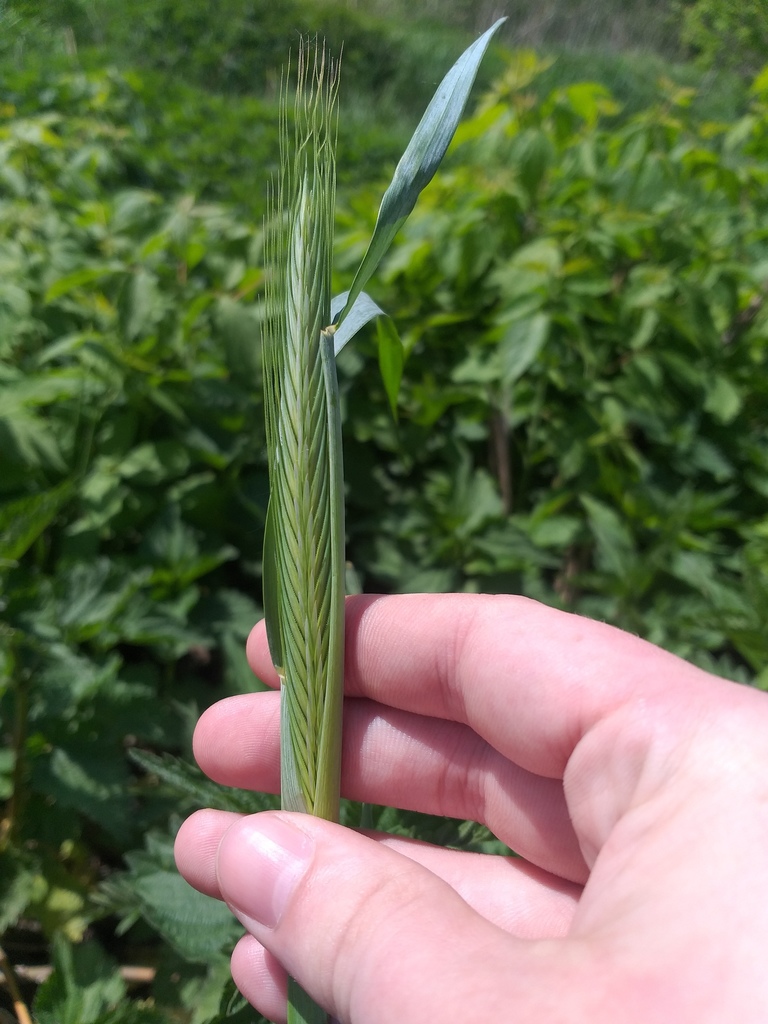
(c) Dmitriy Bochkov, some rights reserved (CC BY) · licence
Family: Poaceae · Type: Grass · Not Native
Secale cereale (Cereal rye) is a non-native California grass in the Poaceae family, recognized by Secale is a small genus of cultivated grains from southwestern Asia, with this species representing occasional escapes from cultivation.
Cereal rye is a naturalized annual grass found in disturbed areas across northern California, from the Klamath Ranges to the Sierra Nevada foothills, the Tehachapi Mountains, and desert mountain regions at elevations below 1,800 meters. Flowering from May to August, this grass produces pale green to tan flower spikes that nod gracefully when mature, with distinctive long awns extending from each spikelet. Growing with robust stems 60 to 125 centimeters tall, the plant develops smooth, upright stems that are glabrous except near the flowering heads. Its leaf blades are relatively narrow, measuring 3 to 10 millimeters wide, with smooth, glabrous leaf sheaths. The distinctive seed heads are 8 to 17 centimeters long, with each spikelet featuring elongated awns measuring 2 to 7 centimeters in length.
Identification and appearance
Key characters: Secale is a small genus of cultivated grains from southwestern Asia, with this species representing occasional escapes from cultivation
Habitat and range
Habitat: Disturbed slopes, roadsides
Elevation: < 1800 m
California counties: Kern, Los Angeles, Santa Cruz, Lassen, San Luis Obispo, Riverside, Ventura, Mendocino, Orange, San Bernardino, San Joaquin, Shasta, El Dorado, Modoc, Butte, Contra Costa, Inyo, Marin, Monterey, Nevada, San Francisco, San Mateo, Santa Barbara, Santa Clara, Sierra, Tulare, Plumas, Siskiyou, Lake, Stanislaus, San Diego, Napa, Humboldt, Merced, Tehama, Tuolumne, Yolo, Alameda, Colusa, Placer, Sacramento
Outside California: to Alaska, Canada, United States, native to southwestern Asia
Bloom period
Secale cereale blooms May-Aug.
How to tell it apart
vs Triticum: Secale has hairy-fringed lemma keels; Triticum has smooth keel edges.; vs Danthonia: Secale has a slender spike; Danthonia has an open, spreading flower cluster.; vs Gaudinia: Secale has straight awns; Gaudinia has twisted, bent awns.; vs Brachypodium: Secale has hairy keel fringes; Brachypodium has smooth lemmas.; vs Elymus: Secale has ciliate lemma keels; Elymus has smooth, rounded lemma backs.
Frequently asked questions
Is Secale cereale native to California?
No. Secale cereale is not native to California (recorded as not native).
When does Secale cereale bloom?
Secale cereale blooms May-Aug.
Where in California does Secale cereale grow?
Secale cereale occurs in Kern, Los Angeles, Santa Cruz, Lassen, San Luis Obispo, Riverside, Ventura, Mendocino and other counties, at elevations of < 1800 m.
What plant family does Secale cereale belong to?
Secale cereale is in the Poaceae family, genus Secale.
What habitat does Secale cereale grow in?
Secale cereale grows in Disturbed slopes, roadsides.
Related species
Other California species in the same genus, family, or bioregion.
Sources: Jepson eFlora · Index of California Plant Names · CalPhotos
Last updated 2026-10-07
Data from The California Species Project — 14,000+ California species with verified data from CNPS, CDFW, USFWS, Cal-IPC, and more.