Sedella pentandra
Mt. Hamilton mock stonecrop
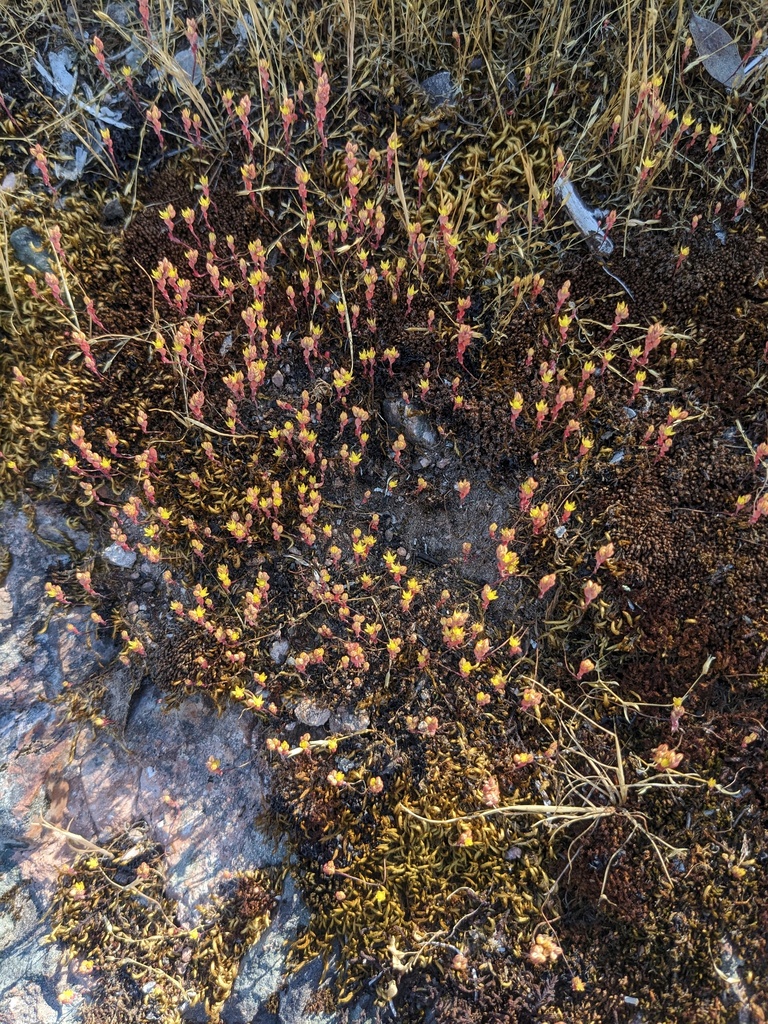
(c) Trevor Van Loon, some rights reserved (CC BY), uploaded by Trevor Van Loon · licence
Family: Crassulaceae · Type: Herb · Native
Sedella pentandra (Mt. Hamilton mock stonecrop) is a native California herb in the Crassulaceae family, recognized by 5 stamens vs 10 is diagnostic, plus glandular fruits.
Mt. Hamilton mock stonecrop is a California native annual found in northern coastal California, eastern Sacramento Valley, northeastern San Joaquin Valley, southern Coast Ranges, and central-southern Coast Ranges on compacted ground, slate, shale, sandstone, and serpentine outcrops at elevations of 300 to 700 meters. Flowering from March to June, this plant produces pale green-yellow flowers with red streaks, small and delicate, with 5 stamens bearing tiny yellow anthers. Growing 2 to 13 centimeters tall with simple, erect stems or 1 to 4 ascending branches, it forms compact clusters on rocky terrain. Its small leaves measure 4 to 7 millimeters long and 2 to 3 millimeters wide, forming a dense base for the plant's diminutive structure. The fruit is tiny, 1 to 1.5 millimeters long, densely covered with stipitate-glandular hairs and bearing erect styles.
Identification and appearance
Key characters: 2 sympatric species; 5 stamens vs 10 is diagnostic, plus glandular fruits
Habitat and range
Habitat: Compacted ground, slate, shale, sandstone or serpentine outcrops
Elevation: 300-700 m
California counties: Colusa, San Luis Obispo, San Benito, Monterey, Lake, Santa Clara, Contra Costa, Merced, Calaveras, Stanislaus, Alameda
Bloom period
Sedella pentandra blooms Mar-Jun.
How to tell it apart
vs Sedum: Sedum is perennial; Sedella is annual and dies back completely each year.; vs Crassula: Crassula leaves clasp the stem at bases; Sedella leaf bases are free from stem.; vs Rhodiola: Rhodiola is a robust perennial with woody base; Sedella is a tiny annual herb.; vs Dudleya: Dudleya forms leaf rosettes; Sedella has leaves scattered up stems.; vs Aeonium: Aeonium forms large rosettes on woody stems; Sedella is a tiny annual with alternate leaves.
Frequently asked questions
Is Sedella pentandra native to California?
Yes. Sedella pentandra is native to California (recorded as native).
When does Sedella pentandra bloom?
Sedella pentandra blooms Mar-Jun.
Where in California does Sedella pentandra grow?
Sedella pentandra occurs in Colusa, San Luis Obispo, San Benito, Monterey, Lake, Santa Clara, Contra Costa, Merced and other counties, at elevations of 300-700 m.
What plant family does Sedella pentandra belong to?
Sedella pentandra is in the Crassulaceae family, genus Sedella.
What habitat does Sedella pentandra grow in?
Sedella pentandra grows in Compacted ground, slate, shale, sandstone or serpentine outcrops.
Related species
Other California species in the same genus, family, or bioregion.
Sources: Jepson eFlora · Index of California Plant Names · CalPhotos
Last updated 2026-10-07
Data from The California Species Project — 14,000+ California species with verified data from CNPS, CDFW, USFWS, Cal-IPC, and more.