Sedella pumila
Sierra mock stonecrop
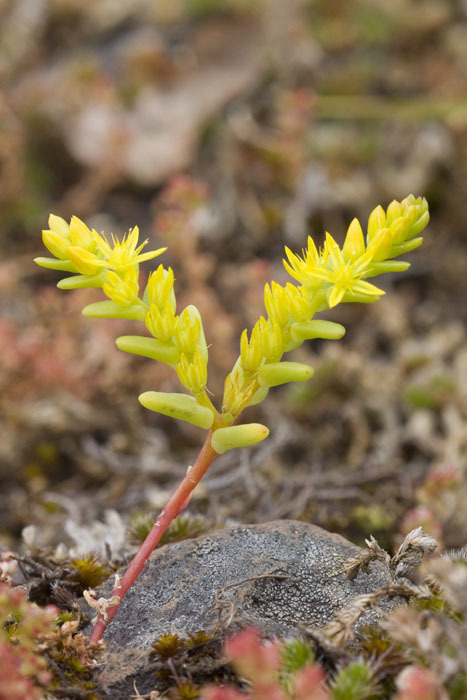
(c) marlin harms, some rights reserved (CC BY) · licence
Family: Crassulaceae · Type: Herb · Native
Sedella pumila (Sierra mock stonecrop) is a native California herb in the Crassulaceae family, recognized by 10 stamens, branching pattern, and size.
Sierra mock stonecrop is a California native annual found in southeastern North Coast Ranges, northern Coast Ranges, California Dry Forests, Sierra Nevada Foothills, central Sierra Nevada, Great Valley, and southern Coast Ranges in open, often wet sites, rock outcrops, and clay soils at elevations of 30 to 1,500 meters. Flowering from March to May, this delicate plant produces pale to bright yellow flowers that spread during blooming and become erect when forming fruit. Growing with multiple erect or spreading branches 2 to 17 centimeters tall, it forms compact clusters across rock surfaces and vernal pool margins. Its tiny leaves measure 4 to 7 millimeters long and 1 to 3 millimeters wide, creating a fine, intricate texture across the plant's structure. The fruit is small, measuring 1.2 to 2.5 millimeters long, and remains erect to ascending with occasional glandular surfaces.
Identification and appearance
Key characters: 2 sympatric species; 10 stamens, branching pattern, and size are diagnostic
Habitat and range
Habitat: Open, often wet sites, rock outcrops, clay soils, vernal pools
Elevation: 30-1500 m
California counties: Sonoma, Tuolumne, Tulare, Calaveras, Sacramento, Sutter, Kern, Butte, Mariposa, Merced, Fresno, El Dorado, Madera, Stanislaus, Tehama, Napa, Plumas, Alameda, Amador, Nevada, Placer, Shasta, San Joaquin, Yuba, Solano
Outside California: OR
Bloom period
Sedella pumila blooms Mar-May.
How to tell it apart
vs Sedum: Sedum is perennial; Sedella is annual and dies back completely each year.; vs Crassula: Crassula leaves clasp the stem at bases; Sedella leaf bases are free from stem.; vs Rhodiola: Rhodiola is a robust perennial with woody base; Sedella is a tiny annual herb.; vs Dudleya: Dudleya forms leaf rosettes; Sedella has leaves scattered up stems.; vs Aeonium: Aeonium forms large rosettes on woody stems; Sedella is a tiny annual with alternate leaves.
Frequently asked questions
Is Sedella pumila native to California?
Yes. Sedella pumila is native to California (recorded as native).
When does Sedella pumila bloom?
Sedella pumila blooms Mar-May.
Where in California does Sedella pumila grow?
Sedella pumila occurs in Sonoma, Tuolumne, Tulare, Calaveras, Sacramento, Sutter, Kern, Butte and other counties, at elevations of 30-1500 m.
What plant family does Sedella pumila belong to?
Sedella pumila is in the Crassulaceae family, genus Sedella.
What habitat does Sedella pumila grow in?
Sedella pumila grows in Open, often wet sites, rock outcrops, clay soils, vernal pools.
Related species
Other California species in the same genus, family, or bioregion.
Sources: Jepson eFlora · Index of California Plant Names · CalPhotos
Last updated 2026-10-07
Data from The California Species Project — 14,000+ California species with verified data from CNPS, CDFW, USFWS, Cal-IPC, and more.