Sedum flavidum
Pale-yellow stonecrop
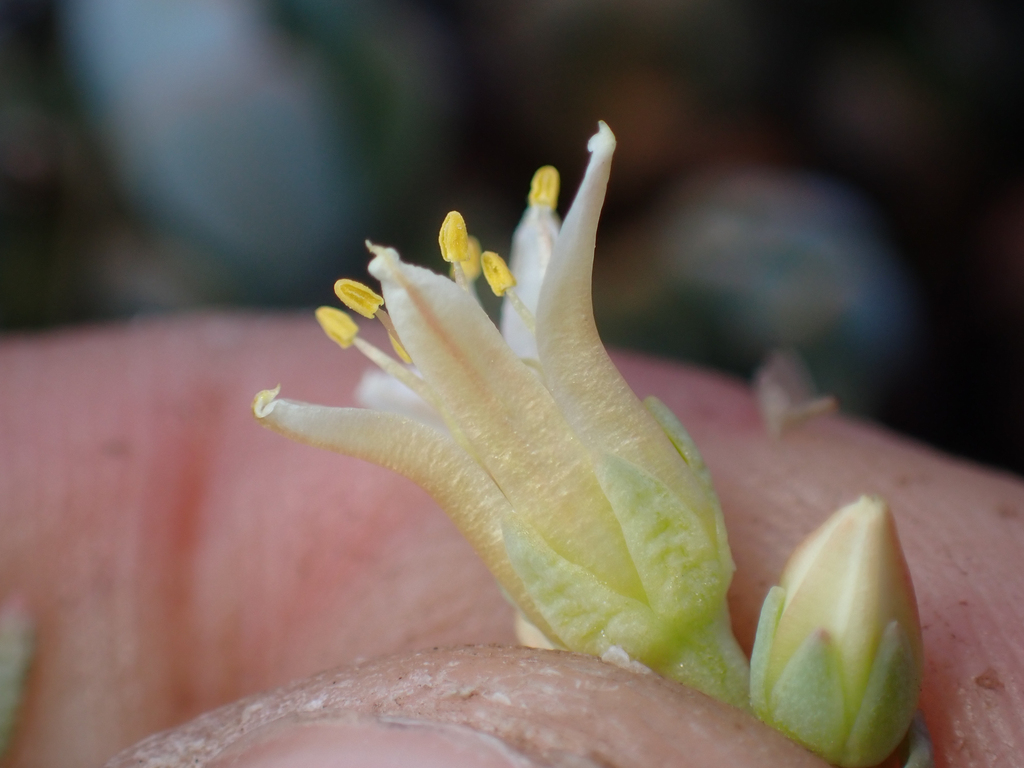
(c) Trevor Van Loon, some rights reserved (CC BY), uploaded by Trevor Van Loon · licence
Family: Crassulaceae · Type: Perennial · Native
Conservation status: CNPS 4.3
Sedum flavidum (Pale-yellow stonecrop) is a native California perennial in the Crassulaceae family, recognized by detailed morphological features available.
Pale-yellow stonecrop is a native perennial ranked 4.3 by CNPS, found in rocky habitats across California, including dry sunny slopes, serpentine outcrops, and scattered pine chaparral at elevations of 200 to 2,200 meters. Flowering from May to July, this plant produces white to light yellow flowers, sometimes with reddish midveins, in dense clusters 12 to 80 flowers long. Growing 9 to 20 centimeters tall with glaucous, glabrous stems, it forms dense rosettes in sunny sites with obscured internodes. Its distinctive leaves range from green to blue-green, pink, and purple, with rosette leaves 12 to 40 millimeters long, broadly obovate to oblanceolate, often with truncate or notched tips. The plant's delicate white to yellow flowers, which may age to pink or red, add a subtle charm to its rocky mountain habitats.
Identification and appearance
Key characters: Geographically isolated; detailed morphological features available
Habitat and range
Habitat: dry sunny or partly shaded rocky slopes, scree, outcrops, barrens, serpentine, basalt, or metamorphic; also duff of scattered pines in chaparral
Elevation: 200-2200 m
Bloom period
Sedum flavidum blooms May-Jul.
Conservation status
CNPS 4.3
How to tell it apart
vs Crassula: Sedum has flowers over 4mm wide; Crassula has tiny flowers typically under 3mm.; vs Aeonium: Sedum leaves have completely smooth edges; Aeonium has tiny hairs along leaf margins.; vs Dudleya: Sedum flowers cluster at stem tips; Dudleya flower stalks emerge from leaf axils on the side.; vs Echeveria: Sedum doesn't form tight rosettes; Echeveria grows in compact, symmetrical rosettes.; vs Sedella: Sedum is perennial with leaves over 1cm; Sedella is annual with tiny leaves under 1cm.
Frequently asked questions
Is Sedum flavidum native to California?
Yes. Sedum flavidum is native to California (recorded as native).
When does Sedum flavidum bloom?
Sedum flavidum blooms May-Jul.
What plant family does Sedum flavidum belong to?
Sedum flavidum is in the Crassulaceae family, genus Sedum.
Is Sedum flavidum rare or endangered?
Sedum flavidum carries California Rare Plant Rank 4.3, state rank S3.
What habitat does Sedum flavidum grow in?
Sedum flavidum grows in dry sunny or partly shaded rocky slopes, scree, outcrops, barrens, serpentine, basalt, or metamorphic; also duff of scattered pines in chaparral.
Related species
Other California species in the same genus, family, or bioregion.
Sources: Jepson eFlora · CNPS Rare Plant Inventory · Index of California Plant Names · CalPhotos · CDFW CNDDB
Last updated 2026-10-08
Data from The California Species Project — 14,000+ California species with verified data from CNPS, CDFW, USFWS, Cal-IPC, and more.