Sedum laxum subsp. laxum
Roseflower stonecrop, Roseflower Stonecrop
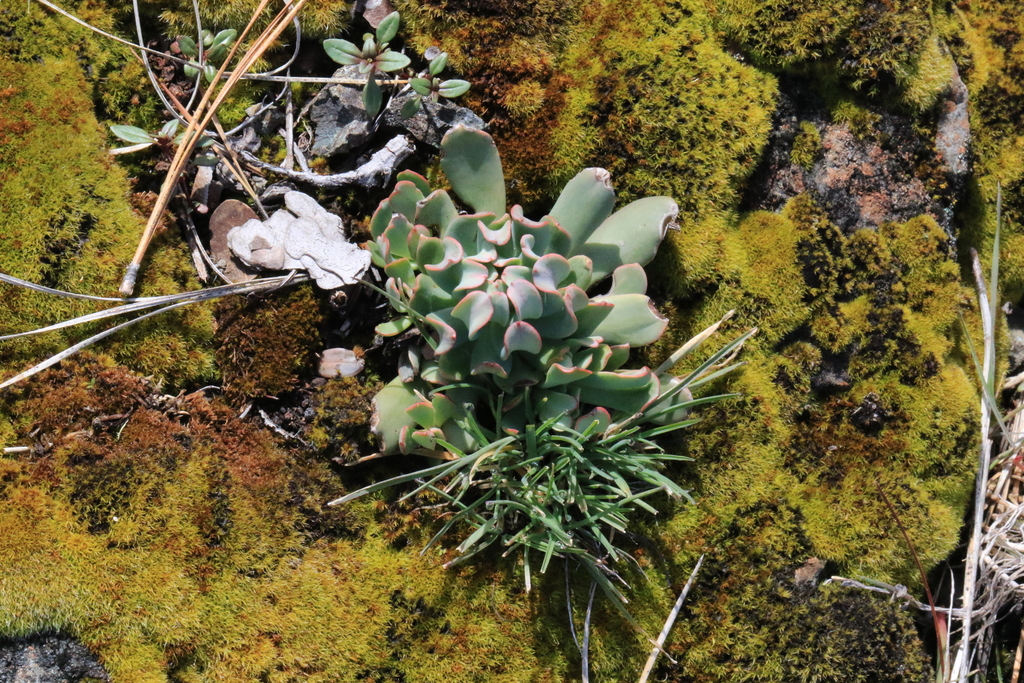
Photo: parent species Sedum laxum · no rights reserved · CC0
Family: Crassulaceae · Type: Herb · Native
Sedum laxum subsp. laxum (Roseflower stonecrop) is a native California herb in the Crassulaceae family, recognized by distinctive pink flowers and leaf proportions.
Roseflower stonecrop is a California native perennial found in the North Coast and Klamath Ranges, growing on cliffs, outcrops, and serpentine areas at elevations below 1,700 meters. Flowering from April to July, this plant produces flowers with petals 7 to 14 millimeters long, featuring anthers that are initially dark red to red-orange and age to black or white. Growing 8 to 48 centimeters tall with a glaucous appearance, it forms distinctive rosettes with spreading stems. Its rosette leaves are 13 to 51 millimeters long and 8 to 23 millimeters wide, broadly obovate with rounded or notched tips, while stem leaves are obovate to oblong, often more than twice as long as wide. The plant's ascending to spreading leaves with truncate bases create a distinctive and compact growth form.
Identification and appearance
Key characters: 14 sympatric species; distinctive pink flowers and leaf proportions
Habitat and range
Habitat: Cliffs, outcrops, boulder fields, roadcuts, generally on serpentine
Elevation: < 1700 m
California counties: Siskiyou, Del Norte, Lake, Plumas, Trinity, Sierra, Tehama, Colusa, Mendocino, Humboldt
Outside California: to sw Oregon
Bloom period
Sedum laxum subsp. laxum blooms Apr-Jul.
How to tell it apart
vs Crassula: Sedum has flowers over 4mm wide; Crassula has tiny flowers typically under 3mm.; vs Aeonium: Sedum leaves have completely smooth edges; Aeonium has tiny hairs along leaf margins.; vs Dudleya: Sedum flowers cluster at stem tips; Dudleya flower stalks emerge from leaf axils on the side.; vs Echeveria: Sedum doesn't form tight rosettes; Echeveria grows in compact, symmetrical rosettes.; vs Sedella: Sedum is perennial with leaves over 1cm; Sedella is annual with tiny leaves under 1cm.
Frequently asked questions
Is Sedum laxum subsp. laxum native to California?
Yes. Sedum laxum subsp. laxum is native to California (recorded as native).
When does Sedum laxum subsp. laxum bloom?
Sedum laxum subsp. laxum blooms Apr-Jul.
Where in California does Sedum laxum subsp. laxum grow?
Sedum laxum subsp. laxum occurs in Siskiyou, Del Norte, Lake, Plumas, Trinity, Sierra, Tehama, Colusa and other counties, at elevations of < 1700 m.
What plant family does Sedum laxum subsp. laxum belong to?
Sedum laxum subsp. laxum is in the Crassulaceae family, genus Sedum.
What habitat does Sedum laxum subsp. laxum grow in?
Sedum laxum subsp. laxum grows in Cliffs, outcrops, boulder fields, roadcuts, generally on serpentine.
Related species
Other California species in the same genus, family, or bioregion.
Sources: Jepson eFlora · Index of California Plant Names · CalPhotos
Last updated 2026-10-07
Data from The California Species Project — 14,000+ California species with verified data from CNPS, CDFW, USFWS, Cal-IPC, and more.