Sedum radiatum
Coast range stonecrop, Coast Range Stonecrop
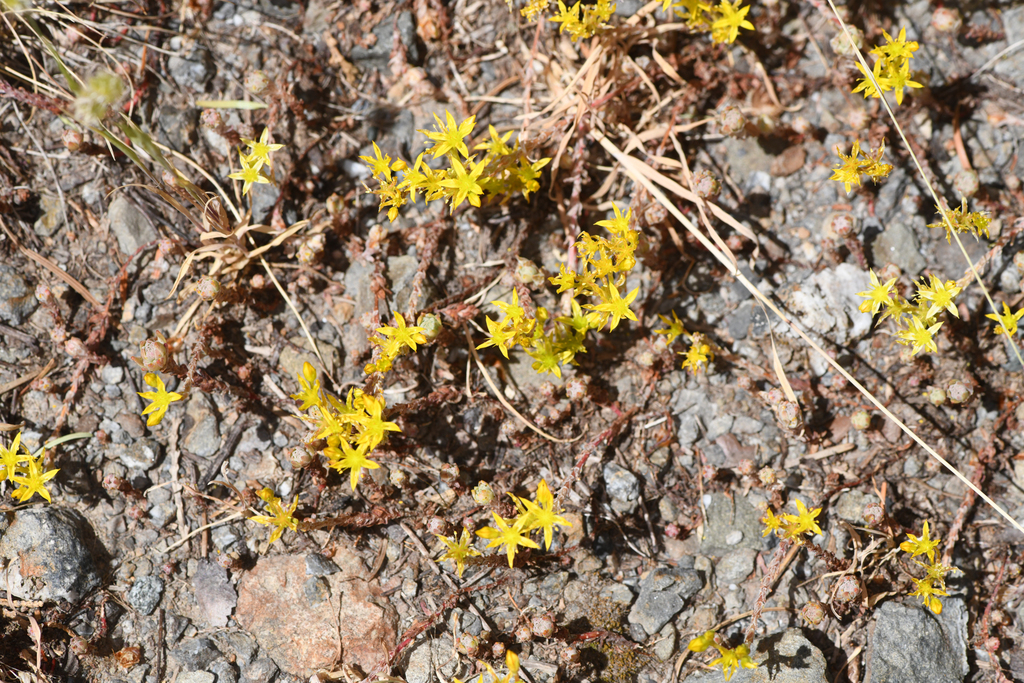
(c) Trevor Van Loon, some rights reserved (CC BY) · licence
Family: Crassulaceae · Type: Herb · Native
Sedum radiatum (Coast range stonecrop) is a native California herb in the Crassulaceae family, recognized by short-lived habit and vegetative bulblets.
Coast range stonecrop is a California native perennial found in the Klamath Ranges, northern Coast Ranges, California Ranges, Sierra Nevada, San Francisco Bay Area, and southern Coast Ranges on rocky ledges and gravelly serpentine slopes at elevations of 60 to 2,100 meters. Flowering from April to July, this plant produces yellow or white flowers in flat-topped clusters with petals 5 to 10 millimeters long. Growing with slender stems 4 to 20 centimeters tall, the plant develops fertile shoots that can create small rosettes from lower leaf axils. Its leaves are oblong to narrowly ovate, 5 to 11 millimeters long, with round to slightly flattened cross-sections and blunt to acute tips. The mature fruit consists of follicles 3 to 5 millimeters long, fused at the base and spreading outward.
Identification and appearance
Key characters: 13 sympatric species; key features are short-lived habit and vegetative bulblets
Habitat and range
Habitat: Rocky ledges, gravelly serpentine slopes
Elevation: 60-2100 m.
California counties: Mendocino, Butte, Glenn, Napa, Tulare, Humboldt, Marin, Trinity, Santa Clara, San Luis Obispo, Lake, Contra Costa, San Benito, Calaveras, Monterey, Siskiyou, Tuolumne, Mariposa, Fresno, Sonoma, El Dorado, Santa Cruz, San Mateo, Mono
Outside California: southwestern Oregon.
Bloom period
Sedum radiatum blooms Apr-Jul.
How to tell it apart
vs Crassula: Sedum has flowers over 4mm wide; Crassula has tiny flowers typically under 3mm.; vs Aeonium: Sedum leaves have completely smooth edges; Aeonium has tiny hairs along leaf margins.; vs Dudleya: Sedum flowers cluster at stem tips; Dudleya flower stalks emerge from leaf axils on the side.; vs Echeveria: Sedum doesn't form tight rosettes; Echeveria grows in compact, symmetrical rosettes.; vs Sedella: Sedum is perennial with leaves over 1cm; Sedella is annual with tiny leaves under 1cm.
Frequently asked questions
Is Sedum radiatum native to California?
Yes. Sedum radiatum is native to California (recorded as native).
When does Sedum radiatum bloom?
Sedum radiatum blooms Apr-Jul.
Where in California does Sedum radiatum grow?
Sedum radiatum occurs in Mendocino, Butte, Glenn, Napa, Tulare, Humboldt, Marin, Trinity and other counties, at elevations of 60-2100 m..
What plant family does Sedum radiatum belong to?
Sedum radiatum is in the Crassulaceae family, genus Sedum.
What habitat does Sedum radiatum grow in?
Sedum radiatum grows in Rocky ledges, gravelly serpentine slopes.
Related species
Other California species in the same genus, family, or bioregion.
Sources: Jepson eFlora · Index of California Plant Names · CalPhotos
Last updated 2026-10-07
Data from The California Species Project — 14,000+ California species with verified data from CNPS, CDFW, USFWS, Cal-IPC, and more.