Sedum stenopetalum subsp. stenopetalum
Yellow wormleaf stonecrop
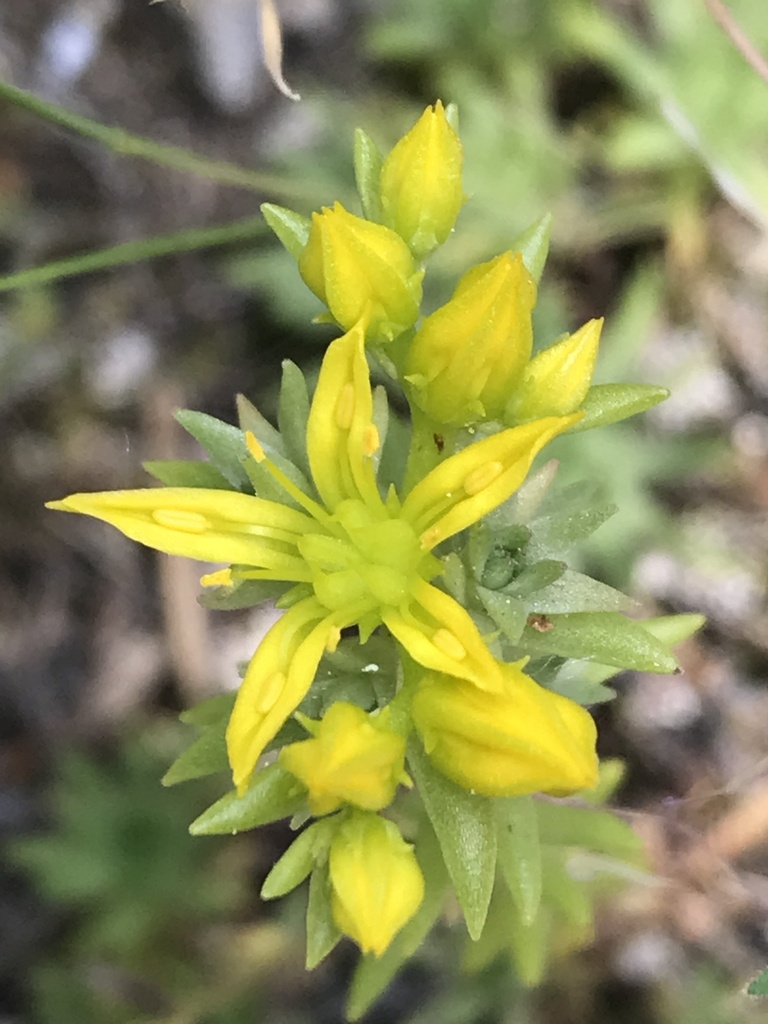
(c) Cindy Bell, some rights reserved (CC BY), uploaded by Cindy Bell · licence
Family: Crassulaceae · Type: Herb · Native
Sedum stenopetalum subsp. stenopetalum (Yellow wormleaf stonecrop) is a native California herb in the Crassulaceae family, recognized by no sympatric species. Key features: yellow petals, smooth leaf margins, conifer forest habitat.
Yellow wormleaf stonecrop is a California native perennial found in the Sierra Nevada, White, and Inyo Mountains on dry sunny and partly shaded rocky slopes and open conifer forest at elevations of 1,300 to 2,100 meters. Flowering from May to August, this plant produces bright yellow flowers in compact clusters with yellow to greenish-yellow stamens. Growing with succulent stems forming dense rosettes 5 to 15 centimeters tall, it develops low-spreading clumps characteristic of stonecrop species. Its leaves form tight rosettes with margins that are nearly smooth or subtly textured toward the leaf tips, creating a compact and architectural appearance. The plant's ability to thrive in rocky, exposed mountain environments highlights its adaptation to challenging high-elevation habitats.
Identification and appearance
Key characters: Geographically isolated; no sympatric species. Key features: yellow petals, smooth leaf margins, conifer forest habitat
Habitat and range
Habitat: dry sunny or partly shaded rocky or gravelly slopes, flats and ridges, open conifer forest
Elevation: 1300-2100 m
Outside California: to British Columbia, Alberta, Montana, Wyoming
Bloom period
Sedum stenopetalum subsp. stenopetalum blooms May-Aug.
How to tell it apart
vs Crassula: Sedum has flowers over 4mm wide; Crassula has tiny flowers typically under 3mm.; vs Aeonium: Sedum leaves have completely smooth edges; Aeonium has tiny hairs along leaf margins.; vs Dudleya: Sedum flowers cluster at stem tips; Dudleya flower stalks emerge from leaf axils on the side.; vs Echeveria: Sedum doesn't form tight rosettes; Echeveria grows in compact, symmetrical rosettes.; vs Sedella: Sedum is perennial with leaves over 1cm; Sedella is annual with tiny leaves under 1cm.
Frequently asked questions
Is Sedum stenopetalum subsp. stenopetalum native to California?
Yes. Sedum stenopetalum subsp. stenopetalum is native to California (recorded as native).
When does Sedum stenopetalum subsp. stenopetalum bloom?
Sedum stenopetalum subsp. stenopetalum blooms May-Aug.
What plant family does Sedum stenopetalum subsp. stenopetalum belong to?
Sedum stenopetalum subsp. stenopetalum is in the Crassulaceae family, genus Sedum.
What habitat does Sedum stenopetalum subsp. stenopetalum grow in?
Sedum stenopetalum subsp. stenopetalum grows in dry sunny or partly shaded rocky or gravelly slopes, flats and ridges, open conifer forest.
Related species
Other California species in the same genus, family, or bioregion.
- Sedum albomarginatum — Feather river stonecrop
- Sedum album — White stonecrop
- Sedum citrinum — Blue creek stonecrop
- Sedum divergens — Cascade stonecrop
- Sedum eastwoodiae — Red mountain stonecrop
- Sedum flavidum — Pale-yellow stonecrop
- Aeonium arboreum var. arboreum — Canary Islands aeonium
- Aeonium haworthii — Haworth's aeonium
- Aeonium sp.
- Cotyledon orbiculata var. oblonga — Cotyledon
Sources: Jepson eFlora · CalPhotos
Last updated 2026-10-07
Data from The California Species Project — 14,000+ California species with verified data from CNPS, CDFW, USFWS, Cal-IPC, and more.