Selaginella eremophila
Desert spike-moss
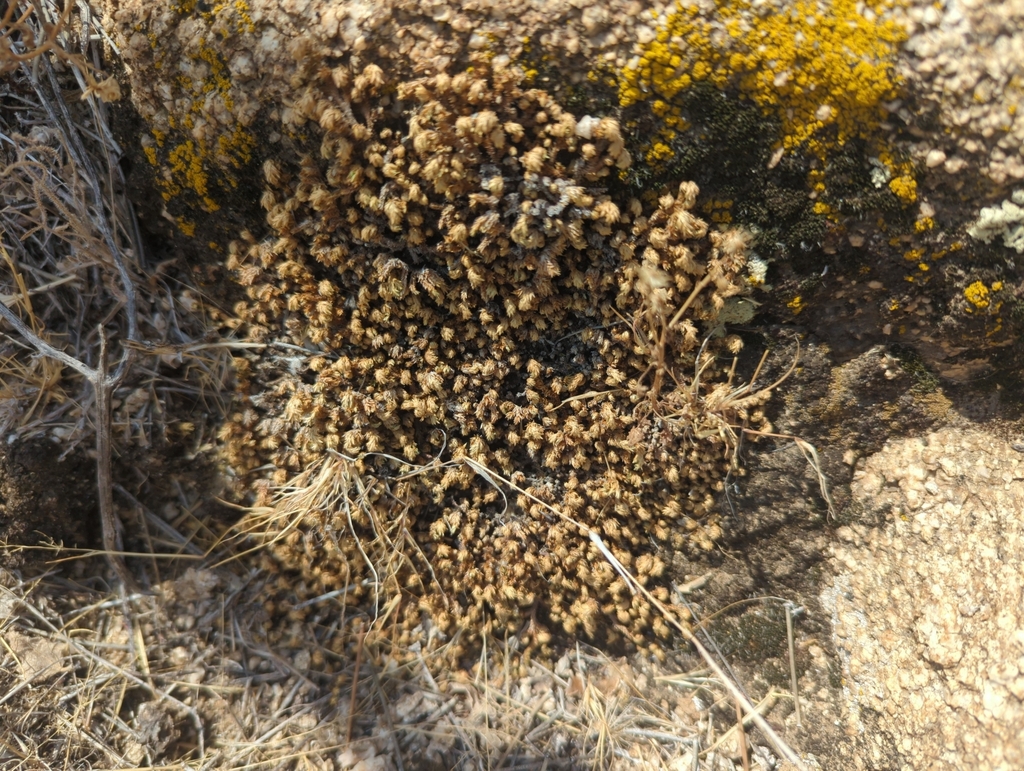
(c) Tom Field, some rights reserved (CC BY) · licence
Family: Selaginellaceae · Type: Herb · Native
Conservation status: CNPS 2B.2
Selaginella eremophila (Desert spike-moss) is a native California herb in the Selaginellaceae family, recognized by heterophyllous leaf arrangement with sickle-shaped under-leaves.
Desert spike-moss is a rare (CNPS 2B.2) California native spikemoss found in the eastern Peninsular Ranges and Sonoran Desert in shaded sites with sandy or gravelly soils, typically at the base of rocks or in rock cracks at elevations below 1,100 meters. This delicate spikemoss forms a distinctive mat with loosely spreading margins, initially green but aging to an orange-brown color. Growing in low, intricate clusters with sub-pinnate branching, the plant has tiny leaves measuring 0.4 to 0.6 millimeters wide, with pointed acute tips. Its leaves are characterized by asymmetrical under-leaves and over-leaves, with the under-leaves slightly longer and often sickle-shaped, creating a complex and intricate texture. Sparse cone-like structures measuring 3 to 10 millimeters emerge from the plant's delicate branching structure, adding to its subtle botanical complexity.
Identification and appearance
Key characters: 4 sympatric species; key feature is heterophyllous leaf arrangement with sickle-shaped under-leaves
Habitat and range
Habitat: Shaded sites, sandy or gravelly soils, at base of rocks, in cracks
Elevation: < 1100 m
California counties: Riverside, Imperial, San Diego
Outside California: to Arizona, northern Mexico
Conservation status
CNPS 2B.2
How to tell it apart
vs Cardionema: Selaginella has overlapping scales spiraling up the stem; Cardionema has paired leaves at intervals.; vs Lycopodium: Selaginella stems feel soft and flexible; Lycopodium stems are firmer and the leaves radiate out in all directions.; vs Polytrichum: Selaginella has square-sided cones and scales; moss capsules sit atop hairlike stalks.; vs Galium: Selaginella has tiny overlapping scales; Galium has narrow leaves in distinct whorls around square stems.; vs Brachythecium: Selaginella has square cones and spiraling scales; moss shoots are feathery with capsules on stalks.
Frequently asked questions
Is Selaginella eremophila native to California?
Yes. Selaginella eremophila is native to California (recorded as native).
Where in California does Selaginella eremophila grow?
Selaginella eremophila occurs in Riverside, Imperial, San Diego, at elevations of < 1100 m.
What plant family does Selaginella eremophila belong to?
Selaginella eremophila is in the Selaginellaceae family, genus Selaginella.
Is Selaginella eremophila rare or endangered?
Selaginella eremophila carries California Rare Plant Rank 2B.2, state rank S2S3.
What habitat does Selaginella eremophila grow in?
Selaginella eremophila grows in Shaded sites, sandy or gravelly soils, at base of rocks, in cracks.
Related species
Other California species in the same genus, family, or bioregion.
Sources: Jepson eFlora · CNPS Rare Plant Inventory · Index of California Plant Names · CalPhotos · CDFW CNDDB
Last updated 2026-10-07
Data from The California Species Project — 14,000+ California species with verified data from CNPS, CDFW, USFWS, Cal-IPC, and more.