Selaginella hansenii
Hansen's spike moss
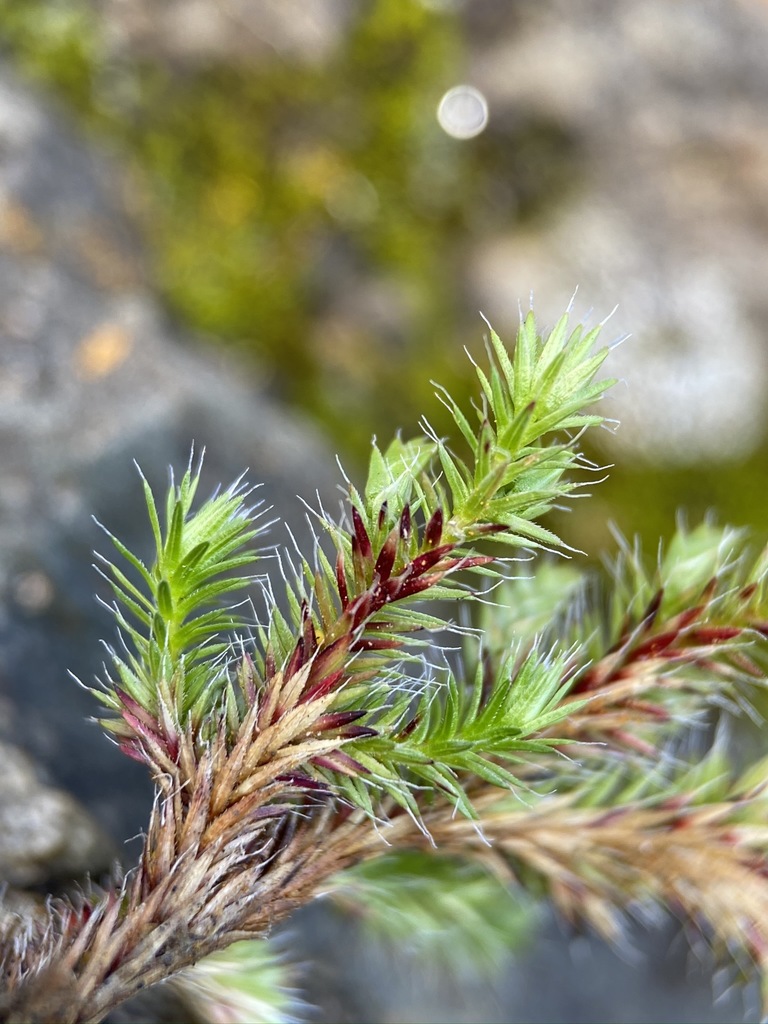
(c) Matt Berger, some rights reserved (CC BY), uploaded by Matt Berger · licence
Family: Selaginellaceae · Type: Herb · Native
Selaginella hansenii (Hansen's spike moss) is a native California herb in the Selaginellaceae family, recognized by key diagnostic feature is red-streaked leaves aging, plus foothill woodland habitat.
Hansen's spike moss is a native spikemoss found in southern North Coast Ranges Interior, Cascade Ranges, Sierra Nevada, Sutter Buttes, San Joaquin Valley, and northern South Coast Ranges in rocky outcrops and foothill woodland at elevations of 250 to 1,700 meters. Its distinctive appearance includes a sprawling mat with green foliage that ages to tan and gray, with some leaves showing red, pink-red, or red-streaked coloration. Growing in loosely spreading branches that are approximately pinnate, this spikemoss forms low-growing mats with leaves measuring 1 to 4.5 millimeters long. Its leaves feature lance-linear under-leaves and linear-deltate over-leaves, with small awns forming tufts at stem tips. Sparse cones measuring 4 to 8 millimeters long are produced at the plant's margins.
Identification and appearance
Key characters: 4 sympatric species; key diagnostic feature is red-streaked leaves aging, plus foothill woodland habitat
Habitat and range
Habitat: Rocks of outcrops, river gorges, foothill woodland
Elevation: 250-1700 m
California counties: Tehama, Tulare, Tuolumne, Yuba, El Dorado, Butte, Calaveras, Fresno, Mariposa, Nevada, Placer, Sacramento, Stanislaus, Sutter, Madera, Kern, Shasta, Merced, Monterey, Amador, Del Norte, San Luis Obispo
How to tell it apart
vs Cardionema: Selaginella has overlapping scales spiraling up the stem; Cardionema has paired leaves at intervals.; vs Lycopodium: Selaginella stems feel soft and flexible; Lycopodium stems are firmer and the leaves radiate out in all directions.; vs Polytrichum: Selaginella has square-sided cones and scales; moss capsules sit atop hairlike stalks.; vs Galium: Selaginella has tiny overlapping scales; Galium has narrow leaves in distinct whorls around square stems.; vs Brachythecium: Selaginella has square cones and spiraling scales; moss shoots are feathery with capsules on stalks.
Frequently asked questions
Is Selaginella hansenii native to California?
Yes. Selaginella hansenii is native to California (recorded as native).
Where in California does Selaginella hansenii grow?
Selaginella hansenii occurs in Tehama, Tulare, Tuolumne, Yuba, El Dorado, Butte, Calaveras, Fresno and other counties, at elevations of 250-1700 m.
What plant family does Selaginella hansenii belong to?
Selaginella hansenii is in the Selaginellaceae family, genus Selaginella.
What habitat does Selaginella hansenii grow in?
Selaginella hansenii grows in Rocks of outcrops, river gorges, foothill woodland.
Related species
Other California species in the same genus, family, or bioregion.
Sources: Jepson eFlora · Index of California Plant Names · CalPhotos
Last updated 2026-10-07
Data from The California Species Project — 14,000+ California species with verified data from CNPS, CDFW, USFWS, Cal-IPC, and more.